

For parents and grandparents thinking generationally, the new Trump Accounts contain one of the most compelling wealth building opportunities we have seen in years. This is not so much for what the accounts are on their own, but for what they can become.
Here is the short version: fund a Trump Account aggressively from birth, wait until your child is in their early 20s and likely still earning a modest income, then convert it to a Roth IRA, paying minimal taxes on the conversion. Done right, roughly $90,000 in contributions could seed a tax-free retirement account worth over $3 million by age 60. We will show the math in a moment.
As a savings vehicle on its own terms, the Trump Account is fine but not exceptional. For most purposes, a 529 or a Roth IRA will serve you better. But if you have already funded those, the Trump Account deserves a close look.
What Is a Trump Account?
Beginning this summer, parents and guardians can open a Trump Account for any child under 18, funded with after-tax dollars up to $5,000 per year, a limit that adjusts for inflation starting in 2028. The accounts must be invested in a US stock index fund until the child turns 18, at which point the rules shift and the account begins following IRA-style tax treatment. Children born between 2025 and 2028 also receive a $1,000 seed contribution from the federal government to get things started. As of mid-March, roughly four million children already have Trump Accounts, with more than 800,000 eligible for the $1,000 government contribution.
Employers and charities can contribute as well, and some high profile donors have stepped in with additional seed money, including Michael and Susan Dell, who have pledged $250 for each child age 10 or under living in a zip code with a median household income below $150,000.
How Do These Compare to 529s?
If your primary goal is saving for college, a 529 plan is clearly the better tool. Contributions to a 529 grow tax-free and come out tax-free when used for qualified education expenses. Many states offer an additional deduction on contributions. Trump Accounts carry none of those education-specific advantages. For families who need to prioritize college savings, the 529 should come first.
Parents and grandparents should maximize their own 401(k)s, IRAs, and 529s before considering a Trump Account. The sequencing matters. Think of the Trump account as the next layer, not the foundation.
The Big Opportunity
If your family can fund one of these accounts aggressively ($5,000 a year, every year, from birth through age 17) and your child has the knowledge and discipline to leave it alone as an adult, there is a potentially extraordinary outcome waiting at the other end.
The math goes like this. Assume the $1,000 in government seed money, $5,000 in annual contributions for 18 years, and a 7% annual return. By the time your child is in their early 20s, the account value will approach $300,000. At that point, if they are in a low tax bracket as many young workers are, they can convert the account to a Roth IRA and pay minimal taxes. Rather than converting all at once, a smart approach is to spread the conversion over a few years, keeping each year’s taxable income in a lower bracket and meaningfully reducing the total tax owed.
The conversion tax, paid with outside dollars as a gift from parents or grandparents rather than drawn from the account itself, is quite modest relative to the potential gains. What you’ve done, in effect, is pre-funded a Roth IRA on your child’s behalf at a fraction of the cost of a lump-sum Roth conversion.
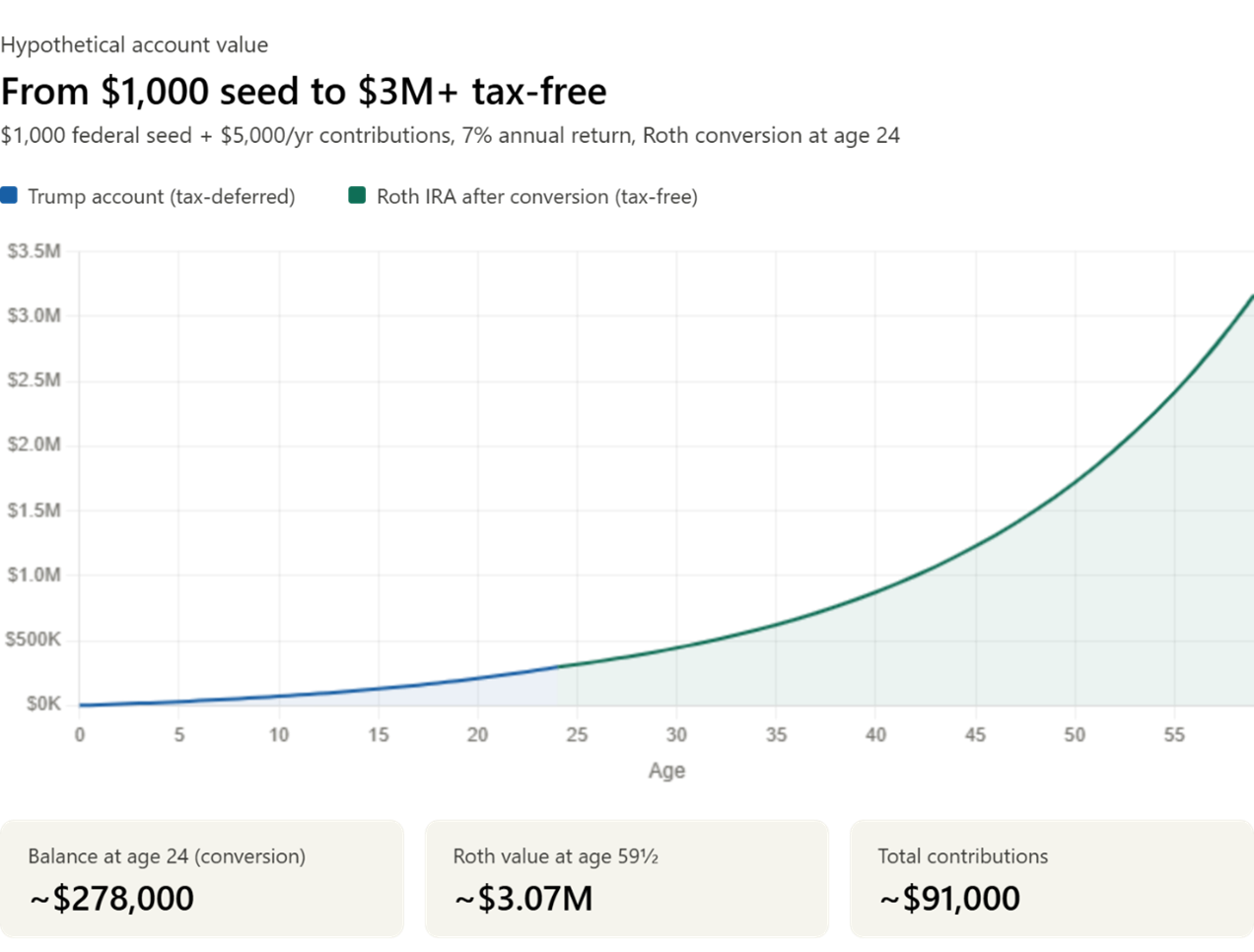
From there, the Roth IRA grows completely tax-free for decades. By age 60, that $278,000 conversion, left untouched, would grow to just over $3 million. No required minimum distributions. No ordinary income tax on withdrawals. Just a tax-free nest egg that has been quietly compounding since birth. Put another way, you’ve used roughly $90,000 in after-tax contributions, plus a modest conversion tax payment, to potentially set your child up with a multimillion dollar tax-free retirement account.
A small note on timing: experts caution against converting immediately at 18. The “Kiddie Tax,” which can apply to unearned income for certain individuals under 24, may cause part of the conversion to be taxed at the parents’ rate rather than the child’s. Patience here pays. Waiting until the child is working, independent, and clearly in a low bracket (typically the early-to-mid 20s) is the smarter move.
Understanding the Risks
This strategy has potential pitfalls that should be understood from the outset.
The first risk is behavioral. The entire thesis depends on your child, in their early 20s, making the disciplined choice not to cash out what may seem like found money. A young adult with more than a quarter million dollars on hand and competing financial priorities is not a guaranteed long-term investor. Helping the child understand the benefits of long-term tax-free compounding will create the best chance of realizing the full potential of these accounts.
The second risk is legislative. Tax laws change. The 529-to-Roth conversion rules, which were themselves a relatively recent and welcome addition to the tax code, already carry a $35,000 lifetime cap. Future Trump Account legislation could impose similar caps, restrict conversions for accounts above a certain balance, or find other ways to tax the transaction more heavily if a low-bracket conversion starts to look too generous. Today’s rules might not be permanent. But even if rules change, we see little downside to this strategy.
And, of course, while we have assumed a 7% rate of return, future returns are never guaranteed.
The Bottom Line
The Trump Account is not a replacement for the tools you already have. Fund your own retirement first. Keep the 529 at the top of the priority list for college savings. But if you’ve done those things and have the capacity to think a generation ahead, this is a genuinely compelling new vehicle because of the Roth conversion opportunity it opens. For those eligible children, the $1,000 seed money is frosting on the cake.
A Trump Account for a child born this year, funded consistently, converted to a Roth IRA in early adulthood, and left to compound for decades, could enable the child to retire with financial security, all because of a decision you made before they ever knew what a tax return was.
As always, the details of your specific situation matter. Tax brackets, other savings priorities, the age of your children, and your estate planning goals all factor in. If you’d like to explore whether this strategy makes sense for your family, we are here to help. Call or email us anytime.