
From the President’s Desk: Thoughts on the First Quarter
Pandemic Jolts Markets
We entered the first quarter in the 11th year of an economic expansion, with low unemployment and buoyant stock markets. And then suddenly everything changed.
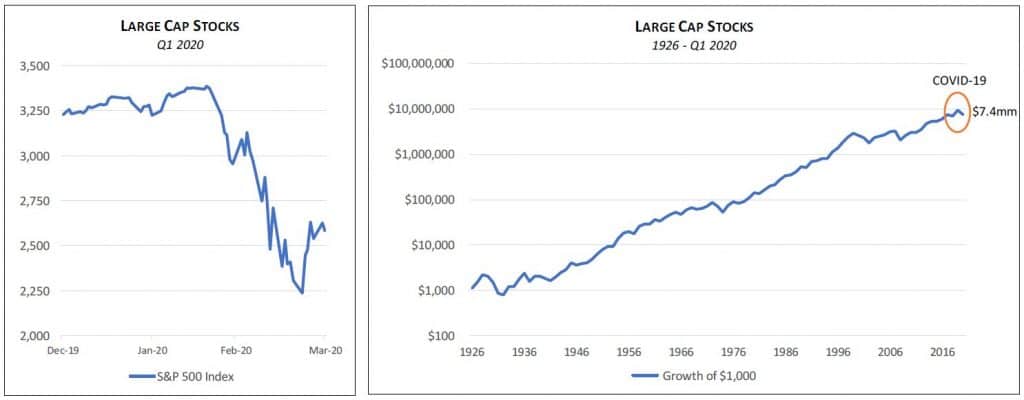
The COVID-19 pandemic has altered our lives in ways that were unimaginable just three months ago. The resulting lockdown has pushed the global economy into a deep recession of unknown duration. Not surprisingly, it was a tough quarter for the stock market, as the temporary shuttering of big parts of the economy will take a large toll on corporate earnings for some period. The benchmark S&P 500 returned -19.6%, its worst calendar quarter since the peak of the financial crisis in the fourth quarter of 2008.
Bonds, however, largely did their job in reducing overall portfolio risk. The leading US bond index returned 3.1%, though that figure masks wide variations in returns across various bond sectors. Asset allocation and diversification again proved their mettle under highly challenging circumstances.
This Situation is Temporary—Really
In this extraordinary setting, it is worth reminding ourselves of some important and positive truths. First, today’s restrictions on everyday living are temporary, despite feeling permanent as time has slowed down. One way or another, the virus and the crisis will run its course. When it’s behind us and those who have been furloughed reenter the workforce, we’ll likely see that people’s needs and wants are much as they were before. Note also that the economy’s infrastructure is entirely intact. Yes, airlines and hotels are largely idle, but the planes and the rooms will be filled again in due time. Finally, much of the economy continues to function well, albeit with much more teleworking.
Government Financial Aid to the Rescue
It’s also clear that government intervention has considerably softened the lockdown’s impact on financial markets. The Federal Reserve commenced a series of actions aimed directly at supporting credit markets, such as providing liquidity to lenders and acting as a lender itself. The Fed’s open market bond purchases alone have largely stabilized the bond market. On top of this, the quickly enacted CARES Act provides a massive $2 trillion economic stimulus package, including direct assistance to businesses, nonprofits, and households.
As this is written in early April, the S&P 500 has climbed a remarkable 25% from its recent March 23 low point. This reflects some optimism that a near-term peaking in COVID-19 cases is the first step towards the reopening of the economy. Though not the explicit policy aim, it’s also likely that much of the cash infusion from the Fed and the CARES Act has or will find its way into stock markets. Just as the lockdown confines both the infected and the healthy, broad-based fiscal and monetary intervention push money into all corners of the economy, from the needy to the affluent.
Reopening the economy is likely to be a lengthy affair, with potential setback along the way. We advise being prepared for significant market volatility in both directions for the foreseeable future.
What’s Next
Even in the most normal of times, we don’t know where the economy and markets are going next. Short-term forecasts today have more uncertainty than at any time we can remember. Fortunately, our investment time horizons are much longer than the duration of today’s health and economic crisis.
We find that looking at data over much longer historical time periods helps us gain perspective on current events. The two charts below show the US stock market—on the left is just the first quarter of 2020; on the right is the entire history since 1926, with the first quarter of 2020 circled on the far right. Close up, problems naturally look bigger, but from a distance, hopefully they appear more manageable and perhaps just the latest in a long line.
Over the last several weeks, we have written several client letters and recorded a client webinar addressing markets and the economy in the context of COVID-19. You can find links to all of these on our website. https://gouldasset.com/blog/
