

Market Value – What It Is and Isn’t
Your monthly account statements from the custodian show the “market value” of each investment, which add up to your portfolio value. What do those numbers actually mean?
Suppose you own 100 shares of Microsoft (symbol: MSFT). At the close of the New York Stock Exchange, on June 30, 2026, at 4 pm Eastern Daylight Time, MSFT’s price was $373.02 per share. Your June statement will say you owned Microsoft stock worth $37,302. In fact, what it really says is that if you had sold your 100 shares at that same price, you would have received $37,302.
At any point in time, however, most investors are holders, not sellers. For holders, today’s price may be unimportant, just in the same way your home’s price on Zillow, though fun to check, is irrelevant if you don’t intend to sell soon. For the long-term investor, the market price of MSFT is an unhelpful distraction. It causes us to focus too much on what we might be able to sell for right now and not enough on what the investment might do for us over the time we plan to hold it.[1] But how else can a long-term investor value an investment in stock?
The answer starts with a reminder that “shares” represent ownership of a share—a fraction—of a business that delivers products and services and earns a profit. Just as the true value of the home is the benefits of living in it, the true value of our investment in a business like Microsoft is our share of the future stream of cash flow the business will generate. Today’s market price simply tells us how a buyer and seller agree to quantify that value at this moment.
Steering Clear of Mr. Market
Fabled investor Benjamin Graham cleverly connected market prices to the swings of human emotion through his fictional “Mr. Market.” Graham observed that group psychology could lead investors (Mr. Market) to periods of excessive optimism[2] or pessimism, causing market prices to move to nonsensical levels, either much higher or lower than a dispassionate valuation of the underlying business.
Graham would likely see today’s Mr. Market as bordering on euphoric. A quick way to measure optimism is to look at how much investors pay today for one dollar of corporate earnings, also known as the price-to-earnings (P/E) ratio. Today’s P/E ratio is high by historical standards. That dollar of earnings is also historically expensive when compared to what one pays today for a dollar of bond interest.
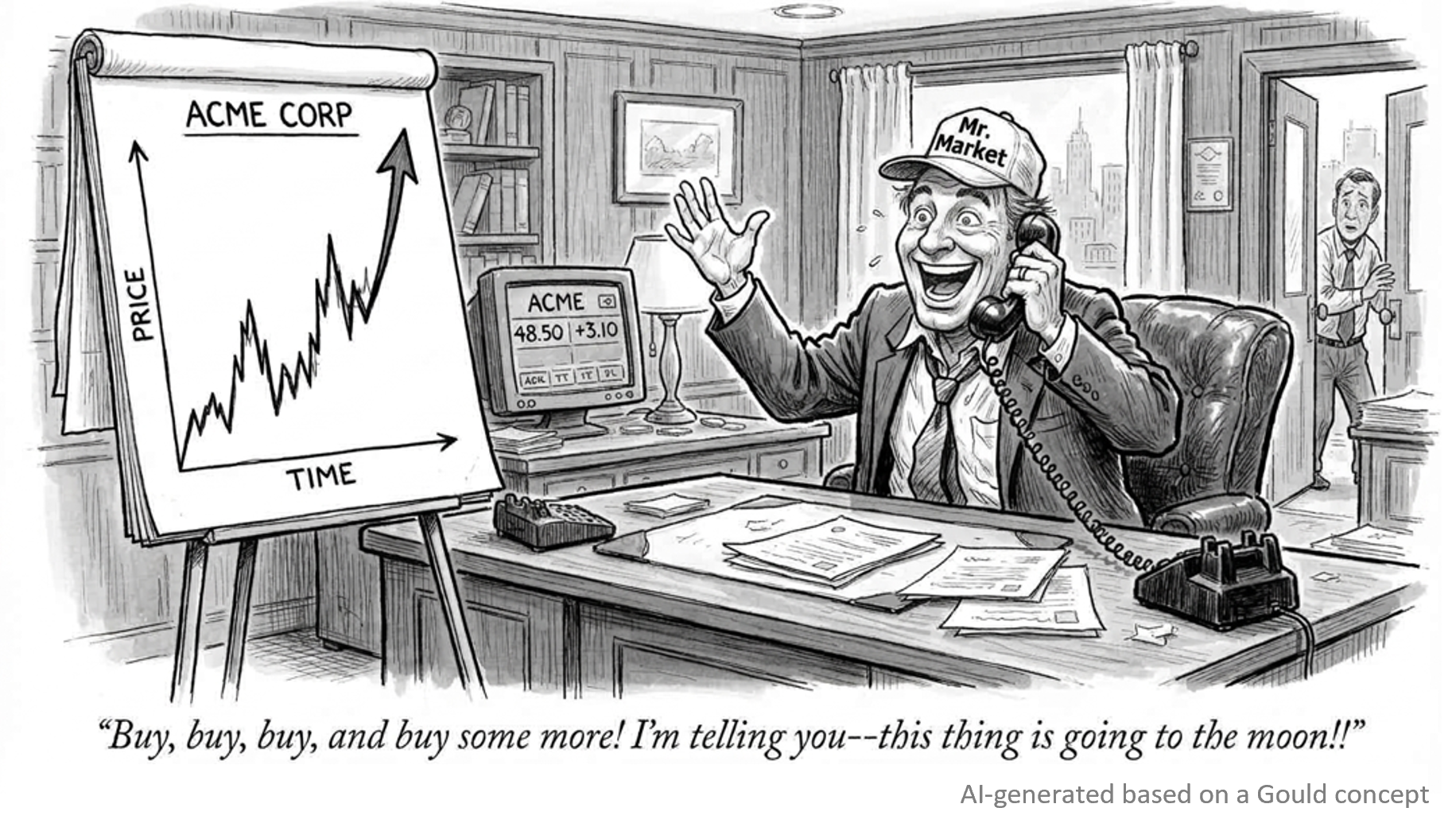
Graham thought that by reading Mr. Market’s moods, he could improve investment returns, selling to the optimists and buying from the pessimists. Count us as skeptical. It is true that stock market prices periodically diverge from the rational, as may be the case today. But seeking to profit from such dislocations is both exceedingly difficult and potentially hazardous.
The Perils of Market Timing
When we are convinced that prices are out of whack, it’s always tempting to try to time the market, but let us count the pitfalls. Suppose a crystal ball tells us that a 46% market drop will begin within five years. What do we do? If the market continues to barrel upward and peaks in three years at 86% above today’s level,[3] a 46% drop will just bring the market back to today’s level.[4] Selling today will have gained very little; in fact, after capital gains taxes, our portfolio might be well below its starting position.
Lacking a crystal ball,[5] potential outcomes of market timing are even more sobering. We do not know the timing or magnitude of the next bear market, we won’t be able to identify it until the market is long past its peak, and we likely won’t believe it’s over until a new uptrend is well established, meaning we’ll miss the best time to reinvest.
Investing as a Statement of Optimism
When we invest in a diversified portfolio of stocks—through an index fund, for example—we buy a cross-section of the businesses that make up the broad economy. We do so with belief that the economy will grow over our time horizon and that the companies we own will, on average, benefit from that growth. Remember, too, that we are investing for a period that makes Mr. Market’s incessant chattering just so much noise.
While such faith has mostly been rewarded over the past century, there are no guarantees that the future will mirror the past. We also understand that ignoring Mr. Market is easier said than done. For these reasons, we diversify almost every portfolio across stocks, bonds, and other assets, consistent with each client’s tolerance for market value fluctuation. In the meantime, we are here to provide you with market noise cancellation, among many other things.
For a detailed discussion of the economy, financial markets, and investment performance, be sure to see the Q2 Economic and Market Review.
As always, we thank you for your business and for the trust you place in us daily. Please call or email whenever we can be of assistance.
The Gould Asset Management Team
[1] Hedge fund manager Cliff Asness makes a similar point, arguing (contrary to conventional wisdom) that some investors will pay more for private (non-traded) investments than for comparable publicly traded investments precisely because private investments are illiquid (therefore immune to the risks of market timing) and valued in a way (infrequently and likely understating their volatility) that reduces investor anxiety.
[2] The recent SpaceX IPO comes to mind.
[3] A return comparable to the S&P 500’s over the past three calendar years, including reinvested dividends.
[4] Start at 100, grow 86% to 186, drop 46% (of 186), and you’re all the way back down to 100 (plus a little interest on our cash).
[5] Or worse, having a defective one.