I am very pleased to announce that effective September 1, 2026, Gould partner and senior portfolio manager Johnny DeBiase will become President of Gould Asset Management. As President, Johnny will oversee the company’s day-to-day business activities.
I will continue to serve as Chief Investment Officer, overseeing investment policy. I will also take on the newly created Chairman role, providing strategic direction and leading communications with clients and the outside community.
Johnny DeBiase joined Gould in 2012 and became a partner in 2016. Working alongside partners Tom Carr, Scott Smith, Derek Baldwin, and the whole Gould team, he has been a key contributor to the company’s growth from six to fifteen people and from under $400 million in assets under management to more than $1.1 billion.
Please join me in congratulating Johnny DeBiase on his appointment as President!
Note: This post is an excerpt from Gould Asset Management’s Economic and Market Review for the Second Quarter of 2026. The excerpt is posted here for the benefit of our blog subscribers.
Stocks Rally in Q2 as Technology Leads Rebound
Global stock markets rebounded sharply in Q2. Investors reacted favorably to an interim US-Iran agreement aimed at ending the conflict and reopening the Strait of Hormuz, leading to lower oil prices. Renewed enthusiasm for artificial intelligence and strong corporate earnings helped investors look past lingering concerns over inflation and interest rates.
US large-cap stocks, represented by the S&P 500 Index, surged 15.2% in Q2, lifting year-to-date returns to 10.2%. The rally more than offset a difficult first quarter. Roughly 85% of S&P 500 companies beat earnings expectations.
Technology led all US sectors in Q2, rocketing 43.5% and pushing its year-to-date gain to 32.7%, as chipmakers and other AI infrastructure companies benefited from rising earnings expectations, strong demand for high-end semiconductors, and continued datacenter investment. Industrials also performed well, gaining 14.9% in Q2 and 20.2% year-to-date, supported by demand tied to AI infrastructure, electrical equipment, defense, and energy investment. Utilities were the weakest-performing sector, declining 0.5%, as defensive areas of the market fell somewhat out of favor
Tax-exempt municipal bonds recorded a strong quarter, returning 2.5% as the market rebounded from a sharp March loss. On a tax-equivalent basis, municipal bond yields reached very attractive levels relative to Treasurys early in Q2, supporting strong investor demand.
Looking ahead, the bond market is likely to remain focused on whether the US economy can sustain the strength it showed during the Iran conflict and whether inflation will begin to moderate. Investors will also be closely watching the early months of new Fed Chair Kevin Warsh's tenure. His suggestion that Federal Reserve officials should communicate less frequently could leave markets with fewer signals about the future path of monetary policy, contributing to greater volatility in fixed income markets.
REITs Rally as Q1 Alternatives Leaders Retreat
Alternatives performance was mixed in Q2, with real estate investment trusts (REITs) posting strong gains while gold, energy stocks, and commodities declined. The sharp retreat in oil prices reversed many of the trends that had driven alternatives higher in Q1, as markets responded favorably to an interim US-Iran agreement and the partial resumption of shipping through the Strait of Hormuz. Despite the quarterly pullback, energy and commodities remain solidly positive for the year.
Gold fell 12.6% in Q2, a sharp reversal from the record highs reached earlier in the year, leaving the precious metal down 6.5% year-to-date. Several of the factors that had supported gold began working against it, including softer demand from gold ETF investors, a stronger US dollar late in the quarter, higher US Treasury yields, and a more hawkish Fed outlook.
Your monthly account statements from the custodian show the “market value” of each investment, which add up to your portfolio value. What do those numbers actually mean?
Suppose you own 100 shares of Microsoft (symbol: MSFT). At the close of the New York Stock Exchange, on June 30, 2026, at 4 pm Eastern Daylight Time, MSFT’s price was $373.02 per share. Your June statement will say you owned Microsoft stock worth $37,302. In fact, what it really says is that if you had sold your 100 shares at that same price, you would have received $37,302.
At any point in time, however, most investors are holders, not sellers. For holders, today’s price may be unimportant, just in the same way your home’s price on Zillow, though fun to check, is irrelevant if you don’t intend to sell soon. For the long-term investor, the market price of MSFT is an unhelpful distraction. It causes us to focus too much on what we might be able to sell for right now and not enough on what the investment might do for us over the time we plan to hold it.[1] But how else can a long-term investor value an investment in stock?
The answer starts with a reminder that “shares” represent ownership of a share—a fraction—of a business that delivers products and services and earns a profit. Just as the true value of the home is the benefits of living in it, the true value of our investment in a business like Microsoft is our share of the future stream of cash flow the business will generate. Today’s market price simply tells us how a buyer and seller agree to quantify that value at this moment.
Steering Clear of Mr. Market
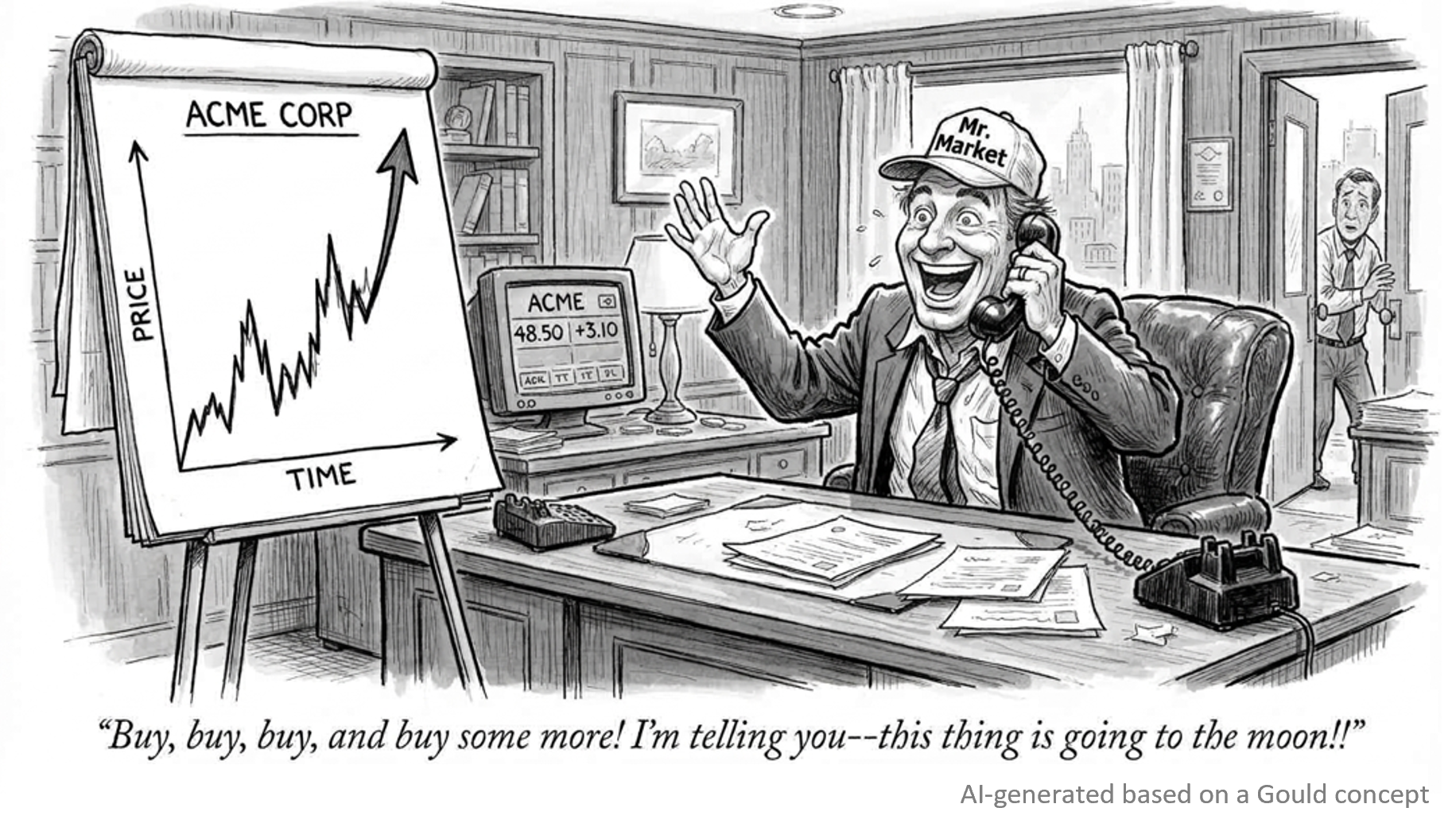
Fabled investor Benjamin Graham cleverly connected market prices to the swings of human emotion through his fictional “Mr. Market.” Graham observed that group psychology could lead investors (Mr. Market) to periods of excessive optimism[2] or pessimism, causing market prices to move to nonsensical levels, either much higher or lower than a dispassionate valuation of the underlying business.
Graham would likely see today’s Mr. Market as bordering on euphoric. A quick way to measure optimism is to look at how much investors pay today for one dollar of corporate earnings, also known as the price-to-earnings (P/E) ratio. Today’s P/E ratio is high by historical standards. That dollar of earnings is also historically expensive when compared to what one pays today for a dollar of bond interest.
Graham thought that by reading Mr. Market’s moods, he could improve investment returns, selling to the optimists and buying from the pessimists. Count us as skeptical. It is true that stock market prices periodically diverge from the rational, as may be the case today. But seeking to profit from such dislocations is both exceedingly difficult and potentially hazardous.
The Perils of Market Timing
When we are convinced that prices are out of whack, it’s always tempting to try to time the market, but let us count the pitfalls. Suppose a crystal ball tells us that a 46% market drop will begin within five years. What do we do? If the market continues to barrel upward and peaks in three years at 86% above today’s level,[3] a 46% drop will just bring the market back to today’s level.[4] Selling today will have gained very little; in fact, after capital gains taxes, our portfolio might be well below its starting position.
Lacking a crystal ball,[5] potential outcomes of market timing are even more sobering. We do not know the timing or magnitude of the next bear market, we won’t be able to identify it until the market is long past its peak, and we likely won’t believe it’s over until a new uptrend is well established, meaning we’ll miss the best time to reinvest.
Investing as a Statement of Optimism
When we invest in a diversified portfolio of stocks—through an index fund, for example—we buy a cross-section of the businesses that make up the broad economy. We do so with belief that the economy will grow over our time horizon and that the companies we own will, on average, benefit from that growth. Remember, too, that we are investing for a period that makes Mr. Market’s incessant chattering just so much noise.
While such faith has mostly been rewarded over the past century, there are no guarantees that the future will mirror the past. We also understand that ignoring Mr. Market is easier said than done. For these reasons, we diversify almost every portfolio across stocks, bonds, and other assets, consistent with each client’s tolerance for market value fluctuation. In the meantime, we are here to provide you with market noise cancellation, among many other things.
For a detailed discussion of the economy, financial markets, and investment performance, be sure to see the Q2 Economic and Market Review.
As always, we thank you for your business and for the trust you place in us daily. Please call or email whenever we can be of assistance.
The Gould Asset Management Team
[1] Hedge fund manager Cliff Asness makes a similar point, arguing (contrary to conventional wisdom) that some investors will pay more for private (non-traded) investments than for comparable publicly traded investments precisely because private investments are illiquid (therefore immune to the risks of market timing) and valued in a way (infrequently and likely understating their volatility) that reduces investor anxiety.
In 1976, Roger Ibbotson and Rex Sinquefield, former classmates at the University of Chicago, published their seminal work, "Stocks, Bonds, Bills, and Inflation: Year-by-Year Historical Returns (1926–1974).” Their study, nicknamed SBBI, was the first to provide reliable data on the historical returns of U.S. financial markets, and its impact was huge.
For the first time, analysts could confidently measure the extra return investors had earned on stocks as compared to bonds, how much additional risk that entailed, and how well stocks and bonds had kept up with inflation. Fifty years later, the updated SBBI now includes a full century of historical returns. The story it tells is remarkable and holds lessons for all investors.
An Astounding Century of Returns
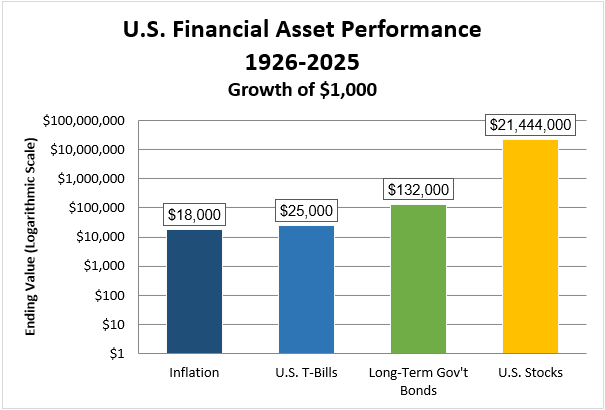
If you invested $1,000 in U.S. large cap stocks at the beginning of 1926, your portfolio would have grown to $21,444,000 by the end of 2025. You read that correctly. If you’re thinking that there’s been lots of inflation over the past century, you’re right. It takes about $18,000 today to match what $1,000 bought a century ago. Still, the purchasing power of the investment grew about 1200-fold, an astonishing feat.
Meanwhile, the same $1,000 invested in long-term U.S. government bonds grew to about $132,000: not bad, but only a tiny fraction of what stocks delivered. The same amount invested in U.S. Treasury bills grew to about $25,000, only modestly ahead of inflation.
Return and Risk
Stock prices fluctuate in response to corporate earnings, economic growth, interest rates, inflation, shocks like war and pandemic, and more. In contrast, high-quality bond prices are far less volatile. Financial theory argues that as compensation for accepting a much bumpier ride, stock investors should earn greater returns in the long term. The SBBI data bears this out. The compound annual growth rates of stocks and bonds over the last century were 10.5% and 5.0%, respectively. The extra 5.5% in annual return from stocks translated into 162 times more money after 100 years, a testament to the wonders of long-term compounding.
But before loading up on stocks, consider their risks. Since 1926, stock investors have endured all sorts of unpleasantness, ranging from overnight crashes to multi-year bear markets to decade-plus stretches of poor returns. The S&P 500 plunged 20.5% in the October 1987 “Black Monday” crash and later experienced prolonged downturns of 49% in the 2000-2002 “Dot-Com Bust” and 57% in the 2007-2009 “Great Financial Crisis.” For the 1966-1981 period, almost a full generation, U.S. stocks failed even to match inflation.
Hazardous Extrapolation
For newer investors, these cautionary tales probably seem like ancient history, making the idea of a bear market something of an abstraction. And with the U.S. stock market mostly soaring over the past 17 years, even veteran investors have dimming memories of bygone traumas.
Against this backdrop, some investment industry voices are calling for very aggressive long-term portfolio allocations (e.g., 90% stocks, 10% bonds/cash), pointing to stocks’ massive performance edge over the last century. Proponents of these high-octane portfolios commonly cite comforting statistics drawn from SBBI data, for example, that stocks have beaten bonds in more than 90% of all 20-year periods in the last century. The implication is that long-term investors can ignore shorter-term fluctuations in portfolio value.
Here's the rub. In my experience, very few investors can tolerate a rapid 40%-50% drop in their portfolio value, something a 90-10 investor would already have experienced twice since 2000. Investors who take on more risk than they can stomach invariably slash their stock holdings after a substantial market decline, locking in losses and limiting gains in subsequent market recovery. The 90-10 mix might have worked for Rip Van Winkle (who took a 20-year nap), but real-life investors must have portfolios they can live with in the short term if they are to benefit from stocks’ long-term higher expected returns.
One More Big Caveat
On one hand, SBBI is a big data set, the kind financial analysts love, with more than 1,200 monthly data points across multiple assets. On the other hand, it covers just a single century in a single country whose markets survived and thrived. Not all countries were so fortunate. Germany and Japan saw their stock markets go to zero in the wake of World War II. The SBBI data on U.S. markets shows just one of many possible outcomes.
Historical investment returns are like history books: instructive, but not necessarily predictive. Facing an uncertain future, an investor’s best tools are diversification, attention to risk, and a measure of cautious optimism. Investors who can absorb the lessons of SBBI, without mistaking past returns for a guarantee, will be better prepared for whatever the coming century brings.
Donald Gould is president and chief investment officer of Gould Asset Management of Claremont.Don is a recurring guest columnist for the Courier, providing his unique insights and observations on matters of money, investing, and personal finance.
The Trump Account: A Powerful Opportunity Hidden in the Details
For parents and grandparents thinking generationally, the new Trump Accounts contain one of the most compelling wealth building opportunities we have seen in years. This is not so much for what the accounts are on their own, but for what they can become.
Here is the short version: fund a Trump Account aggressively from birth, wait until your child is in their early 20s and likely still earning a modest income, then convert it to a Roth IRA, paying minimal taxes on the conversion. Done right, roughly $90,000 in contributions could seed a tax-free retirement account worth over $3 million by age 60. We will show the math in a moment.
As a savings vehicle on its own terms, the Trump Account is fine but not exceptional. For most purposes, a 529 or a Roth IRA will serve you better. But if you have already funded those, the Trump Account deserves a close look.
What Is a Trump Account?
Beginning this summer, parents and guardians can open a Trump Account for any child under 18, funded with after-tax dollars up to $5,000 per year, a limit that adjusts for inflation starting in 2028. The accounts must be invested in a US stock index fund until the child turns 18, at which point the rules shift and the account begins following IRA-style tax treatment. Children born between 2025 and 2028 also receive a $1,000 seed contribution from the federal government to get things started. As of mid-March, roughly four million children already have Trump Accounts, with more than 800,000 eligible for the $1,000 government contribution.
Employers and charities can contribute as well, and some high profile donors have stepped in with additional seed money, including Michael and Susan Dell, who have pledged $250 for each child age 10 or under living in a zip code with a median household income below $150,000.
How Do These Compare to 529s?
If your primary goal is saving for college, a 529 plan is clearly the better tool. Contributions to a 529 grow tax-free and come out tax-free when used for qualified education expenses. Many states offer an additional deduction on contributions. Trump Accounts carry none of those education-specific advantages. For families who need to prioritize college savings, the 529 should come first.
Parents and grandparents should maximize their own 401(k)s, IRAs, and 529s before considering a Trump Account. The sequencing matters. Think of the Trump account as the next layer, not the foundation.
The Big Opportunity
If your family can fund one of these accounts aggressively ($5,000 a year, every year, from birth through age 17) and your child has the knowledge and discipline to leave it alone as an adult, there is a potentially extraordinary outcome waiting at the other end.
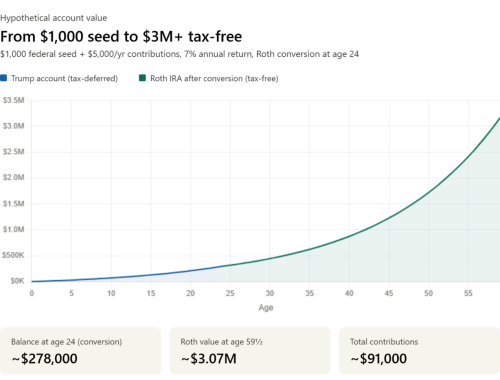
The math goes like this. Assume the $1,000 in government seed money, $5,000 in annual contributions for 18 years, and a 7% annual return. By the time your child is in their early 20s, the account value will approach $300,000. At that point, if they are in a low tax bracket as many young workers are, they can convert the account to a Roth IRA and pay minimal taxes. Rather than converting all at once, a smart approach is to spread the conversion over a few years, keeping each year's taxable income in a lower bracket and meaningfully reducing the total tax owed.
The conversion tax, paid with outside dollars as a gift from parents or grandparents rather than drawn from the account itself, is quite modest relative to the potential gains. What you've done, in effect, is pre-funded a Roth IRA on your child's behalf at a fraction of the cost of a lump-sum Roth conversion.
From there, the Roth IRA grows completely tax-free for decades. By age 60, that $278,000 conversion, left untouched, would grow to just over $3 million. No required minimum distributions. No ordinary income tax on withdrawals. Just a tax-free nest egg that has been quietly compounding since birth. Put another way, you've used roughly $90,000 in after-tax contributions, plus a modest conversion tax payment, to potentially set your child up with a multimillion dollar tax-free retirement account.
A small note on timing: experts caution against converting immediately at 18. The "Kiddie Tax," which can apply to unearned income for certain individuals under 24, may cause part of the conversion to be taxed at the parents' rate rather than the child's. Patience here pays. Waiting until the child is working, independent, and clearly in a low bracket (typically the early-to-mid 20s) is the smarter move.
Understanding the Risks
This strategy has potential pitfalls that should be understood from the outset.
The first risk is behavioral. The entire thesis depends on your child, in their early 20s, making the disciplined choice not to cash out what may seem like found money. A young adult with more than a quarter million dollars on hand and competing financial priorities is not a guaranteed long-term investor. Helping the child understand the benefits of long-term tax-free compounding will create the best chance of realizing the full potential of these accounts.
The second risk is legislative. Tax laws change. The 529-to-Roth conversion rules, which were themselves a relatively recent and welcome addition to the tax code, already carry a $35,000 lifetime cap. Future Trump Account legislation could impose similar caps, restrict conversions for accounts above a certain balance, or find other ways to tax the transaction more heavily if a low-bracket conversion starts to look too generous. Today's rules might not be permanent. But even if rules change, we see little downside to this strategy.
And, of course, while we have assumed a 7% rate of return, future returns are never guaranteed.
The Bottom Line
The Trump Account is not a replacement for the tools you already have. Fund your own retirement first. Keep the 529 at the top of the priority list for college savings. But if you've done those things and have the capacity to think a generation ahead, this is a genuinely compelling new vehicle because of the Roth conversion opportunity it opens. For those eligible children, the $1,000 seed money is frosting on the cake.
A Trump Account for a child born this year, funded consistently, converted to a Roth IRA in early adulthood, and left to compound for decades, could enable the child to retire with financial security, all because of a decision you made before they ever knew what a tax return was.
As always, the details of your specific situation matter. Tax brackets, other savings priorities, the age of your children, and your estate planning goals all factor in. If you'd like to explore whether this strategy makes sense for your family, we are here to help. Call or email us anytime
As always, we thank you for your business and for the trust you place in us daily. Please call or email whenever we can be of assistance.