

The National Debt - $40 Trillion and Counting
“The rapidly growing US national debt will lead to bankruptcy of the US government within three years.” – Paraphrased from “Bankruptcy 1995: The Coming Collapse of America and How to Stop It” by Harry E. Figgie, Jr. and Gerald J. Swanson.
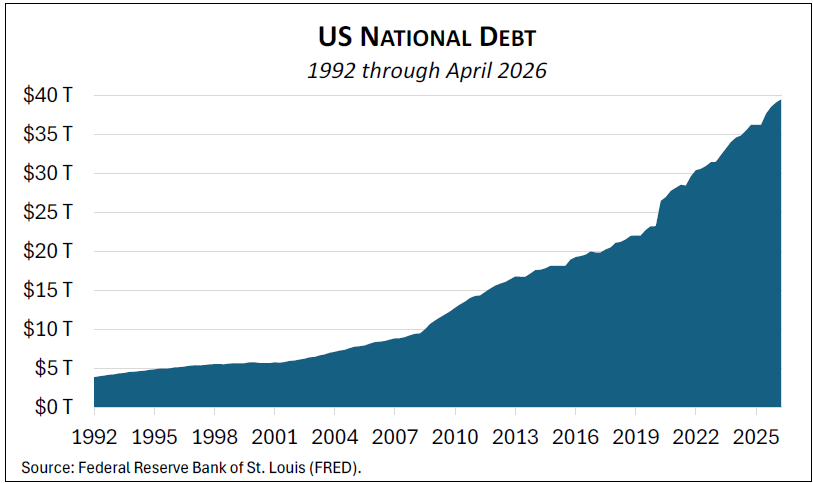
The US national debt stood at $4 trillion when industrialist Harry Figgie published his 1992 bestseller, and clearly the government didn’t go bankrupt in 1995. Thirty-four years later, in August 2026, the debt surpassed $40 trillion, a milestone that garnered considerable media attention in a way that $39 trillion did not. One might wonder why the hoopla. It’s not as though this milestone snuck up on anyone.
Much of the reaction seems linked to other economic issues coming to the fore at the same time. When the debt odometer rolled, consumers were already grappling with stubbornly high inflation, made worse by rising energy costs in the wake of the Iran conflict.
At the same time, bond investors were anticipating the September Federal Reserve interest rate hike, aimed at subduing inflation. Adding to the bond market’s unease, the major tech firms have been borrowing hundreds of billions of dollars annually to help fund their massive AI infrastructure buildout.
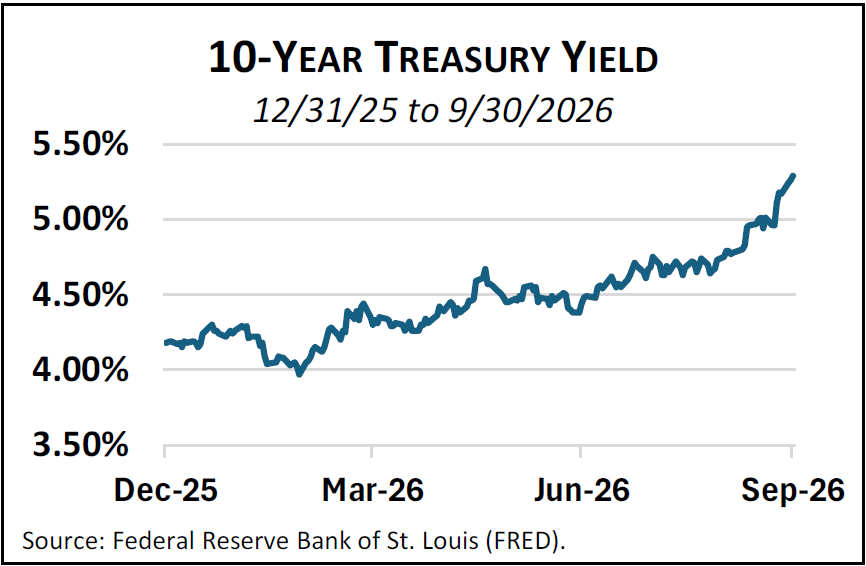
This confluence of factors triggered a spike in interest rates in the third quarter, pushing down bond prices and raising interest expense for borrowers across the economy (the US government included). Though the Fed hiked short-term rates only by 0.25%, more increases are expected. The benchmark 10-year Treasury yield has climbed from 4.18% at year-end 2025 to 5.29% on September 30, with half that rise coming in September alone.
How Big a Problem is this Debt Really?
The source of the debt is the annual federal budget deficit, the result when the government spends more than it receives in taxes. The difference is covered through borrowing—the issuance of new Treasury bonds. In the fiscal year just ended on September 30, the US government spent $7.4 trillion and collected $5.6 trillion in taxes, leaving a nearly $2 trillion deficit. The national debt is simply the accumulation of these deficits over time. The last US budget surplus was a quarter century ago.
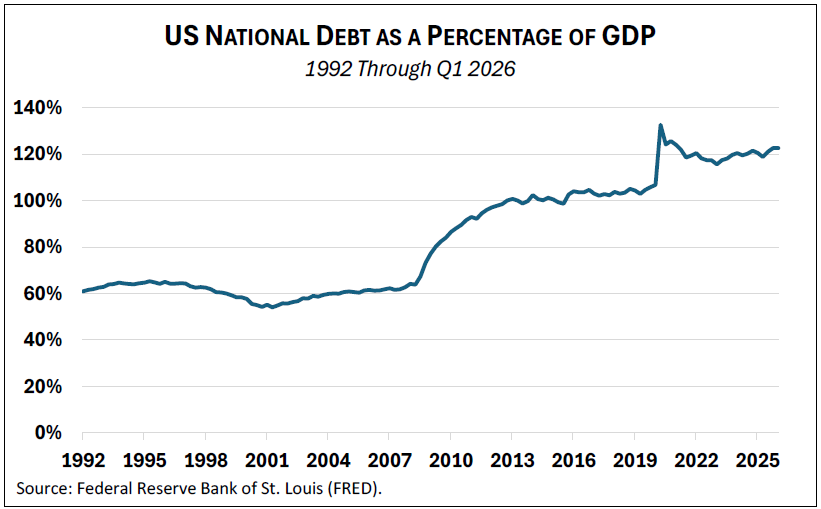
The US national debt has grown ten-fold since Harry Figgie issued his 1992 warning. Since then the US economy has also grown substantially, making comparisons between the two numbers ($4 trillion and $40 trillion) less meaningful. A more telling measure of the debt’s growth is its relation to the economy’s size (i.e., GDP). The debt has doubled from 61% of GDP in 1992 to 123% today. This is worrisome. When the debt grows faster than the economy, an increasing share of the federal budget goes to paying interest on the debt. Annual interest expense (currently over $1 trillion) now exceeds defense spending, trailing only Social Security and Medicare as a percentage of the federal budget. In other words, the debt is feeding itself as growing interest payments necessitate greater borrowing. Higher interest rates compound the problem, making new debt more expensive.

The arithmetic of a solution is simple—some combination of higher taxes and lower spending could shrink annual deficits and put the debt’s growth on a more sustainable path. But the politics are daunting. There is organized and fierce opposition to competing proposals for either tax hikes or cuts in government spending. The AI optimists think that AI will supercharge economic growth, causing tax revenue to soar without the need to raise tax rates. Whether that’s true remains to be seen.
What is the Endgame?
“Stein’s Law: If something cannot go on forever, it will stop.” – Herbert Stein, Chairman of the Council of Economic Advisers (Nixon Administration, 1972-1974).
Maybe the US debt is an exception to Stein’s Law. The US enjoys the privilege of issuing debt in its own currency. No matter how large its debt, the US need never default because it can always print the money necessary to pay off bondholders.[1] But while the US can avoid technical default indefinitely, so-called monetizing of the debt could prove highly inflationary. Still, as unpopular as higher inflation would be, in the face of political stalemate, it might be the path of least resistance.
One way to monitor whether investors anticipate elevated inflation down the road is the so-called “break-even” rate, which is the implied future rate of inflation that is derived from the yield on Treasury Inflation-Protected Securities (TIPS). This long-term inflation forecast has bounced between 2.0% and 2.5% for the past three years, suggesting that bond investors today are not unusually concerned about future inflation. But as The Wall Street Journal astutely observed on October 3, 2026, “In markets, a risk factor might not matter for a long time until it suddenly does.” Just as the $40 trillion headline may have awakened bond markets to an array of challenges both old and new, the trajectory of US deficits and debt may catalyze long-term inflation concerns. We’re watching this closely.
A final note on debt and deficits. This phenomenon is not unique to the US. Most leading western industrialized nations are facing major debt challenges of their own, with France and the UK of particular concern lately. Burgeoning government debt is a global problem.
For a detailed discussion of the economy, financial markets, and investment performance, be sure to see the enclosed quarterly Economic and Market Review and Strategy Performance Review, as well as your personalized quarterly investment report. We have also enclosed some helpful year-end tax planning tips.
For a detailed discussion of the economy, financial markets, and investment performance, be sure to see the Q3 Economic and Market Review.
As always, we thank you for your business and for the trust you place in us daily.
The Gould Asset Management Team