by Samantha Sisson | Oct 15, 2026 | Blog
The National Debt - $40 Trillion and Counting
“The rapidly growing US national debt will lead to bankruptcy of the US government within three years.” – Paraphrased from “Bankruptcy 1995: The Coming Collapse of America and How to Stop It” by Harry E. Figgie, Jr. and Gerald J. Swanson.
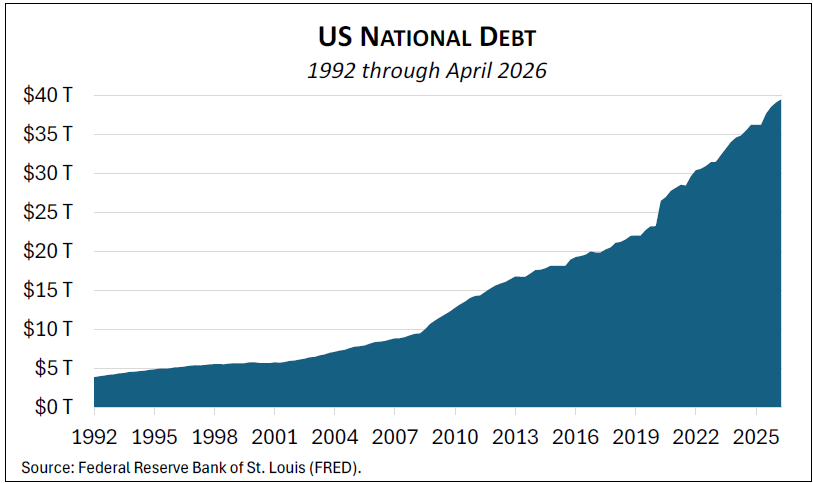
The US national debt stood at $4 trillion when industrialist Harry Figgie published his 1992 bestseller, and clearly the government didn’t go bankrupt in 1995. Thirty-four years later, in August 2026, the debt surpassed $40 trillion, a milestone that garnered considerable media attention in a way that $39 trillion did not. One might wonder why the hoopla. It’s not as though this milestone snuck up on anyone.
Much of the reaction seems linked to other economic issues coming to the fore at the same time. When the debt odometer rolled, consumers were already grappling with stubbornly high inflation, made worse by rising energy costs in the wake of the Iran conflict.
At the same time, bond investors were anticipating the September Federal Reserve interest rate hike, aimed at subduing inflation. Adding to the bond market’s unease, the major tech firms have been borrowing hundreds of billions of dollars annually to help fund their massive AI infrastructure buildout.
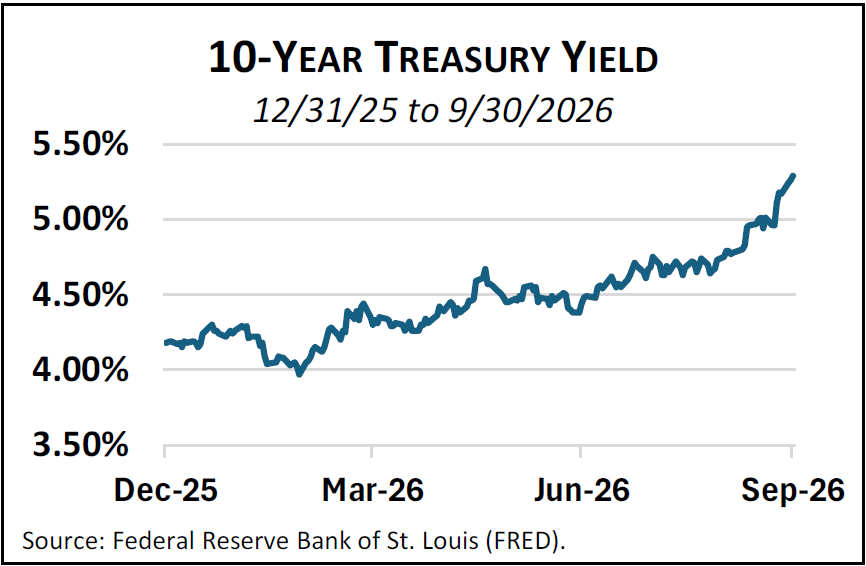
This confluence of factors triggered a spike in interest rates in the third quarter, pushing down bond prices and raising interest expense for borrowers across the economy (the US government included). Though the Fed hiked short-term rates only by 0.25%, more increases are expected. The benchmark 10-year Treasury yield has climbed from 4.18% at year-end 2025 to 5.29% on September 30, with half that rise coming in September alone.
How Big a Problem is this Debt Really?
The source of the debt is the annual federal budget deficit, the result when the government spends more than it receives in taxes. The difference is covered through borrowing—the issuance of new Treasury bonds. In the fiscal year just ended on September 30, the US government spent $7.4 trillion and collected $5.6 trillion in taxes, leaving a nearly $2 trillion deficit. The national debt is simply the accumulation of these deficits over time. The last US budget surplus was a quarter century ago.
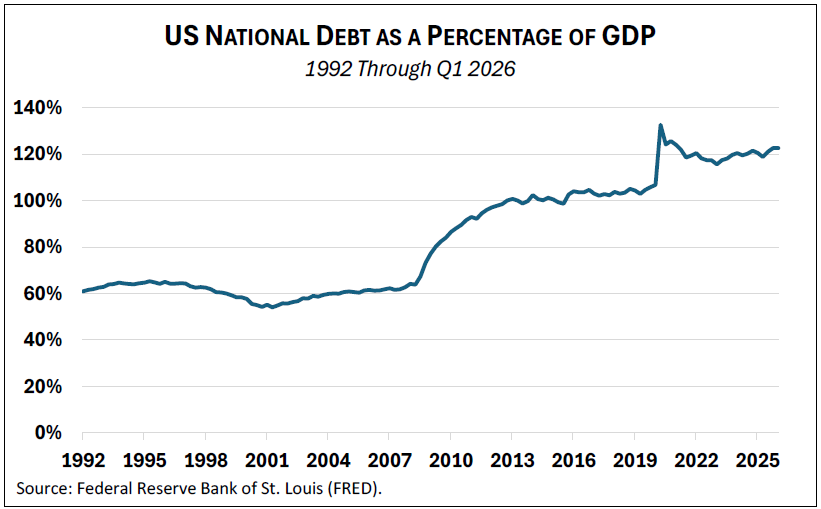
The US national debt has grown ten-fold since Harry Figgie issued his 1992 warning. Since then the US economy has also grown substantially, making comparisons between the two numbers ($4 trillion and $40 trillion) less meaningful. A more telling measure of the debt’s growth is its relation to the economy’s size (i.e., GDP). The debt has doubled from 61% of GDP in 1992 to 123% today. This is worrisome. When the debt grows faster than the economy, an increasing share of the federal budget goes to paying interest on the debt. Annual interest expense (currently over $1 trillion) now exceeds defense spending, trailing only Social Security and Medicare as a percentage of the federal budget. In other words, the debt is feeding itself as growing interest payments necessitate greater borrowing. Higher interest rates compound the problem, making new debt more expensive.

The arithmetic of a solution is simple—some combination of higher taxes and lower spending could shrink annual deficits and put the debt’s growth on a more sustainable path. But the politics are daunting. There is organized and fierce opposition to competing proposals for either tax hikes or cuts in government spending. The AI optimists think that AI will supercharge economic growth, causing tax revenue to soar without the need to raise tax rates. Whether that’s true remains to be seen.
What is the Endgame?
“Stein’s Law: If something cannot go on forever, it will stop.” – Herbert Stein, Chairman of the Council of Economic Advisers (Nixon Administration, 1972-1974).
Maybe the US debt is an exception to Stein’s Law. The US enjoys the privilege of issuing debt in its own currency. No matter how large its debt, the US need never default because it can always print the money necessary to pay off bondholders.[1] But while the US can avoid technical default indefinitely, so-called monetizing of the debt could prove highly inflationary. Still, as unpopular as higher inflation would be, in the face of political stalemate, it might be the path of least resistance.
One way to monitor whether investors anticipate elevated inflation down the road is the so-called “break-even” rate, which is the implied future rate of inflation that is derived from the yield on Treasury Inflation-Protected Securities (TIPS). This long-term inflation forecast has bounced between 2.0% and 2.5% for the past three years, suggesting that bond investors today are not unusually concerned about future inflation. But as The Wall Street Journal astutely observed on October 3, 2026, “In markets, a risk factor might not matter for a long time until it suddenly does.” Just as the $40 trillion headline may have awakened bond markets to an array of challenges both old and new, the trajectory of US deficits and debt may catalyze long-term inflation concerns. We’re watching this closely.
A final note on debt and deficits. This phenomenon is not unique to the US. Most leading western industrialized nations are facing major debt challenges of their own, with France and the UK of particular concern lately. Burgeoning government debt is a global problem.
For a detailed discussion of the economy, financial markets, and investment performance, be sure to see the enclosed quarterly Economic and Market Review and Strategy Performance Review, as well as your personalized quarterly investment report. We have also enclosed some helpful year-end tax planning tips.
For a detailed discussion of the economy, financial markets, and investment performance, be sure to see the Q3 Economic and Market Review.
As always, we thank you for your business and for the trust you place in us daily.
The Gould Asset Management Team
[1] In practice, when monetizing federal debt, the government does not actually print paper currency. Instead, the Federal Reserve buys Treasury bonds in the open market, crediting the bond seller’s account at the Fed. It is this last step that creates new money.

by Rami Taha | Oct 15, 2024 | Blog
By Johnny DeBiase, CFA
As you approach retirement, it is essential to consider how best to manage your retirement assets. For many college professors, these assets are tied to TIAA, a leading provider in higher education retirement plans such as 403(b) plans. Founded over a century ago, TIAA has built a reputation for serving the financial needs of those in academia and other non-profit fields. But what happens to your TIAA retirement assets once you retire? Let’s explore your options.
Understanding Your TIAA Retirement Assets
The first step in planning for your retirement is understanding what you have. Over your career, you may have worked at multiple institutions, each with its own retirement plan under the TIAA umbrella. It’s not uncommon for professors to accumulate multiple accounts, each with different investment options and rules. Therefore, a comprehensive review of your TIAA accounts is critical before making any decisions.
The Options: What Can You Do With Your TIAA Assets?
Once you’ve taken stock of your retirement accounts, you have several options to consider. Each option comes with its own set of pros and cons, and the best choice will depend on your financial goals, the specifics of your TIAA plan, and your comfort level with managing your own investments.
1. Roll Over Some or All of Your Assets Immediately
One option is to roll over some or all of your TIAA assets into another retirement account, such as an IRA. This option provides flexibility in choosing investments outside the TIAA platform, which is particularly appealing if you find the investment options within TIAA limited. Rolling over to an IRA could give you access to a broader range of investment vehicles, including stocks, bonds, and mutual funds.
Special consideration must be taken with accounts invested in TIAA Traditional, a guaranteed annuity product unique to TIAA. Unlike other investments, TIAA Traditional cannot be rolled over as a lump sum. Instead, it must be rolled over in ten equal installments over nine years. A financial advisor can help you determine how best to plan for rolling over your investment in TIAA Traditional.
2. Roll Over Assets Over Time
If you’re not ready to make a full transition out of TIAA or are currently still employed, you can choose to roll over your assets gradually. This approach allows you to continue working while transferring assets from old TIAA plans, gaining access to a broader investment universe with an IRA.
Assets that you don’t want to move or can’t move can be managed by certain advisors without requiring you to move them out of the TIAA platform. This can be an ideal solution if you prefer to keep your assets with TIAA but want professional management to keep your investments aligned with your retirement goals. These advisors can also help manage your TIAA assets in conjunction with other outside assets, providing a holistic approach to your retirement planning.
3. Leave Your Assets at TIAA
Another option is to leave your assets with TIAA. For many, this is the simplest and most straightforward option, especially if you are comfortable choosing your own investments and calling the TIAA customer service phone number when you need assistance.
Leaving your assets with TIAA might also make sense if you want to remain invested in TIAA Traditional or if you’re satisfied with the investment options provided by TIAA and the associated fees they charge.
Final Thoughts: Professional Guidance
As a college professor, you’ve dedicated your career to educating others. Now, as you approach retirement, it’s time to focus on pursuing your ideal financial future. Understanding your TIAA retirement assets and knowing your options are crucial steps in this journey.
Whether you choose to roll over your assets, leave them with TIAA, or gradually transition to a different investment strategy, the most important thing is to make informed decisions that align with your retirement goals. By taking the time to review your options and consulting with knowledgeable advisors, you can confidently navigate this next phase of your life and enjoy the retirement you’ve earned.
That’s where Gould Asset Management can help. Each client comes to our firm with unique circumstances. Age, assets, investment experience, life and financial goals, and risk tolerance are just a few factors. Based on careful consideration, our team crafts unique portfolios for each client.
To schedule a meeting, call (909) 445-1291, email contact@gouldasset.com, or request a meeting on our website.
About Johnny
Johnny DeBiase is Partner and Senior Portfolio Manager at Gould Asset Management, an independent registered investment adviser based in Claremont, California. The firm manages customized portfolios on behalf of individuals, families, and nonprofits, and offers a range of services, including retirement planning, charitable giving strategies, and values-based investment options. As fiduciaries, they always put their clients’ interests first while providing a culture of superior personal service.
With responsibilities including portfolio management, market and investment research, and client relationship management, Johnny enjoys how investing combines numbers and finance with an element of human psychology. A big part of his job involves breaking down complex topics and helping clients tune out the noise to see the big picture. He’s a firm believer that clients come to Gould for the investment advice and stay for the exceptional client service.
Johnny obtained his bachelor’s degree in economics with a minor in chemistry from the University of North Florida and his master’s degree in finance from the Robert Day School of Economics and Finance at Claremont McKenna College. He also holds the Chartered Financial Analyst® (CFA®) designation and is a member of the CFA Institute. In his free time, he enjoys hiking with his wife, Jill, playing with his dogs, Millie and Lola, cooking, practicing yoga, and reading fantasy and sci-fi books. To learn more about Johnny, connect with him on LinkedIn.

by Rami Taha | Aug 6, 2024 | Blog
By Scott Smith, CFA
Socially responsible investing is on the rise, and Gould Asset Management has a process to support clients who want to incorporate social considerations into their investment portfolios.
According to Sustainable Signals, a report from the Morgan Stanley Institute for Sustainable Investing, roughly 54% of individual investors say they plan to increase sustainable investments over the next year. And 77% of global investors are interested in investing in companies or funds that give them both a competitive market return and a positive impact on society or the environment.
If you want to invest and try to move the needle on a specific issue or cause, Gould Asset Management has considerable experience in socially responsible investing. Here’s a look at the process a registered investment advisor (RIA) can use to help you make a difference.
What Is Socially Responsible Investing?
Socially responsible investing, also known as ethical investing, green investing, sustainable investing, or values-based investing, focuses on selecting investments that aim to generate competitive long-term financial returns while positively impacting society. Once considered an unusual approach, it has evolved and grown in popularity among investors over the years.
This investment strategy is often implemented with a focus on three key factors: environmental, social, and governance (ESG).
- Environmental: Company’s policies and impact with respect to the environment
- Social: Company’s practices with employees, customers, and the community
- Governance: Company’s management structure, policies, and practices
Socially responsible investing also includes impact investing, where an investment is expected to produce a direct social benefit, and investment screening, which excludes companies and/or industries whose businesses or practices run contrary to a client’s goals.
Our Role in Assisting Your Socially Responsible Investing Goals
Many Gould Asset Management clients consider socially responsible investing for their portfolios, and our process supports them. Understanding clients' objectives and values is essential in all types of investing, but it is especially important here.
The advisors at Gould Asset Management work closely with clients to learn about their social goals, values, and motivations. A crucial point to understand from the start is how clients think about defining and implementing a socially responsible investment plan. It’s different for every client.
While each client might have a different way of looking at socially responsible investing, there are three elements we focus on to align with our clients’ investment goals:
- Determining the social goals with the highest priority
- Identifying the investments that match those priorities
- Understanding the tradeoffs
To identify investments for clients, our firm monitors an ever-growing pool of socially responsible investment vehicles, including index and actively managed funds, exchange-traded funds, managed mutual funds, and individual equities managed according to client-specified criteria.
Gould Asset Management overlays its approach to socially responsible investing on top of diversified, risk-managed strategies, which can be customized for different risk tolerances and return objectives.
A Financial Advisor Can Guide Your Socially Responsible Investment Journey
Do you have causes or issues you want to support financially while generating a competitive market return? Gould Asset Management works with a diverse range of investors, applying our substantial experience in socially responsible investing.
Please contact us to see how we might help you invest in a way that supports the issues and causes you believe in. To schedule a meeting, call (909) 445-1291, email contact@gouldasset.com, or request a meeting on our website.
About Scott
Scott Smith is Partner and
Senior Portfolio Manager at Gould Asset Management (founded in 1999), an independent registered investment adviser based in Claremont, California. The firm manages customized portfolios on behalf of individuals, families, and nonprofits, and offers a range of services, including retirement planning, charitable giving strategies, and values-based investment options. As fiduciaries, they always put their clients’ interests first while providing a culture of superior personal service.
Scott Smith joined Gould Asset Management in 2004 and is a partner at the firm. In his role as a senior portfolio manager, he provides ongoing expert management of client investment portfolios, with an emphasis on Gould’s asset allocation and covered-call writing strategies. Among his investment interests, Scott has developed expertise in helping clients implement their “responsible investing” goals, which can include environmental, social and corporate governance aims. He also oversees the firm’s investment technology initiatives.
Prior to 2004, Scott worked as a business and litigation consultant for Tucker Alan Inc (now Navigant Consulting), where he performed financial and economic analyses, developed financial models, and conducted market and company-specific research.
Scott received a Bachelor of Arts in Economics, with honors, from Claremont McKenna College and an MBA from the Peter F. Drucker and Masatoshi Ito Graduate School of Management at the Claremont Graduate University (CGU). It was at CGU that Scott met Don Gould, who was teaching an investment management practicum course as an adjunct faculty member. Upon completion of the course (and Scott’s MBA), Don offered Scott a position at Gould and the rest, as they say, is history.
Scott holds the Chartered Financial Analyst® (CFA®) designation, and is a member of the CFA Institute and the CFA Society of Los Angeles. Scott resides in Claremont, California with his wife, Claire, and their two children, Addie and Asher. He enjoys traveling, skiing, and golfing in his free time and is actively involved in his local church. To learn more about Scott, connect with him on LinkedIn.

by Rami Taha | Jul 9, 2024 | Blog
By Tom Carr, CFP®
If you think most financial advisors are more or less the same, think again. Beyond the numbers, a relationship built on trust, understanding, and shared goals can go a long way in helping you develop an investment strategy that works for you.
According to recent research, clients most value the following attributes in their financial advisors:
- Frequent, proactive communication
- Personalized investing guidance
- Matching client needs with services provided
It seems that a strong personal connection plays as big a role as financial performance in the best client-advisor relationships. The research also suggests that solid relationships between clients and advisors are key to positive, long-term collaborations.
At Gould Asset Management, relationships are core to our business, and trust is at the heart of our relationship with each client. Here’s why your relationship with your financial advisor matters.
Your Relationship Is About Managing Money…and Much More
A strong relationship between you and your financial advisor is built on trust and understanding. That trust can lead to a more comprehensive plan and more personalized advice. Thorough and customized financial planning can result in a portfolio that meets your investment needs.
Initially, you might wonder why you and your financial advisor spend time discussing more than just money management. For example, your advisor might ask about your health, housing, or retirement plans. You might even chat about your upbringing, family, hobbies, and personal values.
But think about it this way: The more a financial advisor knows about you, the better you can work together to tailor strategies to your goals.
A thoughtful financial advisor does more listening than talking. This personal attention to the details of your life is a good sign the financial advisor cares about you and is looking out for your interests.
Why Your Personal Relationship with a Financial Advisor Matters
Trust between you and your financial advisor offers benefits in both directions. The more you lean on your financial advisor for financial guidance, the more your advisor can use their skills and experience to find strategies that deliver on your goals.
Here’s what to look for in a personal relationship with your advisor:
Trust and Comfort
A financial advisor who provides open, honest, and clear communication can build trust and comfort with a client. You should feel understood and supported by your financial advisor. This level of comfort can provide you confidence when making decisions.
Quality Advice
A financial advisor who understands more about your values, goals, and personal life can provide customized guidance. While there are no guarantees with investing, a tight alignment between the investor’s objectives and the advisor’s guidance could offer advantages.
Behavioral Coaching
Financial decisions can be emotional, especially in volatile markets or during a life change.
When you trust your advisor, you can rely on them to steer you clear of making calls based on emotions and encourage you to stay the course of your financial plan. You’ve learned you can depend on and trust your financial advisor, and your advisor can offer reassurance about your decisions.
Focused Planning
When you and your financial advisor are well attuned to one another, a financial plan focused on your goals can naturally follow. Whether your goal is building wealth, retiring in comfort, providing for the next generation, or supporting a charity, a financial advisor who understands what you believe in and want to do can build a better financial plan.
A financial advisor who gives quality advice, understands and caters to your needs, and provides emotional support adds significant value to your relationship.
Find a Financial Advisor
If you need help meeting your financial goals, let’s talk. We’ll introduce you to our financial advisor and client service teams, which work together to deliver personal client service tailored to your unique circumstances and desires.
To schedule a meeting, call (909) 445-1291, email contact@gouldasset.com, or request a meeting on our website.
About Tom
Tom Carr joined Gould Asset Management in 2002. He is a partner and chief compliance officer for the firm. His primary responsibilities include compliance oversight, portfolio management, investor reporting, and relationship management with clients and financial advisors. As a portfolio manager, Tom plays a lead role in the fixed income area and has been instrumental in establishing and maintaining Gould’s high level of client service. Prior to joining Gould Asset Management, he was a senior investment specialist with Charles Schwab & Co., where he provided financial planning and investment advice for nine years.
Tom has a BA in Management Science from the University of California at San Diego and holds both the CERTIFIED FINANCIAL PLANNER™ (CFP®) and Accredited Estate Planner® (AEP®) certifications. He has served as treasurer for the House of Ruth, a non-profit organization that assists women and children affected by domestic violence. He also is a member of the board of directors of the Estate Planning Council of Pomona Valley, the board of the Inland Empire Estate Planning Seminar, and the consultative board of Pomona Catholic High School. Tom is an avid sports fan and enjoys cycling, running, and golf. To learn more about Tom, connect with him on LinkedIn.
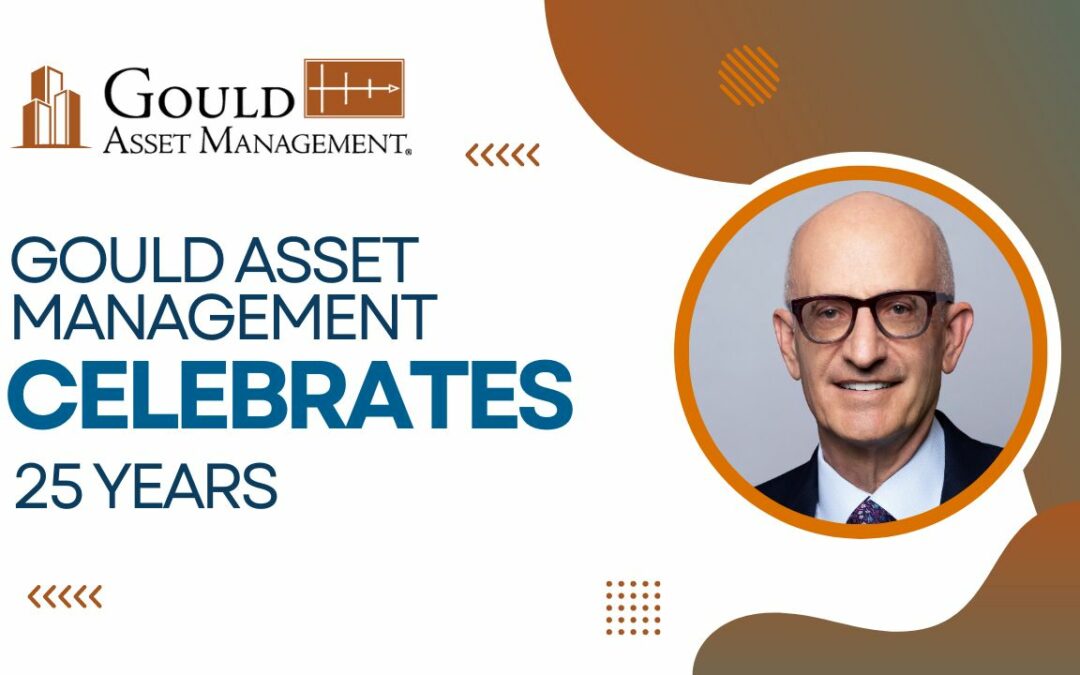
by Rami Taha | May 17, 2024 | Blog
Gould Asset Management marks its 25th anniversary! Company founder Don Gould reflects on the journey in this brief video.

by Rami Taha | Mar 21, 2024 | Blog
By Johnny DeBiase, CFA
April 15th is just around the corner, and many of us are knee-deep in tax planning. When inundated with massive quantities of receipts, financial statements, forms, and spreadsheets, it can be all too easy to make errors that can lead to inaccurate calculations, delayed refunds, and penalties in worst-case scenarios.
Fortunately, many of these errors are easy to avoid or correct. To assist in the ultimate goal of pursuing your ideal financial future, here are some of the most common tax-planning mistakes and how to prevent them.
Missing Deadlines
Although April 15th happens every year (we checked), the deadline for filing taxes has a way of sneaking up on many people.
While it’s perfectly acceptable to file for an extension, one way or another, you need to give the IRS something by April 15th. Failing to give any notice whatsoever can result in a penalty of 5% of unpaid, owed taxes per month. Interest charges and other penalties may follow.
If you need to extend the April 15th deadline, you can submit Form 4868 to the IRS before that date, or simply make an electronic extension payment online (no need to file Form 4868). If you expect to owe taxes after filing, it’s a good idea to estimate how much you’ll owe and make at least a partial payment when requesting an extension.
Overlooking Credits, Breaks, and Deductions
Tax planning is a tough task. In trying to streamline the process, many taxpayers only count standard annual deductions and move on. In doing so, they miss out on tax credits and deductions they could have taken advantage of.
Credits are available for taxpayers in certain situations—those with children, those saving for retirement, those financing education, those supporting green initiatives, and more. Take the extra step of learning what tax advantages are available to you.
Providing Inaccurate Information
Whether you use automated software or an old-fashioned calculator, it’s a good idea to double-check your work to verify it’s accurate. This advice goes beyond mathematical errors; it also applies to changes to your personal info or bank account numbers and other common typos.
It’s important to be careful and accurate when calculating your finances. Rounding up deductions might be seen as incorrect by the IRS, and could potentially lead to an audit—which most people prefer to avoid!
Not Reporting All Income Sources (and Losses)
The days of having a single 9-to-5 job that accounts for all of a household’s income are gone. Realistically, they were never really there—investment dividends, retirement fund distributions, Social Security benefits, stock sales, and other miscellaneous revenue streams have always been reportable income sources.
However, with today’s gig economy and increasing diversity of income opportunities, it’s important not to skip over any financial gains—or, if applicable, capital losses. In addition, many financial institutions are foregoing mailing tax documents, opting instead to post them electronically. Just because you didn’t receive a tax form in the mail does not mean you don’t have taxable income that needs to be reported.
Missing Quarterly Estimated Tax Payments
For most of us, tax planning is only an annual chore centered around the April 15th deadline. But many self-employed or freelance workers, as well as those earning income from investments, may be required to file taxes four times a year. That’s because they’re in charge of their own paycheck deductions since they don’t have a regular employer to make them automatically.
If this situation applies to you, the IRS requests that you fill out and submit Form 1040-ES every quarter. It might be an additional hassle, but it could also instill a sense of discipline about tax planning. It may even optimize cash flow and put a cap on interest charges.
Not Getting Tax-Planning Help
If you find yourself underwater with tax planning, the best thing you can do is ask for help. Don’t hesitate to contact Gould Asset Management, a financial advising firm serving clients in Claremont, CA, and beyond. If you need a referral to a tax planning expert, we work with some of the best tax planners in the industry who understand the personal approach we take to every interaction and, like us, desire to help people turn their hard work into a prosperous future.
To schedule a meeting, call (909) 445-1291, email contact@gouldasset.com, or request a meeting on our website.
About Johnny
Johnny DeBiase is Partner and Senior Portfolio Manager at Gould Asset Management, an independent registered investment advisor based in Claremont, California. The firm manages customized portfolios on behalf of individuals, families, and nonprofits, and offers a range of services, including retirement planning, charitable giving strategies, and values-based investment options. As fiduciaries, they always put their clients’ interests first while providing best-in-class financial advice.
With responsibilities including portfolio management, market and investment research, and client relationship management, Johnny enjoys how investing combines numbers and finance with an element of human psychology. A big part of his job involves breaking down complex and emotionally charged topics like death and divorce, helping clients tune out the noise and see the big picture. He’s a firm believer that clients don’t stay for investments, they stay for client service.
Prior to joining the Gould team in 2012, Johnny interned for Fidelity National Information Services in their corporate tax department, analyzing data and assisting in the preparation of tax returns. He obtained his bachelor’s degree in economics with a minor in chemistry from the University of North Florida and his master’s degree in finance from the Robert Day School of Economics and Finance at Claremont McKenna College. He also holds the Chartered Financial Analyst® (CFA) designation and is a member of the CFA Institute. In his free time, he enjoys hiking with his wife, Jill, playing with his dogs, Millie and Lola, cooking, yoga, and reading fantasy and sci-fi books. To learn more about Johnny, connect with him on LinkedIn.