Today’s stock market looks expensive by historical standards. By expensive, we are not talking about the price of stocks, but rather their value—how much we pay for a dollar of corporate earnings, or profits. That measure is called the price-to-earnings (P/E) ratio.
Divide Microsoft’s stock price of $510 by its earnings-per-share of $18 and you get a P/E ratio of 28. Do this for every stock and you can calculate the whole market’s P/E ratio. The accompanying chart shows that today’s market P/E is near its all-time high reached in 2000.
Today’s stock market: Fairly priced, or in a bubble?
There are two main schools of thought on why stocks might look expensive right now. The “efficient market hypothesis” (EMH) argues that prices fairly reflect all information available in the moment. If P/E ratios are historically high, EMH says there must be a good reason. As an example, today’s high P/E ratios might reflect a consensus that AI will accelerate corporate profit growth by increasing efficiency or creating whole new categories of economic activity. The expectation of increased future earnings would justify a higher P/E than before. Bolstering the case for EMH is the lightning speed with which information now moves around the globe and is digested by markets.
The second school focuses on the “animal spirits” that often dominate investor behavior. British economist John Maynard Keynes coined that term to describe how mass psychology periodically drives markets sharply above or below any reasonable measure of their true value. Bouts of widespread euphoria can lead to bubbles in markets for stocks, real estate, and other assets. A storied example: At the peak of the Dutch tulip bulb craze of the 1600s, a single bulb reportedly fetched ten times the annual wage of a skilled craftsman. Likewise, extreme pessimism can color investors’ perceptions. After a decade of high inflation and poor stock market returns, a famous 1979 BusinessWeek cover declared the “death of equities.” Three years later, stocks turned sharply higher, a trend they’ve maintained for most of the past 44 years.
What should a stock market investor do?
If you subscribe to the EMH school, the long-term investor should not change course in response to today’s expensive market. Though the market looks expensive, it’s priced fairly and should deliver a return in line with its risk. So, instead of worrying about whether stocks are overpriced or a bargain (since EMH says they are neither), investors should keep their focus on asset allocation, making sure their portfolio is well diversified and properly reflects their tolerance for risk.
And if today’s prices reflect animal spirits more than logic? Market history is awash in bubbles. If you are over 40, you likely remember the dot-com mania of the late 1990s, when investor rapture over the world-changing potential of the internet pushed the tech-heavy Nasdaq index skyward by about 600% over a 5-year period. The internet did indeed change the world, but investors wildly overestimated its impact on corporate profits. The Nasdaq peaked in March 2000 and then plunged nearly 80% over the next 19 months, giving back almost all its gains of the late 1990s. It was not until 2015 that the index recaptured its 2000 high point.
Today’s AI boom shares characteristics with the dot-com bubble, with companies (and their investors) committing trillions of dollars to AI infrastructure in a race with highly uncertain returns. There are important differences between the two periods, as well. The public companies spending the largest amounts on AI are mostly established and solidly profitable businesses, which was not the case in the dot-com era. Will future earnings justify today’s lofty stock prices? We’ll only know in hindsight.
An investor who is convinced that prices are out of whack due to animal spirits might be tempted to try to time the market. This path is littered with pitfalls.
First, even if you know you’re in a bubble, you still have no idea how much bigger the bubble will get and how long it will take to peak. Suppose a crystal ball tells you that a 46% market drop will begin within five years. What do you do? If the market continues to barrel upward and peaks in three years at 86% above today’s level—about what the US stock market has gained over the last three calendar years—a 46% drop will just bring the market back to today’s level. (The math: (100+86) x (100%-46%) ≈ 100.) Selling today will have gained very little; in fact, after capital gains taxes, your portfolio might be well below its starting position.
Several additional factors argue for staying the course even if you think investor emotions are distorting market prices. No one knows the timing or magnitude of the next bear market. We can’t identify an extended downturn until the market is long past its peak. And most won’t believe the market has reached its low point until a new uptrend is well established. The sobering upshot: it’s highly unlikely we’ll sell at the top or buy at the bottom.
The Surprising Conclusion…and One Caveat
So, it turns out that if the simple objective is making money, it doesn’t matter much whether or not the market is priced correctly. If it’s priced correctly (per EMH), then there’s nothing to be gained from trading. And if it’s in a bubble, arguably the hazards of market timing more than offset any potential gains.
That said, there is still one argument in favor of reducing stock exposure in an overpriced market, and it has to do with risk. The most severe bear markets tend to be those that follow the biggest runups. If you’re convinced we’re in a bubble, trimming your stock allocation might help you sleep better at night, knowing that your portfolio will decline less when the bubble eventually pops. There is great value in a good night’s rest.
Donald Gould is chairman and chief investment officer of Gould Asset Management of Claremont.Don is a recurring guest columnist for the Courier, providing his unique insights and observations on matters of money, investing, and personal finance.
In 1976, Roger Ibbotson and Rex Sinquefield, former classmates at the University of Chicago, published their seminal work, "Stocks, Bonds, Bills, and Inflation: Year-by-Year Historical Returns (1926–1974).” Their study, nicknamed SBBI, was the first to provide reliable data on the historical returns of U.S. financial markets, and its impact was huge.
For the first time, analysts could confidently measure the extra return investors had earned on stocks as compared to bonds, how much additional risk that entailed, and how well stocks and bonds had kept up with inflation. Fifty years later, the updated SBBI now includes a full century of historical returns. The story it tells is remarkable and holds lessons for all investors.
An Astounding Century of Returns
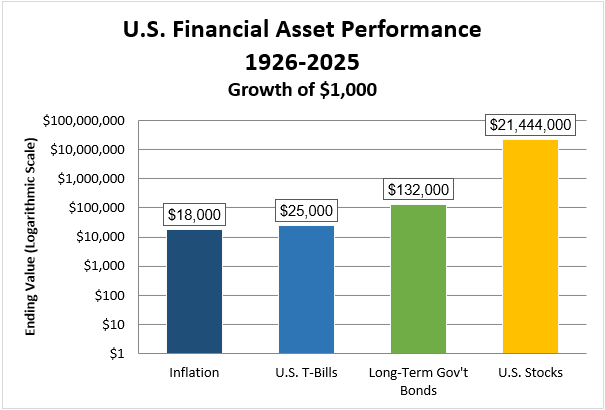
If you invested $1,000 in U.S. large cap stocks at the beginning of 1926, your portfolio would have grown to $21,444,000 by the end of 2025. You read that correctly. If you’re thinking that there’s been lots of inflation over the past century, you’re right. It takes about $18,000 today to match what $1,000 bought a century ago. Still, the purchasing power of the investment grew about 1200-fold, an astonishing feat.
Meanwhile, the same $1,000 invested in long-term U.S. government bonds grew to about $132,000: not bad, but only a tiny fraction of what stocks delivered. The same amount invested in U.S. Treasury bills grew to about $25,000, only modestly ahead of inflation.
Return and Risk
Stock prices fluctuate in response to corporate earnings, economic growth, interest rates, inflation, shocks like war and pandemic, and more. In contrast, high-quality bond prices are far less volatile. Financial theory argues that as compensation for accepting a much bumpier ride, stock investors should earn greater returns in the long term. The SBBI data bears this out. The compound annual growth rates of stocks and bonds over the last century were 10.5% and 5.0%, respectively. The extra 5.5% in annual return from stocks translated into 162 times more money after 100 years, a testament to the wonders of long-term compounding.
But before loading up on stocks, consider their risks. Since 1926, stock investors have endured all sorts of unpleasantness, ranging from overnight crashes to multi-year bear markets to decade-plus stretches of poor returns. The S&P 500 plunged 20.5% in the October 1987 “Black Monday” crash and later experienced prolonged downturns of 49% in the 2000-2002 “Dot-Com Bust” and 57% in the 2007-2009 “Great Financial Crisis.” For the 1966-1981 period, almost a full generation, U.S. stocks failed even to match inflation.
Hazardous Extrapolation
For newer investors, these cautionary tales probably seem like ancient history, making the idea of a bear market something of an abstraction. And with the U.S. stock market mostly soaring over the past 17 years, even veteran investors have dimming memories of bygone traumas.
Against this backdrop, some investment industry voices are calling for very aggressive long-term portfolio allocations (e.g., 90% stocks, 10% bonds/cash), pointing to stocks’ massive performance edge over the last century. Proponents of these high-octane portfolios commonly cite comforting statistics drawn from SBBI data, for example, that stocks have beaten bonds in more than 90% of all 20-year periods in the last century. The implication is that long-term investors can ignore shorter-term fluctuations in portfolio value.
Here's the rub. In my experience, very few investors can tolerate a rapid 40%-50% drop in their portfolio value, something a 90-10 investor would already have experienced twice since 2000. Investors who take on more risk than they can stomach invariably slash their stock holdings after a substantial market decline, locking in losses and limiting gains in subsequent market recovery. The 90-10 mix might have worked for Rip Van Winkle (who took a 20-year nap), but real-life investors must have portfolios they can live with in the short term if they are to benefit from stocks’ long-term higher expected returns.
One More Big Caveat
On one hand, SBBI is a big data set, the kind financial analysts love, with more than 1,200 monthly data points across multiple assets. On the other hand, it covers just a single century in a single country whose markets survived and thrived. Not all countries were so fortunate. Germany and Japan saw their stock markets go to zero in the wake of World War II. The SBBI data on U.S. markets shows just one of many possible outcomes.
Historical investment returns are like history books: instructive, but not necessarily predictive. Facing an uncertain future, an investor’s best tools are diversification, attention to risk, and a measure of cautious optimism. Investors who can absorb the lessons of SBBI, without mistaking past returns for a guarantee, will be better prepared for whatever the coming century brings.
Donald Gould is president and chief investment officer of Gould Asset Management of Claremont.Don is a recurring guest columnist for the Courier, providing his unique insights and observations on matters of money, investing, and personal finance.
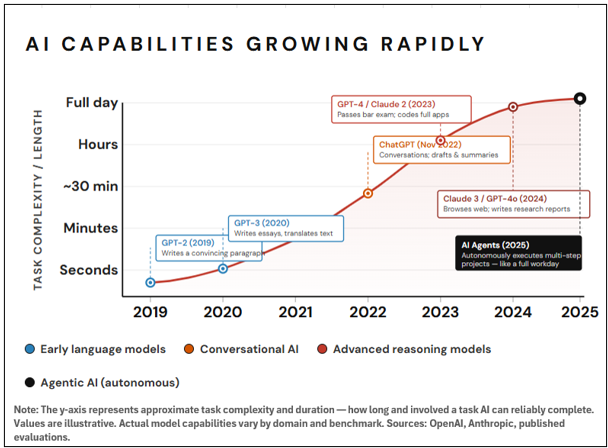
If you love trains, you understand the big difference between knowing a train is due soon and actually seeing the massive engine rounding the bend. For months or even years, artificial intelligence experts have told us to prepare for the arrival of an AI that builds ever more powerful versions of itself. Well, now it’s in sight, horn blaring and ground shaking.
Over the past few weeks, leading AI developers Anthropic and OpenAI have each released new versions with computer programming capabilities that veteran software engineers describe as both astonishing and terrifying. The AI can now do software coding at a level comparable to experts with decades of experience. Soon, its capabilities will zoom past that.
Concurrently, we are told that much of the latest AI was built by the AI itself. This so-called “self-recursive” activity implies ever more powerful AI models, released with increasing frequency.
Productivity Up. Unemployment to Follow?
The most immediate impact of these developments is felt by software coders themselves. Suddenly, they are vastly more productive, as AI can now employ an army of virtual agents to quickly do most of the previously laborious coding work. But this same advance might also make many coders redundant. We read stories of Stanford grads with computer science degrees—once a golden ticket to lucrative employment—facing a more difficult entry level job market.
Of course, AI’s impact doesn’t stop with coders. In a world where almost every business is to varying degrees a technology enterprise, the implications are enormous. Over time, as with technological advances dating back at least to the start of the Industrial Revolution, we can expect AI to take over a wide range of tasks currently performed by humans.
The optimistic take on this envisions a future of greater output and wealth, with employees quickly elevating their work to more valuable activities. The more worrisome outlook is that AI advances quicker than the average worker can adapt, leading to high levels of unemployment. Such impact would be most immediately felt in white collar jobs that are mostly performed on a computer. However, in time, AI-enhanced robotics could replace blue collar workers, too.
AI and Your Investments
The stock market is doing its best to digest all the AI news. We see its verdict rendered in the daily movement of stock prices, much of it very volatile of late. Right now, there are many more questions than answers. Here are a few that are top of mind.
The tech giants (Google, Meta, etc.) are pouring hundreds of billions of dollars annually into building datacenters in a sort of AI arms race that many view as winner-take-all. How will they earn a fair return on these massive investments? And what becomes of the losers in this race?
AI can help companies in many ways, including enabling the creation of new products and services, increasing worker productivity, and reducing labor costs. Will these benefits more than offset the potential reduction in consumer demand resulting from an AI that puts people out of work?
It appears that AI can quickly replicate complex software that may have taken thousands of engineers decades to build and refine. Does this mean AI will ultimately bankrupt countless companies whose primary value resides in their proprietary software?
Economist Joseph Schumpeter coined the phrase “creative destruction” to describe the process by which technological advances lay the groundwork for both the introduction of the better mousetrap and the obsolescence of what came before. With AI, it is very possible we will witness creative destruction of a scale and speed well beyond anything ever experienced.
What is an investor to do in the face of all this? It is impossible to know in advance who the winners and losers will be in the brave new world of AI. The possibility that there will be a very small number of big winners and a much larger number of losers makes the task more challenging still.
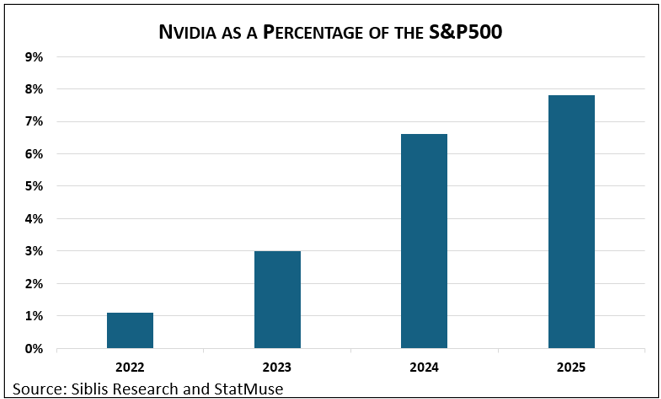
It is wisely said that if you must own the needle in the haystack, you should buy the haystack. Put another way, stay diversified. Index funds—which own the entire market—ensure that you will participate in the growth of the market’s top performers. A prime example is Nvidia, maker of the graphics processors so critical to AI. Its share of the S&P 500 ‘s total value grew from about 1% to well over 7% in just the past three calendar years, which is even more remarkable considering that the index nearly doubled in that timeframe.
It also makes sense to diversify across asset categories, for example, stocks, bonds, real estate, and even perhaps precious metals such as gold. Diversification cannot ensure success. But in the face of AI-fueled rapid change with unpredictable consequences, it might just make failure less likely.
Donald Gould is president and chief investment officer of Gould Asset Management of Claremont.Don is a recurring guest columnist for the Courier, providing his unique insights and observations on matters of money, investing, and personal finance.
How about this for a New Year’s resolution: don’t let anyone steal your money.
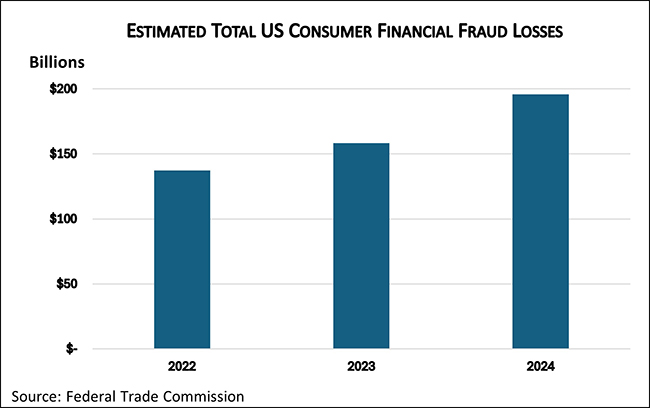
Simple as it sounds, avoiding financial scams gets more challenging by the day. Our electronic financial lives create a bonanza of opportunity for bad actors to separate us from our cash. The scams get ever more clever and sophisticated, with AI opening still new avenues of fraud. The Federal Trade Commission recently released a report estimating that American consumers lost a staggering $196 billion to financial fraud in 2024, a 43% increase in just the previous two years, with older adults losing nearly half the total. If you have been a victim of financial fraud, you are not alone.
A list of dos and don’ts for avoiding scams, while useful, is never quite enough because the landscape of financial fraud is always evolving. I believe a more helpful framework is to understand the psychology of these scams — how they look and feel — so you’ll recognize one when it crosses your path.
The scammer’s secret weapons
Signs that a stranger is trying to steal your money include:
Surprise – You receive a communication (a phone call, an email, a message popping up on your smartphone or tablet, a note on social media, etc.). It usually appears to be from someone authoritative (law enforcement, bank antifraud unit, Microsoft tech support, etc.), but sometimes from someone you know well. Either way, it’s a message you were not expecting when you woke up that morning.
Danger – The communication says you or someone you love is at risk. Your bank account has been compromised. Your grandchild has been arrested and needs bail money. Your computer is infected and exposing you to this or that risk. Your cousin’s passport and cellphone were stolen while traveling abroad and she needs cash to get back home, and so on.
Urgency – You are told time is of the essence. You must act quickly to cure the problem and avoid even greater troubles later.
Secrecy/Paranoia – The scammer implores you not to share this information with anyone. No one can be trusted. Or sharing will embarrass you or someone else.
Combining surprise, danger, urgency, and secrecy is intended to knock you off balance and create a sense of panic—sure ways to compromise your decision making.
Your secret weapon: slow down the process
If you spot any of these signs, the best way to avoid getting scammed is to slow down the entire process. First, just stop the interaction — hang up the phone, end the online chat, don’t reply to the email, ignore the threats. Instead, talk it over with someone you trust. That could be a close friend or relative, or it could be a professional you work with, such as a lawyer, accountant, or financial advisor.
If you find yourself about to do something that you could not have imagined doing when you woke up that morning — for example, buying retail store gift cards, wiring money to a third-party, investing in cryptocurrency, or withdrawing large sums of cash from your bank — again, stop and talk it over with someone you trust.
Consulting with a trusted friend or advisor slows down the process. Your fear and panic subside, you regain your balance, and you’re able to think more clearly. The second set of eyes will help you take a rational approach to addressing the “crisis.” Also, when you bring a second person into the picture, the scammer’s odds of success drop precipitously because now they must fool both you and your friend/advisor.
Taking charge
After regaining your equilibrium, if you still have nagging fears that those urgent warnings might be valid, then take charge of the situation. For example, if you’re worried your bank account might really have been compromised, then independently obtain your bank’s phone number and ask your friend/advisor to do the same. Make sure you get the same number. Then call your bank, explain the situation, and ask if anything is amiss with your account. Or visit a bank branch if convenient.
It is said that a fool and his money are soon parted, but countless unfoolish people daily are the victims of financial theft. With a little preparation, this year you can put the dunce cap on the scammers.
Donald Gould is president and chief investment officer of Gould Asset Management of Claremont.Don is a recurring guest columnist for the Courier, providing his unique insights and observations on matters of money, investing, and personal finance.
Almost from his first days in office, President Trump has been lobbying for lower interest rates. This has taken the form of the president’s consistent criticism of Federal Reserve chairman Jerome Powell for not lowering rates further, even musing about firing Powell before his term expires next year.
Presidents of both parties — from Lyndon Johnson and Richard Nixon to more recent administrations — have expressed frustration when Fed decisions did not align with their economic or political priorities. What makes today’s situation stand out is the unusually public and persistent nature of the criticism, along with open discussion about terminating the Fed chair.
Lower interest rates usually stimulate economic activity by reducing interest expense for all variety of borrowers, from homeowners with mortgages to businesses taking out loans for expansion or acquisitions. Rate cuts can also boost the stock market simply by making cash and bonds less attractive in comparison. And higher stock prices tend to increase spending by households that own stocks, further juicing the economy.
Political strategist James Carville, summing up a key to modern elections, famously said, “it’s the economy, stupid.” With midterm elections only a little more than a year away, President Trump is likely aware of how the economy’s vigor in 2026 might affect the balance of power in Congress.
The Fed, however, has a broader set of priorities. Its dual mandate, established by Congress in 1977, is to promote both maximum employment and stable prices. These two goals often are at odds with one another, and that teeter-totter relationship puts the Fed in a bind right now.
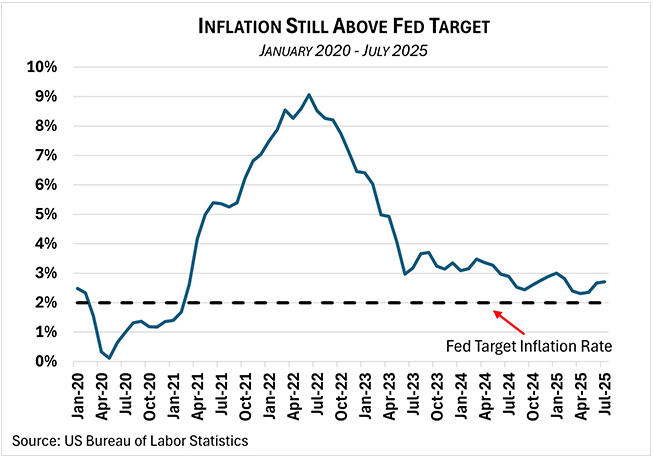
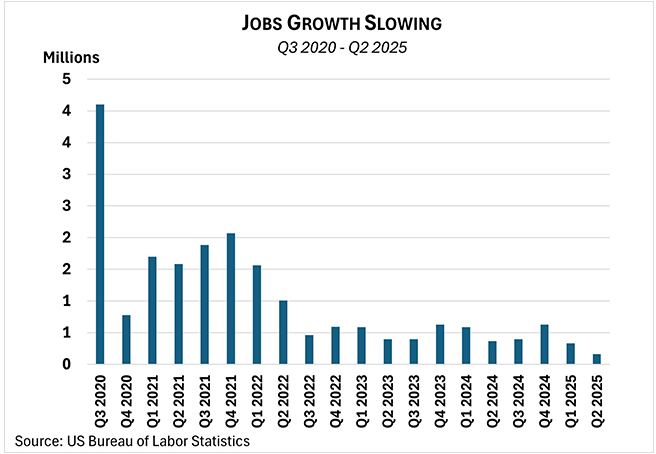
Inflation, though down sharply from its short-lived post-pandemic peak of 9%, is holding stubbornly above the Fed’s 2% target — currently closer to 3%. Arguably, current policies on trade and immigration are also inflationary. Meanwhile, recent jobs reports show significant slowing in new job creation. Despite the inflation risks, it appears likely the Fed will cut rates in its September 17 announcement, giving greater priority to its employment mandate for the moment.
The Fed was established as an independent agency so that political considerations would not drive monetary policy. A Fed heavily influenced by an administration’s short-term political priorities could, in theory, lose sight of its mandate to control inflation. Market watchers both here and abroad have expressed concern that President Trump’s criticism and threatened firing of Fed chair Powell, as well as his recent actual firings of Fed governor Lisa Cook (currently put on hold by a federal judge) and the head of the Bureau of Labor Statistics, threaten the Fed’s actual or perceived independence.
If bond traders — the so-called bond market “vigilantes” — lose faith in the Fed’s independence, interest rates on longer-term bonds could rise despite the Fed cutting short-term rates, as investors demand higher bond yields to compensate for the increased risk of elevated inflation. While the Fed sets short-term rates, which in turn influence long-term rates, ultimately the bond market determines interest rates on longer-term obligations.
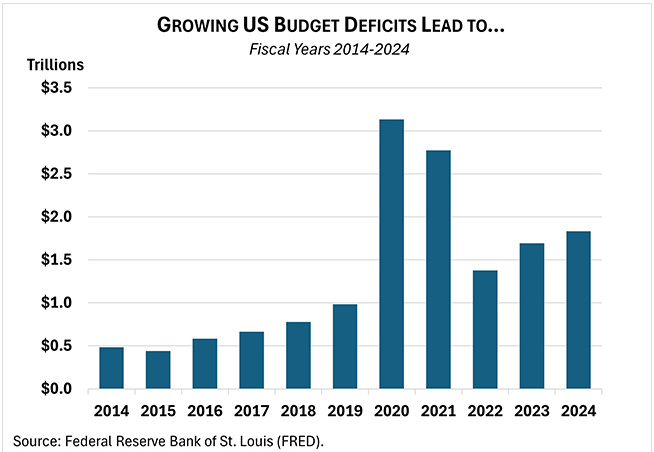
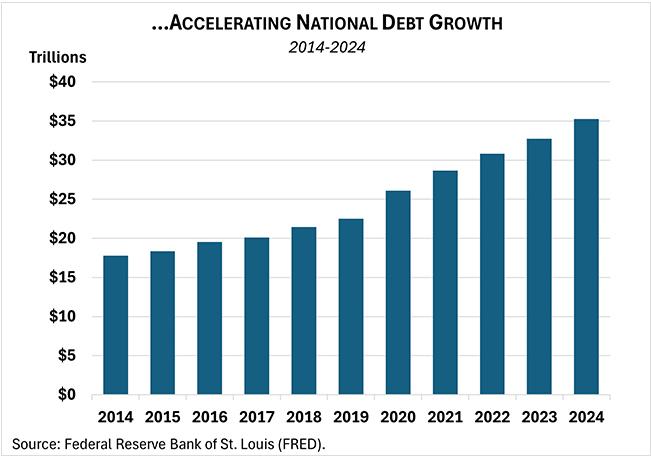
The other big worry surrounding long-term interest rates is America’s burgeoning national debt. The U.S. runs a large annual budget deficit, currently projected at nearly $2 trillion for fiscal year 2025. The U.S. Treasury must borrow that amount to pay the government’s bills, adding to an existing debt pile of about $37 trillion. The problem is that the debt plus the annual interest payments are growing faster than the economy. In a sort of vicious cycle, interest paid on U.S. Treasury debt is now the largest component of the federal budget — larger even than the defense budget — and rapidly rising.
Unless there are major budget cuts and/or tax increases, or the economy grows much faster than it has historically, the Treasury will need to issue ever more debt annually. Other things being equal, a growing supply of new government debt will push longer-term interest rates higher.
And yet … bond and stock market investors have so far largely shown little concern. The yield on the benchmark 10-year Treasury has fallen from 4.8% to near 4.0% since January, and the U.S. stock market is near record highs. Are markets whistling past the graveyard? Or is a new and brighter economy around the corner? Stay tuned.
Donald Gould is president and chief investment officer of Gould Asset Management of Claremont.
This is the third in a three-part series of reflections on changes in the investment industry in the 25 years since I started Gould Asset Management in Claremont.
Perhaps the most important trait an investor can have is humility, a lesson I’ve been taught repeatedly over the past quarter century. The good news is that if you don’t have humility yet, markets will eventually provide it to you free of charge, except for the hole in your month-end brokerage statement. With humility comes respect for markets, even when you disagree with their verdict.
The Wisdom (and Madness) of Crowds
In his excellent book, The Wisdom of Crowds, James Surowiecki demonstrates that a large group of non-experts, on average, arrives at more accurate estimates than even the most informed expert. Market prices represent the weighted average opinion of a very large crowd at any moment in time, so market “experts” who ignore prices do so at their peril.
Of course, crowds can also be spectacularly wrong. Another investment classic, Charles Mackay’s Extraordinary Popular Delusions and the Madness of Crowds, documents how mass psychology can drive up prices to ridiculous extremes. A famous example is the Dutch tulip mania of 1634-1637. At its height, a single bulb cost more than ten times the annual earnings of a skilled artisan.1
I’ve been thinking about the market crowd even more than usual of late. In the 100+ days since the inauguration, the new administration in Washington has shattered more norms more rapidly than almost anyone might have imagined. However one feels about this, these actions raise important questions for investors. Here are a few of mine.
Some Questions for the Markets…
Immigration. President Trump has pledged to deport more than ten million unauthorized immigrants. Will his plan succeed and, if so, will the workforce shrink, or will citizens fill the gap? And if there are fewer workers, how will that affect labor costs and the inflation rate?
Trade. The president in early April imposed higher tariff rates on scores of countries, notably a 145% rate on imports from China and a 25% rate for Canada and Mexico. A month later, most of the tariffs are on hold, and the China tariff has been temporarily scaled back to 30%, though tariffs remain well above their pre-April levels. Tariffs act as a tax on consumers and businesses, reducing economic activity and raising prices at the same time. Will tariffs, as the president asserts, lead to a resurgence in US manufacturing and raise revenue that will permit tax cuts? Or will tariffs push the US and the world into recession? Or both? And how soon?
Foreign Relations. The past three months have seen some cooling of US relations with traditional allies here in North America and across the Atlantic. Administration actions have raised questions about the longstanding US commitment to defend western Europe against potential Russian aggression. Meanwhile, the president’s oft-stated desire to annex Canada and acquire Greenland have caused tensions closer to home. How might these actions affect economic activity between the US, its neighbors, and western Europe? Will new economic and political alliances emerge as a result? Will a less interconnected America be a more prosperous America?
Higher Education. The new administration has launched an ideological battle with many prominent American universities. Harvard is the most notable example, where the government has frozen billions of dollars of federal research funding and threatened other actions unless the school yields to a series of administration demands. Will cutbacks in university research be permanent? If so, how will this affect discovery and innovation in health care, technology, and other areas? Will this change where top researchers choose to work? And how might this affect the technology entrepreneurship that has powered so much of America’s wealth gains in recent decades?
Larger questions, beyond our scope here, would examine the relationships between financial markets, capitalism, democracy, and the rule of law.
…And Some Tentative Answers
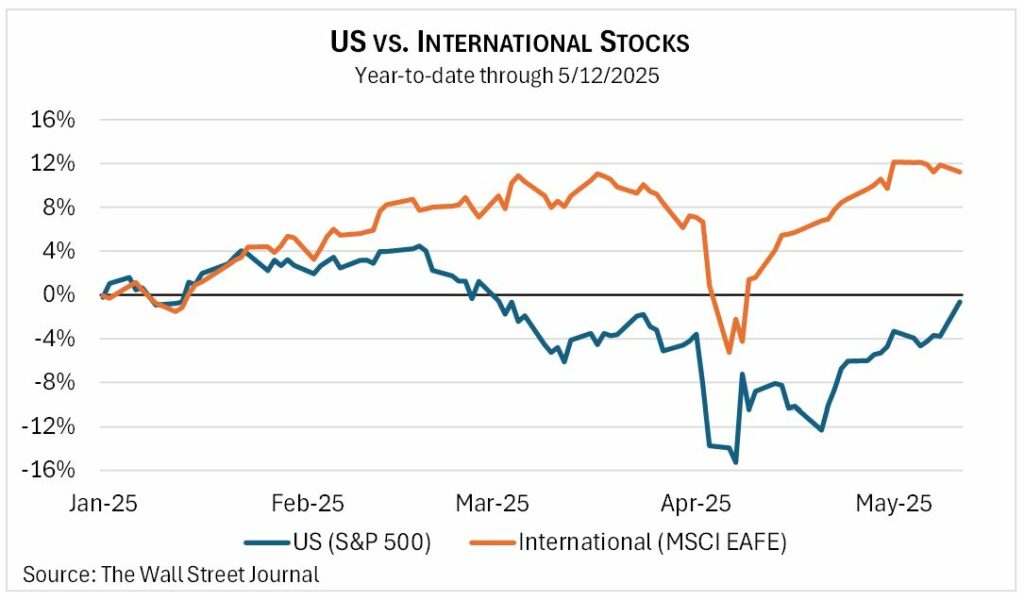
Returning now to the wisdom of the crowd, let’s see how markets might be answering some of these questions. Through May 12, the leading US stock index (the S&P 500) is down about 1% in 2025, though it is up substantially from its initial plunge after tariffs were announced in early April. In contrast, the leading international stock index (MSCI EAFE) is up about 11%, a full 12 percentage points above the US. Fueling the gap is this year’s 6% decline in the US dollar against a basket of foreign currencies. The recent strong relative performance of foreign stocks and currencies runs counter to the most recent 15-year period, during which US stocks and the dollar generally outperformed the rest of the globe.
Explaining market performance is inherently speculative, as we’re trying to read the mind of the crowd, but here goes. In the stock market’s late April recovery, investors might be saying that tariffs will be permanently rolled back to a level that won’t be as damaging as first feared. Meanwhile, strong relative performance of foreign stocks, coupled with dollar weakness, might reflect the view that administration policies more generally will cause US economic interests to suffer.
That’s some of what markets might be telling us today. Tomorrow may be a different story. And even if we could foresee future events, we still would not know with any certainty how markets would respond. So, keep listening to the market’s messages. To paraphrase those clever beer ads, stay humble, my friends—especially when you find the market’s messages most confounding.
Donald Gould is president and chief investment officer of Gould Asset Management of Claremont.