
From the President’s Desk: Thoughts on the Fourth Quarter

From the President’s Desk: Thoughts on the Fourth Quarter

Having penned these quarterly letters for the past two decades, we cannot recall a time as…as…as what? As remarkable? As eventful? As challenging? Take your pick, but let’s just settle on…extraordinary.

America has just concluded a year that defies description. 

The Covid pandemic took hold in late winter and dominated all our lives, tragically so for the more than 375,000 dead and their loved ones. The near miraculous rapid development of effective vaccines gives us hope that life could return to a semblance of normal in a matter of months. But in the meantime, the virus rages on and the daily statistics remain grim.

Over the summer the country was racked with unrest over racial justice, triggered by the police killing of George Floyd in Minneapolis. We still have a long and hard road ahead to realize our aspirations of liberty and justice for all. 

Here in the west, California and other states suffered horrendous and destructive wildfires, further evidence of the dangers posed by climate change. If you happened to be in the San Francisco Bay Area on September 9, you could be excused for thinking that Biblical plagues had descended upon us. The sky took on a surreal dark orange hue that no words can capture. Even at midday, the landscape was dimmer than after sunset on any other day.

The year concluded with the election of a new president, Joe Biden, and a subsequent two-month effort by President Trump to discredit and overturn the result. Congress ultimately confirmed Biden’s election, but not before a mob laid siege to the Capitol in Washington, DC on January 6. 

If 2020 has left you feeling wrung out, you are not alone. We hope 2021 brings consolation, recovery, healing of division, and renewed optimism about our collective future.

Extraordinary Markets, Too

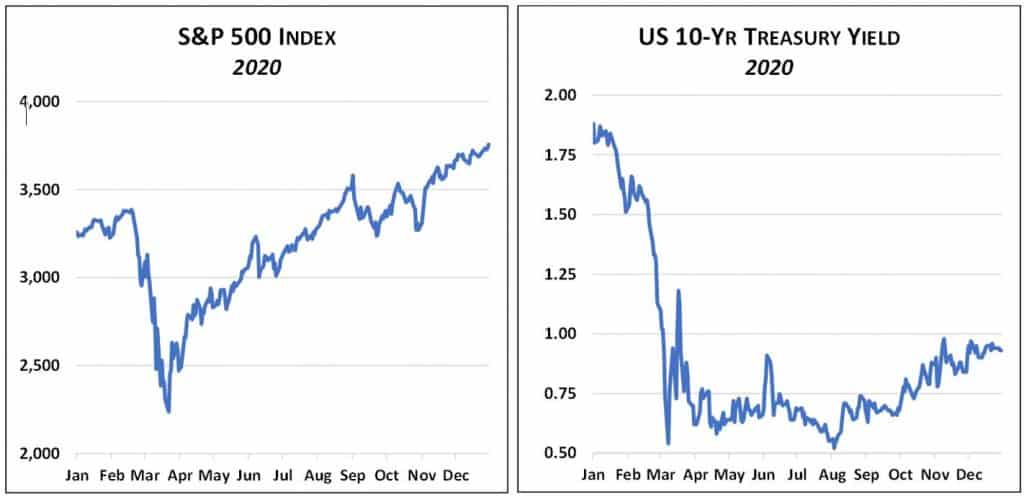
The pandemic triggered one of the steepest—and briefest—bear markets in history in February and March, followed by a mindboggling ascent. The S&P 500 fell 34% in five weeks from its high in February, only to climb 68% from its March low, ending the year at an all-time high. The index returned a remarkable 18.4% for the year, a result that confounds many observers in the face of 2020’s myriad challenges, not least of which is massive business disruption and unemployment that persists to this day. Many factors might explain the historic rebound.

The stock market’s shift from bear to bull market was sparked by massive government relief packages and central bank intervention. Beyond stimulating the economy, a meaningful portion of the pandemic-driven multi-trillion-dollar government infusions made its way into financial markets, pushing up the prices of both stocks and bonds.

While the pandemic did not create the online economy, it greatly accelerated the transition in that direction. In the process, some parts of the economy—think online retailers, videoconferencing providers, and suburban homes—were huge winners, while other parts—shopping malls, airlines, and office towers—were losers. Revenue shifted away from low profit margin, high employment industries in favor of high margin, lighter staffed businesses. To give a stark example, the technology sector accounts for just 2% of total employment, but a whopping 38% of the market value of the S&P 500.

Note that interest rates also plunged with the pandemic’s onset. The 10-year US Treasury yield fell from 1.92% at year-end 2019 to a miniscule 0.54% at one point in March, before ending the year at a still historically low 0.93%. The benchmark Fed Funds rate was cut from about 1.5% to near zero, where it remains today. Recall that other things being equal, lower interest rates push up the price of stocks by reducing the relative attractiveness of alternatives such as bonds.
More recently, the wonderful news about the efficacy of multiple Covid vaccines has helped power the market higher. Most market analysts anticipate a major economic and earnings rebound as the vaccines are rolled out more widely, case counts fall, and life gradually returns to normal. Here’s hoping. 

As we have discussed at more length elsewhere, the stock market is essentially just a machine that estimates the present value of future corporate profits. The market passes no judgment on the size of those profits, the division of the spoils, or even the system of government under which they are achieved. Those are matters of the political realm.

We are left with the incongruous result that we finished 2020 with both a higher stock market and substantially greater misery across the economy in the form of higher unemployment and poverty levels. 

Market Froth – Tesla and Bitcoin

The stock market’s recovery from its March lows included some sure signs of speculative excess. Front and center is the case of Tesla, whose eccentric genius founder Elon Musk is now the world’s wealthiest person, besting even the likes of Amazon’s Jeff Bezos. Tesla began 2020 at $83.67 per share and finished at $705.67, a 743% climb. As this is written in early January, the stock has gone “asymptotic,”[1] that is, rising almost vertically on a chart, now at well over $800 per share. With a market capitalization of almost $800 billion, the market is valuing Tesla at more than $1.5 million per annual vehicle sold. In sharp contrast, GM is valued at less than $10,000 per car. Yes, Tesla is more than a car company, but this still looks like a bubble of major proportions.

Bitcoin, the leading cryptocurrency, is another case in point, having started 2020 at around $7,000 and climbing at an accelerating rate throughout the year, finally going asymptotic in late December and touching $40,000 in the past few days. Putting a value on Bitcoin is even harder than Tesla, but the price increase again is indicative of the fever that overtakes financial assets periodically.
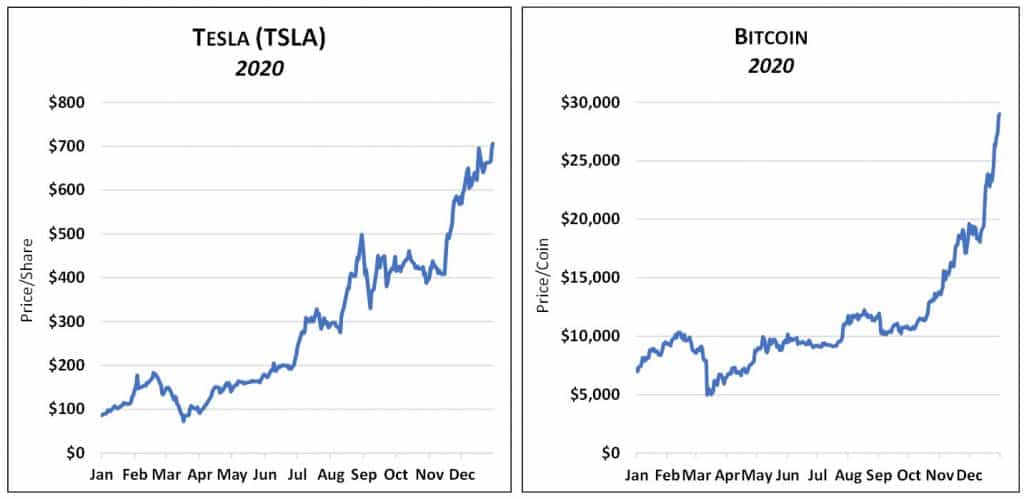
Even broad market benchmarks, fueled by the extraordinary performance of growth stocks, are showing signs of froth. Consider that the S&P 500’s 68% rise from its March lows to year-end compressed six years of average market performance into just nine months.

We sense a connection between the pandemic and the “animal spirits,” as British economist John Maynard Keynes described such investor mania. Lockdowns, smartphone trading applications, and social media have mixed to form a volatile brew.

We are not declaring a generalized market bubble (though some leading thinkers are) and in any case, timing the end of a bubble is impossible. A bubble can grow and grow and grow, deflating only when sentiment shifts. The one defense against a potential market bubble is having the discipline to stick to one’s long-term plan and not let greed or the fear of missing out dominate your thinking. An important form of discipline is periodic portfolio rebalancing, regularly selling some of those assets that have risen the most and allocating the proceeds to those that have lagged. This practice keeps the portfolio from drifting to a higher risk level than intended.


[1] Think way back to your high school geometry course when you learned about parabolas, ellipses, and hyperbolas, the latter of which in some cases rise so steeply that they nearly parallel a vertical line known as the asymptote.

Economic & Market Review: Fourth Quarter 2020

Economic & Market Review: Fourth Quarter 2020

by The Gould Asset Management Team Note: This post is an excerpt from Gould Asset Management’s Economic and Market Review for the Fourth Quarter of 2020. The excerpt is posted here for the benefit of our blog subscribers.

Despite Pandemic, Stocks Finish 2020 on High Note, Capping Extreme Year for US and International Equities

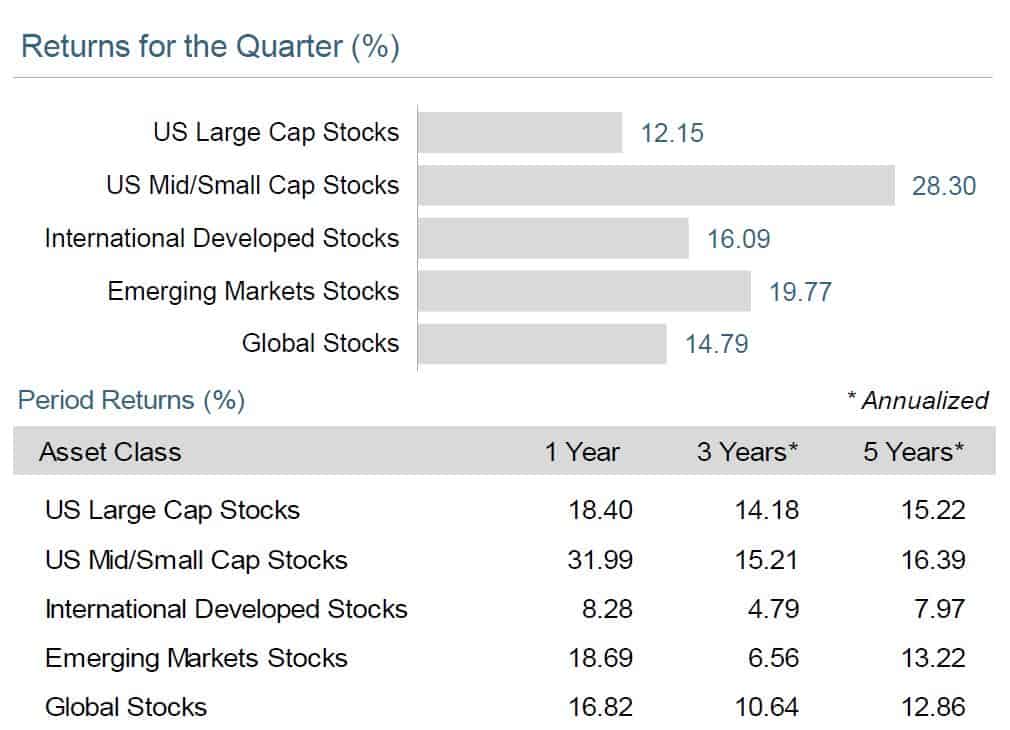
US stocks rose over the course of a newsworthy fourth quarter in which Joe Biden became President-Elect, Covid vaccines came on line, and another round of government stimulus was approved. The quarter ended with the S&P 500 index—a measure of US large cap stock performance—finishing at an all-time high, with the index rising 12.2% on the quarter and 18.4% for
the year, despite a new surge in Covid cases.

The market followed a remarkable path in 2020, with the S&P 500 benchmark tumbling 33.9% at the onset of the pandemic before rocketing 67.9% from its March lows through year-end. It was a reminder of the benefits of “staying the course” and sticking with one’s long-term investment plan, even in the face of a once-in-a-century type disaster.

Mid and small cap US stocks, as measured by the Wilshire 4500 index, had a scintillating fourth quarter, gaining 28.3% and returning 32.0% on the year. It was a surprising come-from behind victory considering large cap stocks (particularly in the tech sector) had dominated headlines throughout most of the year.

The launch of several vaccines kindled hopes of a relatively quick return to economic normalcy. Economically sensitive sectors logged the biggest gains, while defensive sectors posted more modest progress. Financials rose the most (up 23.2%) followed by Industrials (up 15.7%) and Materials (up 14.5%).

International developed stocks outperformed US stocks on the quarter, with the MSCI EAFE index gaining 16.1%, yet still underperformed on the year—rising 8.3% compared to the 18.4% gain by the S&P 500. Investors were relieved the EU and the UK came to some basic terms on a Brexit trade deal after four years of haggling, averting the economically painful “hard Brexit” scenario.

Emerging markets stocks posted their strongest quarterly return in over a decade, rising 19.8% as measured by the MSCI Emerging Markets index. A weak US dollar amplified gains. For the year, emerging markets rose 18.7%, besting developed market stocks (both domestic and foreign) in 2020.

To continue reading, please see our entire Economic and Market Review.

MONEY and INVE$TING: Is Now a Safe Time to Buy Stocks and Bonds?

MONEY and INVE$TING: Is Now a Safe Time to Buy Stocks and Bonds?


by Don Gould

Frequently we encounter a client who has a substantial cash balance and wants to get it invested for the long term, but is unsure about when to enter the financial markets. The cash might be from an inheritance, the sale of a home or business, or simply accumulated savings. For many, today’s painfully low interest rates create more urgency to seek investments with better returns. At the same time, with stock and bond markets at all-time highs, investing right now can seem daunting.

Is now a safe time to buy stocks and bonds? The question reminds us of the famous lines from Mark Twain’s Pudd’nhead Wilson: “October: This is one of the peculiarly dangerous months to speculate in stocks. The others are July, January, September, April, November, May, March, June, December, August and February.”

Twain had it right—markets are inherently unpredictable in the short run. That’s what makes the entry decision agonizing. We see two primary approaches to solving the problem. Which one is best depends on the psychology of the individual investor.

Approach 1: Invest It All and Don’t Look Back

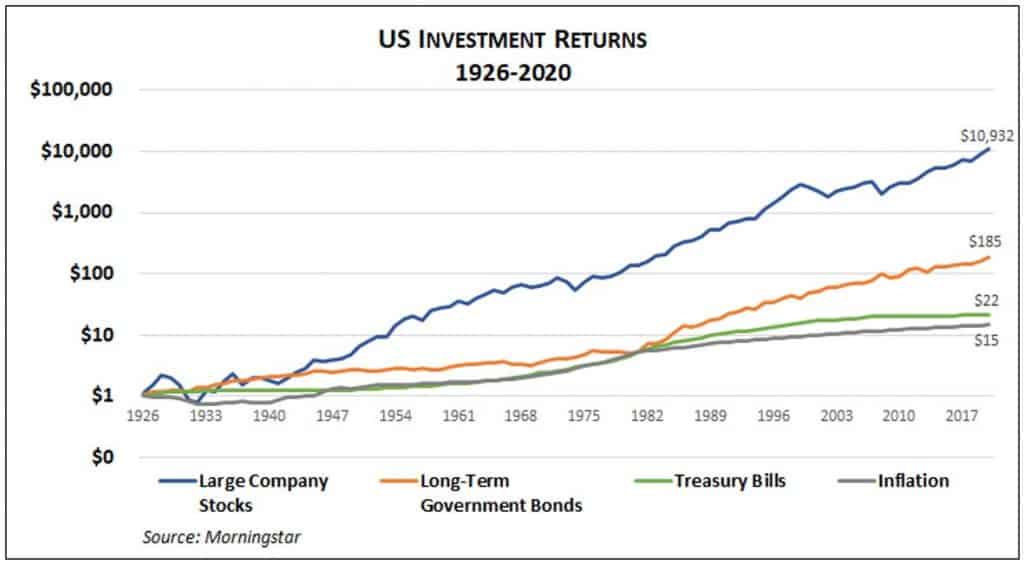
Stocks and bonds unquestionably have higher long-term expected rates of return than cash. This is the compensation investors expect for accepting the greater variability of these assets’ returns, as compared to cash. From 1926-2020, one dollar invested in US large cap stocks grew to a whopping 496 times the accumulated value of the same dollar invested in interest-bearing cash instruments. Even a US bond portfolio would have reached an end value more than eight times higher than cash.


Like Twain, we take as a given that no one knows the near-term direction of financial markets. Deferring entry in hopes of buying at a lower price later might—through dumb luck—result in better performance, but cannot be expected to improve performance. In fact, the opposite is true. Because the long-term trend of risk assets (stocks and bonds) is upward, deferral of implementation only delays the investor’s participation in these assets’ superior long-term trend.

Putting off investing now with the aim of getting a better deal down the road is itself an investment decision. The investor has passively decided to own cash, the asset with both the lowest risk and lowest expected return.

If you decide to play the odds and invest the whole amount at one time, we advise the following: (1) determine your investment strategy and asset allocation across stocks, bonds, cash, and other assets, taking into account both your objectives and tolerance for risk; (2) put the whole amount to work; and, (3) don’t look back.

However, investing it all and then not looking back may be more easily said than done, and it is not necessarily the right course for everyone.

Approach 2: Staged Implementation Over Time

While Approach 1 may be best from a “textbook” standpoint, investing a large sum all at once is emotionally challenging, not least because you will doubtless be second-guessed by yourself and maybe others if markets drop following your investment.

The saying, hindsight is 20/20, is particularly apt when it comes to investing. With the benefit of hindsight, right decisions seem obvious. At the time of the decision, however, things are never obvious. At any moment in time, market prices represent the weighted average of all investor views, meaning that some investors think prices are about right (or have no opinion), while the rest are split roughly evenly between those who think assets are “expensive” and those who see them as “cheap.”

Extending Twain’s observation, the market can easily nosedive right after a full implementation, making the move feel in retrospect like an imprudent plunge. If this worry predominates, then we recommend the client invest the portfolio in stages, at predetermined intervals. For example, a cash balance could be invested in four equal 25% portions over four calendar quarters. This reduces the risk of investing the whole portfolio at a recent market high, or more to the point, it reduces the risk of future regret over a “bad” timing decision.

By determining both the schedule and the dollar amount of each phase at the outset, the investor also avoids market timing, an impossible and hazardous pursuit.

As with so many investment questions, the answer to whether to invest a large sum all at once or in stages is, it depends. Consider your temperament and how you weigh the probability of a better outcome against the risk of near-term regret. And then, as Nike says, just do it!

Don Gould is president and chief investment officer of Gould Asset Management.