This is the second in a three-part series of reflections on changes in the investment industry in the 25 years since I started Gould Asset Management in Claremont.
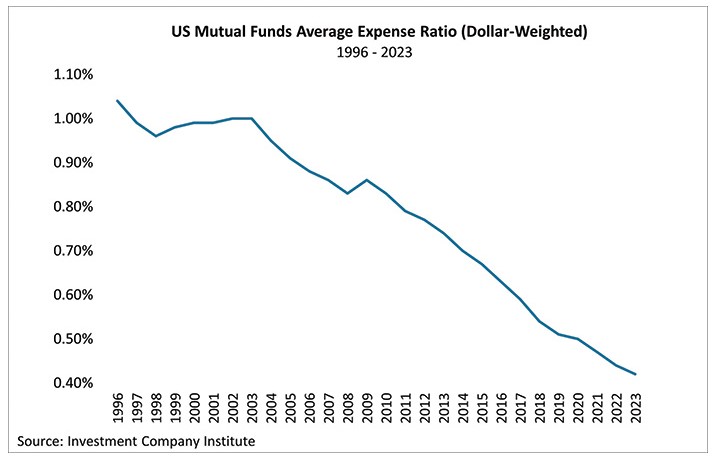
In part one of this series, I described how core investment products such as mutual funds have become commoditized in recent decades, leading to ever lower fees and profits for fund management companies, but commensurately higher returns for their investor clients.
Of course, the Wall Street empire wasn’t going to let disappearing mutual fund profit margins go unanswered. To replace those lost profits, big financial firms have increasingly turned to more complex and less liquid investment products that can command higher fees. These include private equity and private debt funds, which invest in the securities of companies that do not trade on public markets, real estate funds, and so-called “hedge funds” that pursue esoteric trading strategies.
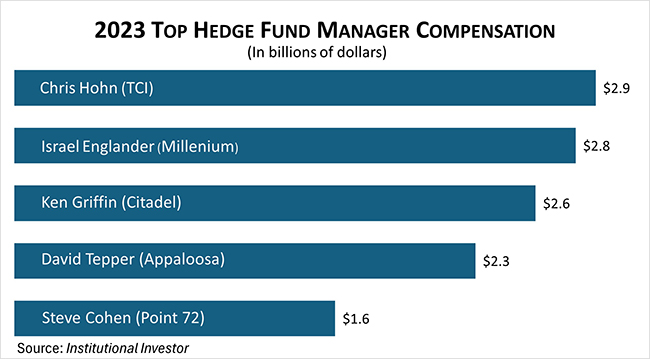
Some of these products are fabulously expensive, which is why you may have read about some hedge fund managers pulling down billions of dollars in annual compensation. It reminds me of the old joke about the tourists visiting lower Manhattan. Their guide points out one financier’s yacht after another. Finally, one rube asks, “Where are the customers’ yachts?”
Enter the index fund:investments get commoditized
The higher the fees on a product, the more skeptical you should be about the value you’ll receive. It is common for private equity and hedge funds to charge a base annual fee of 2% of assets, plus 20% of any profits. These fund managers argue that getting a cut of fund profits gives them an incentive to generate the biggest possible profits for investors.
A more cynical take: this is a one-sided bet squarely in the manager’s favor, not the client’s. If the fund performs great, the manager does extremely well, and the client perhaps does well enough. If instead the fund performs badly, the investor shoulders all the losses.
Don’t get me wrong: these products have their place in a diversified portfolio, but it’s always important to keep an eye on costs. Often, the costs are too high to justify the potential benefits. And sometimes a similar investment can be found in a liquid form at a lower cost.
Innovations: a mixed bag
One of the more useful financial product innovations of recent years are funds whose returns are not highly correlated with either the stock or bond markets. A portfolio reduces risk by including components that don’t all move in the same direction at the same time. That’s the point of diversification.
An example of such a product is catastrophe bonds. (Granted, not the most inviting name for an investment.) These bonds are sold by property-casualty insurance companies looking to off-load some of their risk exposure from, say, an extraordinary major hurricane. “Cat” bonds chalk up steady returns in most years, but face substantial losses in the event of a Hurricane Katrina type event. The timing of natural disasters generally has very little correlation with the economy or financial markets, so purchased in proper quantities, catastrophe bonds can be a good portfolio diversifier.
Another innovation is the so-called “structured note,” an investment product whose return and risk characteristics are very different from an ordinary stock or bond. Large banks and brokerage firms use complex quantitative techniques to engineer these unnatural investments into being and sell them to the investing public. The notes usually offer a deal that sounds attractive, but no amount of financial wizardry can improve the fundamental tradeoff between risk and return.
As an example, a structured note might have a three-year term, over which it pays you the gain of the S&P 500 stock index (if the market goes up), up to a maximum of 25%, and protects you against the first 20% loss on the index (if the market goes down). It’s clear you are giving up some upside return potential for some downside protection, but even very sophisticated investors cannot evaluate whether this is a fair deal. Similarly, it’s nearly impossible to measure the underlying expense the sponsor has built in as compensation for structuring the product. All are reasons to steer clear.
I’ll conclude with an innovation that seems positive for investors, but is at best a mixed blessing. About 10 years ago, upstart broker Robinhood began offering zero-commission stock trading. Eventually, this forced larger competitors like Charles Schwab to follow suit. To make up for lost commission revenue, Schwab now sweeps clients’ idle cash balances into a bank deposit that today pays 0.20% at a time when Schwab’s own money market funds are paying about 4.70%. The spread between the two generates billions of dollars of annual revenue for Schwab, reducing their customers’ returns dollar for dollar.
With every innovation that works to investors’ favor, it seems that the Wall Street empire finds a new way to regain its profits. Stay nimble, and may the force be with you.
Next up is Part III: lessons learned over the past 25 years.
Don Gould is president and chief investment officer of Gould Asset Management of Claremont.
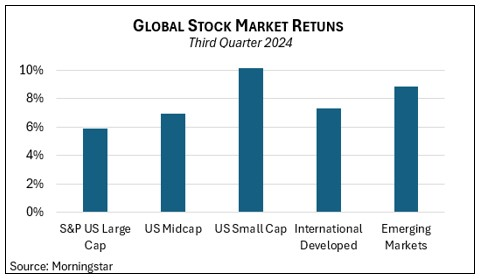
Global stock markets vaulted upward yet again in the third quarter. The S&P 500 US large cap benchmark returned almost 6% and, for a change, US midcap and small cap, international developed, and emerging markets stocks did even better. The S&P 500 closed the quarter up about 22% year to date, matching its 2023 return and bringing its return since the start of last year to nearly 50%. This works out to a 25.5% compound annual rate of return over the last 21 months, which is great but also unsustainable. Over the past century, the US market has averaged just north of 10% per year, a number that many consider optimistic today, with stocks expensive by historical standards.
In September, the Federal Reserve made its long-awaited easing, a hefty 0.50% reduction in short-term interest rates. Combined with continued steady growth in both the economy and corporate profits, investors celebrated by bidding up stock prices worldwide. The S&P 500 and the venerable Dow Jones Industrial Average both hit record highs in September.
Bonds joined the party in the third quarter, with the main US bond index leaping just over 5% and nearly matching the S&P 500. (Declining interest rates push up the price of existing bonds.) The result was a heady quarter for investors across the risk spectrum, with both stocks and bonds shining. For a fuller discussion of the past quarter, be sure to see our Economic and Market Review that accompanies this letter.
Keeping Our Heads
Normally this phrase (from Kipling’s famous poem “If”) refers to difficult times and the challenge of maintaining one’s equilibrium amid turbulence. But for investors, we think the concept equally applies to the best of times, which describes the stock market for most of the last fifteen years and especially 2023 and 2024.
When stocks race higher, there is a natural tendency to expect the trend to continue. It goes against our gut to sell stocks in a rising market. If anything, the apparent uptrend makes investors want to allocate more to stocks. This is the “greed” half of the fear-and-greed cycle.
To keep our heads (and yours), we regularly rebalance portfolios, selling some of the assets that have risen most (lately, that’s stocks), bringing the asset allocation back within a range that reflects our understanding of the client’s tolerance for risk. This discipline is important. When the inevitable market downturn arrives, we want clients in a position that enables them to ride out the storm, rather than having to abandon ship because their portfolio inadvertently became too risky.
Note: This post is an excerpt from Gould Asset Management’s Economic and Market Review for the Third Quarter of 2024. The excerpt is posted here for the benefit of our blog subscribers.
US Consumers Continue Spending, Employers Continue Hiring
US Consumers Continue Spending, Employers Continue Hiring
The US economy accelerated in the second quarter, driven by strong consumer spending. GDP grew at a 3.0% annualized rate in April through June, nearly double its first quarter pace.
The unemployment rate ticked down to 4.1% in September, as employers added over 250,000 jobs last month, the most since March.
Manufacturing activity remained subdued all summer, with weak demand and a slump in hiring. In a sign of potential rebound for the sector, though, new orders increased last month, and input prices fell to a nine-month low.
US home sales fell in August despite the recent decline in mortgage rates. Existing home sales declined 4.1% from a year ago, while the median sale price is up 3.1% over the same period.
Interest Rate Cuts are Here
The Federal Reserve opted for a bold start to its monetary easing, reducing the fed funds rate by 0.50% to a range of 4.75% to 5.00%, its first rate cut since 2020. Fed Chair Jerome Powell stressed that the more aggressive cut is not indicative of a less favorable economic outlook, but rather a decision to support the labor market.
Mr. Powell cautioned that the 0.50% rate cut does not imply a similarly rapid pace of rate cuts going forward. The Fed’s latest forecast shows two additional 0.25% rate cuts this year, aligning with current market expectations. In 2025, the Fed expects to reduce the federal funds rate by another 1.00%.
The Fed’s updated projections also show a slightly weaker labor market in the next year plus, raising their year-end 2024 unemployment forecast from 4.0% to 4.4%, where they expect it to remain through 2025.
The following is a recap of Don Gould’s remarks to clients at our 25th anniversary client appreciation event at The Huntington on September 30, 2024.
Dear Clients,
It seems that a 25th company anniversary calls for some reflections, so here goes.
First, my thanks to the whole Gould team, from Portfolio Management to Service to Administration. As you know from your interactions with us, it’s an amazing team that always puts service to our clients first. I am so proud of the workplace we have built. It’s a place where we can know each of our clients in a close and personal way, and where our clients—you—can look for trusted advice and excellence in the management of your financial assets. It’s a place where we can see our work meaningfully improving your lives. It’s also a workplace where everyone likes one another, likes their work, and works together as a team, all while promoting a healthy work-life balance.
For most of the 1990s, I was a “big shot” at one of the world’s largest asset managers. I jetted around the world, had a prestigious business card, and regularly rubbed elbows with the famous, powerful, and very wealthy. It was heady stuff. One day I gave it all up to start Gould Asset Management in a one-room office above Goldstein Optometry on Indian Hill Boulevard in bucolic little Claremont. What motivated me to make such a move?
We live in a culture that tends to worship growth and bigness. Bigger is different, but not necessarily better. When I was in a big company, I found that the higher up you are on the ladder, the more removed you are from the people your business is supposed to be serving. You spend most of your time negotiating deals with other businesspeople, and you tend to focus on keeping the people above you happy rather than the company’s clients.
I once read a book titled “Small Is Beautiful: Economics as if People Mattered” by E. F. Schumacher. I took the title to heart and believe it contains an essential truth about business and human relations. Starting Gould Asset Management was about getting back to smallness. We are, at heart, a small and personal company. Not by accident, we are based in Claremont, a small town where people know each other, are involved in the community, and work together toward the collective good. We are proud that Gould is a strong and consistent contributor to that effort.
Now, obviously, this small company has grown. From one person to fourteen, serving well over 300 households and nonprofit organizations, with about $950 million in assets under management. So, you may be thinking, how does this growing company stay small? I think that is both our great accomplishment and our ongoing commitment to you, our clients. We have retained the culture and essence of a small and personal business, and we will strive to maintain that no matter how much we may grow by the numbers.
How will we do that? First, by always making service to our existing clients our top priority; we will never sacrifice quality of service for the sake of growth. Second, by keeping our independence. That starts with running our own show—our company is majority-owned and 100% controlled by the people who work here. That means we are not beholden to some large, remote organization telling us how to manage our clients’ portfolios. Independence means we can think independently on your behalf, and we believe this leads to better outcomes. At Gould, there’s only one client and it’s you.
Finally, none of this happens without you, our clients. On behalf of the whole Gould team, thank you from the bottom of our hearts for allowing us to serve you for the last 25 years. To the next 25!
Twenty-five years ago, I started Gould Asset Management in a small office above what was then Goldstein Optometry, on the east side of Indian Hill Boulevard between First and Second streets. The occasion of our silver anniversary prompted me to reflect on the major changes I’ve witnessed in the investment world since 1999. This is the first in a series looking back at major developments over the last quarter century, and lessons learned.
The Vanguard effect: driving down fund costs
Among the most important financial services industry trends of the last quarter century is the steady decline in the cost of core investment products such as mutual funds. It all began with Vanguard, the mutual fund behemoth launched in the 1970s. Unlike for-profit fund companies, Vanguard’s management company is indirectly owned by its customers, the investors in its funds. Consequently, Vanguard charges only enough management fees to cover its costs, with no profit margin added on, leading to lower fund expenses than most competitors.
This cost edge has given Vanguard funds a lasting performance advantage, enabling Vanguard to grow faster than its competitors. As a fund grows, its fixed costs are spread over a larger base, leading to still lower fund expenses per dollar invested, a larger performance advantage, and yet bigger funds — a virtuous circle.
Thanks to Vanguard, price competition has spread across the entire fund industry, bringing down costs for all investors and effectively shifting hundreds of billions of dollars annually from fund managers to investors. Vanguard’s founder, the late Jack Bogle, arguably has done more for investors than anyone else, ever.
Enter the index fund:investments get commoditized
But the story would not be complete without another Vanguard innovation, the index fund. An index fund simply seeks to replicate the performance of a selected index (such as the S&P 500) by owning all the component stocks of the index in the same proportions as the index.
Index funds have become a commodity — Vanguard’s and Fidelity’s S&P 500 funds are virtually indistinguishable, holding the same stocks in the same proportions. Like soybeans or copper, there is essentially no difference between two index funds following the same index. So, like dueling gas stations on opposite corners, index fund providers must compete on their management fees, which have become vanishingly small. Many index funds charge less than two basis points annually, which equates to under $20 per year on a $100,000 investment.
Historically, mutual funds were promoted with the idea that if you just picked the right fund (which employed the right manager, who picked the right stocks), you would beat the pack. But because the average performance of all investors is, by definition, average, for every stock picker who beats the average, there must be one who trails it. Unlike in mythical Lake Wobegon, all money managers cannot be above average. Compounding the challenge, markets seem to be mostly efficient. That means that a manager who beats the market in one year has only a coin’s toss chance of doing it again the next year.
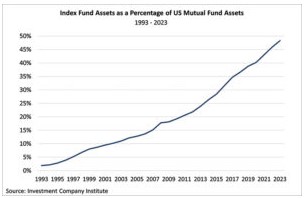
Collectively, non-index funds, aka active funds, perform in line with an index fund (before expenses and taxes), though individual fund performance varies widely. This is true, even if you could find that elusive manager who consistently beats the market.* When we consider the higher expenses of active funds, their collective performance consistently trails the performance of index funds. So, it’s no surprise that index funds have steadily gained market share in recent decades.
A third innovation is the exchange-traded fund, or ETF. The ETF is a special form of a mutual fund that trades continuously throughout the day, like individual stocks. Traditional mutual funds trade only once a day. First launched by State Street Bank in 1993, the ETF is in many ways a better mousetrap than the traditional mutual fund, offering greater liquidity and ease of trading, better tax efficiency, and lower costs. ETFs, which are mostly index funds, have boomed in recent decades and represent the latest chapter in the commoditization of investment products.
In a commoditized world, the biggest players tend to have the lowest prices. Think Amazon and Walmart in retailing. Their counterparts in the ETF world are BlackRock and Vanguard, which together control about two-thirds of the market. Each firm oversees roughly $9 trillion in assets.
The tax savings have a present value of roughly $30 million, recouping part of the contract money he left on the table—and at the expense of California’s tax collector, not the Dodgers.
Next up is, Part II — The empire strikes back: investments get complexified.
Don Gould is president and chief investment officer of Gould Asset Management of Claremont.
How is it already July? Some posit that time seems to accelerate because each successive year represents a smaller fraction of our lifetime. In briefer contexts, the perception of time seems to depend on where you sit. For example, during the recent deciding Game 7 of the National Hockey League’s Stanley Cup Finals, the Florida Panthers led the Edmonton Oilers 2-1 early in the final 20-minute period. The announcer insightfully observed that Edmonton players and coaches likely saw the clock flying by (their time running out), while to the Florida side it seemed to crawl. (Florida outlasted the clock, hanging on to win 2-1 and taking its first-ever championship.)
Another Banner Quarter for Stocks
Time moves briskly for investors when stock indexes are surging upward as they have in 2024, and while the pace of the rise moderated in the second quarter, equity markets still did well. The leading global benchmark added about 3%, taking its year-to-date gain to nearly 12%. Meanwhile, the S&P 500 US large cap index did better still as the usual tech giants fueled a 4.3% second quarter rise, bringing the year-to-date return to a heady 15.3%. Since the 2022 financial markets debacle, the S&P 500 is up a remarkable 45.6%
Bond returns remained lackluster in the second quarter, as interest income mostly offset modest bond price declines. But stellar stock market returns were enough for balanced portfolios to deliver solid returns in the second quarter and for 2024 year-to-date.
Both stocks and bonds may benefit from newfound, if cautious, optimism that the economy will achieve a soft landing, bringing inflation back toward central bank targets without a near-term recession. For a more detailed discussion on the economy and financial markets, be sure to see our accompanying quarterly Economic and Market Review.
Curbing Our Enthusiasm
To put recent equity market returns in perspective, US stocks have compounded at an average rate of about 10% per year over the past century, so we’ve seen about four years’ worth of normal returns in just the past 18 months. As usual, we have no crystal ball—returns over the next 3, 6, or 12 months could fall anywhere on the map. But common sense tells us that in an economy growing at its long-term trend rate of about 2% per year (net of inflation), recent equity market returns are not sustainable.
Further tempering our view is that by historical measures, stocks are expensive. What do we mean by “expensive?” We maintain an internal measure that compares how much investors are paying for a dollar of corporate earnings (from stocks) to what they must pay for a dollar of bond interest. As compensation for accepting the much greater volatility of stock markets, we would expect a dollar to buy more earnings than interest. When the spread is narrow, the expected reward for owning stocks is less, and in that situation, we might say stocks are expensive.
By our measure, the S&P 500 is, by a small amount, at its most expensive since at least 1941. Sadly, knowing when stocks are expensive has not been a reliable guide for market timing (and nor has anything else). Stock markets can remain expensive for a long time and continue climbing throughout. And there’s never any guarantee that historical relationships will be the norm in the future. Nonetheless, we believe the risk-reward tradeoff for stocks is less attractive than usual. Accordingly, in the second quarter we modestly trimmed our equity allocations in balanced portfolios. Should the situation persist, we are likely to continue to trim.
We note that valuation is only one of many factors we consider in determining target asset allocations. Even with our recent reduction in equity allocation, we remain slightly above a neutral target stock allocation. And, of course, regular portfolio rebalancing helps ensure that buoyant stock markets don’t leave risk exposures at undesirably high levels.
The Big Get Bigger
The ten largest US stocks now account for 37% of the S&P 500’s total value, their highest level since the 1960s. Just three stocks—Microsoft, Nvidia, and Apple—make up 21% of the index value. As investors, should we be concerned about the rising concentration? The answer is a definite maybe.
Those who worry about growing concentration cite similar periods in market history that ended badly. Some recall the so-called “Nifty 50” from the late 1960s. Xerox , GE, IBM, and Coca-Cola headlined the list of companies to buy and hold forever. The problem with this almost religious devotion to any set of stocks is that investors begin to ignore price. Almost any stock price can be justified—for a time. Eventually, usually after a negative turn in investor sentiment, people begin to scrutinize how much they are paying for an uncertain stream of future earnings. Before long, this buy-and-hold-no-matter-what wisdom is widely (and smugly) regarded as just another chapter in the long history of foolish speculative manias. Such was the fate of the Nifty 50.
Arguing the other side are those who say that this time is different. Today’s market leaders are viewed as quasi-monopolies that have already won a winner-take-all game. The omnipresence of Microsoft software, Apple iPhones, and Nvidia chips (reportedly an 80+% share of the AI chip market) makes this a compelling argument.
Absent the crystal ball, it’s impossible to know which side will prevail. Fortunately, you don’t need to pick sides. Diversification through index funds assures exposure to the market’s leaders. Index funds are often called “passive” because they simply replicate the weightings of a selected benchmark index such as the S&P 500. In fact, indexes (and the funds that follow them) are quite dynamic. Their company weightings change minute to minute based on the relative performance of the component stocks. Additionally, stocks are regularly added to (and removed from) the index based on such factors as a company’s growth (or shrinkage) and company mergers.
Most importantly, the stocks that perform the best make up a growing share of the index over time. If today’s big keep getting bigger, their weight in the index fund will continue to grow. And just as important, when today’s leaders are ultimately supplanted by companies we’ve not yet heard of, the index fund will own those, too.
[1] “Nifty” now seems like such a quaint word.
[2] The younger generations might be shocked to know that baby boomers viewed the first photocopiers with the same kind of wonder now reserved for virtual reality and artificial intelligence.
[3] In case you missed it, our recent webinar on AI touches on the potential rewards and risks of owning Nvidia. You can watch a replay here.