This is the third in a three-part series of reflections on changes in the investment industry in the 25 years since I started Gould Asset Management in Claremont.
Perhaps the most important trait an investor can have is humility, a lesson I’ve been taught repeatedly over the past quarter century. The good news is that if you don’t have humility yet, markets will eventually provide it to you free of charge, except for the hole in your month-end brokerage statement. With humility comes respect for markets, even when you disagree with their verdict.
The Wisdom (and Madness) of Crowds
In his excellent book, The Wisdom of Crowds, James Surowiecki demonstrates that a large group of non-experts, on average, arrives at more accurate estimates than even the most informed expert. Market prices represent the weighted average opinion of a very large crowd at any moment in time, so market “experts” who ignore prices do so at their peril.
Of course, crowds can also be spectacularly wrong. Another investment classic, Charles Mackay’s Extraordinary Popular Delusions and the Madness of Crowds, documents how mass psychology can drive up prices to ridiculous extremes. A famous example is the Dutch tulip mania of 1634-1637. At its height, a single bulb cost more than ten times the annual earnings of a skilled artisan.1
I’ve been thinking about the market crowd even more than usual of late. In the 100+ days since the inauguration, the new administration in Washington has shattered more norms more rapidly than almost anyone might have imagined. However one feels about this, these actions raise important questions for investors. Here are a few of mine.
Some Questions for the Markets…
Immigration. President Trump has pledged to deport more than ten million unauthorized immigrants. Will his plan succeed and, if so, will the workforce shrink, or will citizens fill the gap? And if there are fewer workers, how will that affect labor costs and the inflation rate?
Trade. The president in early April imposed higher tariff rates on scores of countries, notably a 145% rate on imports from China and a 25% rate for Canada and Mexico. A month later, most of the tariffs are on hold, and the China tariff has been temporarily scaled back to 30%, though tariffs remain well above their pre-April levels. Tariffs act as a tax on consumers and businesses, reducing economic activity and raising prices at the same time. Will tariffs, as the president asserts, lead to a resurgence in US manufacturing and raise revenue that will permit tax cuts? Or will tariffs push the US and the world into recession? Or both? And how soon?
Foreign Relations. The past three months have seen some cooling of US relations with traditional allies here in North America and across the Atlantic. Administration actions have raised questions about the longstanding US commitment to defend western Europe against potential Russian aggression. Meanwhile, the president’s oft-stated desire to annex Canada and acquire Greenland have caused tensions closer to home. How might these actions affect economic activity between the US, its neighbors, and western Europe? Will new economic and political alliances emerge as a result? Will a less interconnected America be a more prosperous America?
Higher Education. The new administration has launched an ideological battle with many prominent American universities. Harvard is the most notable example, where the government has frozen billions of dollars of federal research funding and threatened other actions unless the school yields to a series of administration demands. Will cutbacks in university research be permanent? If so, how will this affect discovery and innovation in health care, technology, and other areas? Will this change where top researchers choose to work? And how might this affect the technology entrepreneurship that has powered so much of America’s wealth gains in recent decades?
Larger questions, beyond our scope here, would examine the relationships between financial markets, capitalism, democracy, and the rule of law.
…And Some Tentative Answers
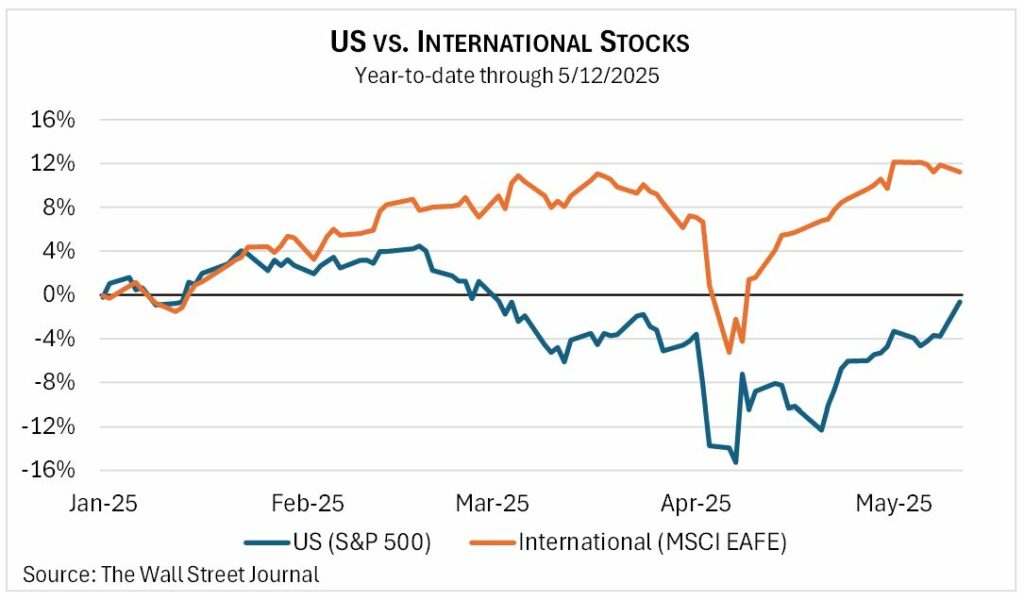
Returning now to the wisdom of the crowd, let’s see how markets might be answering some of these questions. Through May 12, the leading US stock index (the S&P 500) is down about 1% in 2025, though it is up substantially from its initial plunge after tariffs were announced in early April. In contrast, the leading international stock index (MSCI EAFE) is up about 11%, a full 12 percentage points above the US. Fueling the gap is this year’s 6% decline in the US dollar against a basket of foreign currencies. The recent strong relative performance of foreign stocks and currencies runs counter to the most recent 15-year period, during which US stocks and the dollar generally outperformed the rest of the globe.
Explaining market performance is inherently speculative, as we’re trying to read the mind of the crowd, but here goes. In the stock market’s late April recovery, investors might be saying that tariffs will be permanently rolled back to a level that won’t be as damaging as first feared. Meanwhile, strong relative performance of foreign stocks, coupled with dollar weakness, might reflect the view that administration policies more generally will cause US economic interests to suffer.
That’s some of what markets might be telling us today. Tomorrow may be a different story. And even if we could foresee future events, we still would not know with any certainty how markets would respond. So, keep listening to the market’s messages. To paraphrase those clever beer ads, stay humble, my friends—especially when you find the market’s messages most confounding.
Donald Gould is president and chief investment officer of Gould Asset Management of Claremont.
The first quarter of 2025 was unlike any we have experienced. The second Trump administration shattered more norms more rapidly than almost anyone could have imagined. In just over two months we have witnessed the upending of longstanding international alliances through a variety of actions. New tariffs on goods imported from our biggest trading partners, a perceived backtracking of US security guarantees in Europe, and an expressed desire for US annexation of Canada and Greenland are among the headliners. However one may judge these, all will agree we are suddenly living in a changed world, one much different than the post-World War II international order we all grew up with.
Tariffs and Other Storms
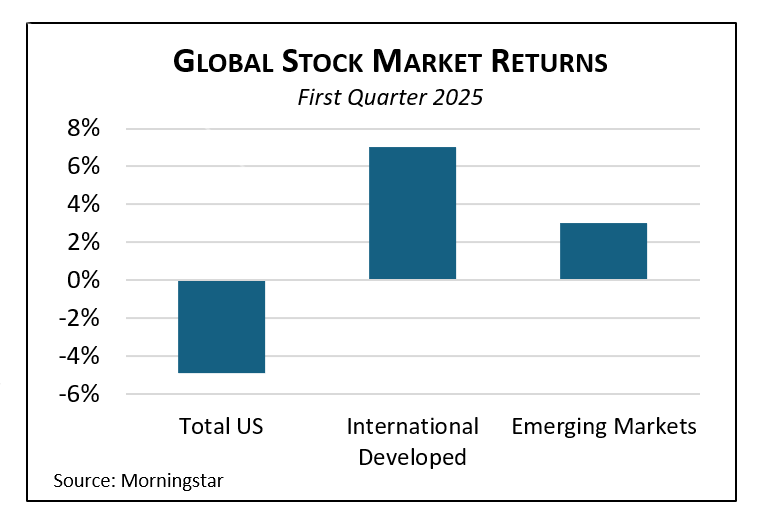
Financial markets reacted negatively, with US stocks substantially underperforming the rest of the globe. The slide accelerated dramatically with President Trump’s April 2nd announcement of unexpectedly large across-the-board tariffs. After dropping 4.3% in the first quarter, the S&P 500 plunged another 10.5% in the two days following the latest tariffs statement. Facing a global stock market rout, a worrisome rise in long-term interest rates, and a weakening US dollar, one week later the president abruptly paused a portion of the tariffs on most countries, and stock markets soared for a day. The US and China remain locked in an escalating trade war, with reciprocal tariffs potentially more than doubling the cost of imports between the two countries.
Tariffs act as a tax on consumers and businesses, reducing economic activity and raising prices at the same time. A slowing economy dents corporate earnings, while higher inflation reduces what investors will pay for those earnings. Both weigh on stock prices. Economists and markets are placing higher odds on a near-term recession in the wake of the new tariffs, though the odds fluctuate with each presidential social media post.
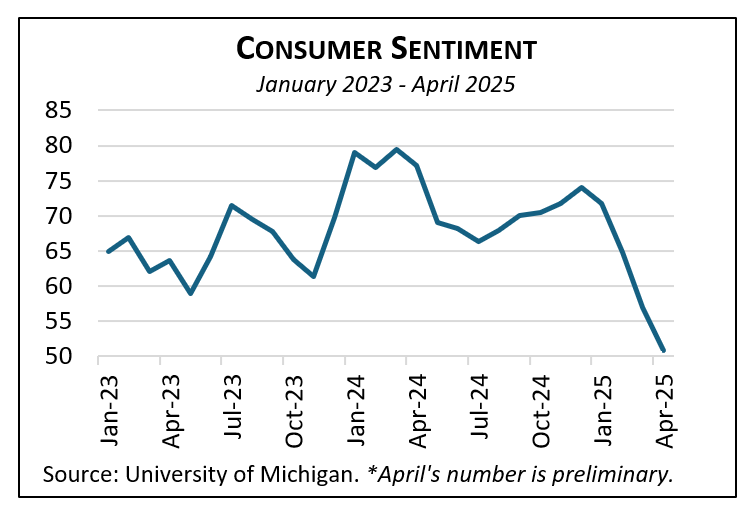
The Fed finds itself in an awkward spot, its hands somewhat tied. The prospect of tariffs challenges both elements of the central bank’s dual mandate of price stability and economic growth. Cutting rates might offset some economic drag from the tariffs, but could worsen the already challenging inflation picture. On balance, recession fears seem to predominate now, with markets now forecasting up to a one percentage point cut in short term rates over the remainder of the year. Well before April’s tariff pinball, consumer sentiment showed a sharp decline in the first quarter.
While our focus understandably is on the financial side of things, we must also acknowledge the unprecedented disruption of the domestic landscape. Multiple US government agencies have been effectively eliminated, while many others are being quickly downsized. Countless new court cases are adjudicating disagreements about the limits of the executive branch’s power within our constitutional system. And there are other shocks to the system too numerous to list. All this has happened less than three months into the new administration’s term. Volatility may be a way of life for some time to come.
Navigating a Whirlwind of Change
We would like to tell you what these tectonic shifts will mean for the world and particularly its financial markets, but there is no road map to consult about the speed and magnitude of change we are experiencing. Investing is about making rational decisions in the face of uncertainty. For us, that means continuing to rely on our investment discipline—principles such as diversification across asset types and regions, asset allocation consistent with client risk tolerance, and periodic portfolio rebalancing.
With great change comes heightened uncertainty about the future and, by extension, elevated investment risk. We are carefully considering the investment implications of the current upheaval and adjusting portfolios as we see appropriate. We are also taking a measured approach. On a boat in a storm, jumping overboard is rarely a sound response.
Note: This post is an excerpt from Gould Asset Management’s Economic and Market Review for the First Quarter of 2025. The excerpt is posted here for the benefit of our blog subscribers.
US Enters 2025 on Uncertain Footing
The US economy expanded at a healthy 2.4% annualized rate in the fourth quarter of 2024, supported by strong consumer spending in the final months of the year. However, first quarter GDP is expected to show a marked slowdown.
The job market looked healthy as of March, before the US announcement of sweeping tariffs. Unemployment ticked up to 4.2% last month, but hiring remained strong. The economy added roughly 152,000 jobs per month in the first quarter, slightly below the 168,000 average for the same period last year. Average hourly earnings grew 3.8% year-over-year in March, cooling a bit from the 4.0% pace in February.
Consumer spending rose 0.4% in February following a drop of 0.3% in January. Spending surged on motor vehicles, furniture, and other durable goods as consumers likely moved up the timing of large purchases to get ahead of looming tariffs. Spending on restaurants and hotels declined as consumers reduced their discretionary expenditures.
US manufacturing activity slipped into contraction territory following two months of expansion. Demand softened and production slowed as input prices surged due to uncertainty surrounding the impact of potential tariffs.
The Fed’s Conundrum
The Federal Reserve held its federal funds rate steady between 4.25% and 4.50% in March, opting for a wait-and-see approach as it assesses the administration’s policy changes on trade, government spending, taxes, and immigration.
The Fed is in a tricky position. New tariffs have raised concerns about a combination of slower growth and rising inflation, a scenario often referred to as stagflation. Fed Chair Jerome Powell noted that economic uncertainty remains high. In its latest projections, the Fed sees growth slowing from 2.1% to 1.7% in 2025, while inflation is expected to rise from 2.5% to 2.8%.
Fed officials projected two 0.25% cuts to the federal funds rate this year, unchanged from their December forecast. This was largely in line with market expectations at the time. However, since the tariff announcements, market participants are now pricing in three to four 0.25% cuts.
Many thanks to those who joined us Tuesday, February 25th, 2025 for Don Gould's live webinar which provided an in-depth update on the current market environment and some of the ongoing challenges facing investors .
Don touched upon quite a few topics which included:
Thanks again to all those who attended. If you have ideas for future topics we should cover or ways we can continue to improve the experience for upcoming broadcasts, please feel free to contact us at contact@gouldasset.com.
We usually kick off this year-end report with a “Happy New Year” greeting. And while we do indeed wish all our clients the very best for 2025, this very young new year has not been a happy one here in our home base of Los Angeles County. Wildfires have destroyed the homes of many clients, business associates, and friends. Others are displaced from their surviving homes for an indefinite period. And virtually everyone in California knows someone severely impacted by the fires. The trauma is both deep and wide. If you have been affected by these terrible fires, please know we are here for you in whatever ways we can help.
A Year of Market Divergences
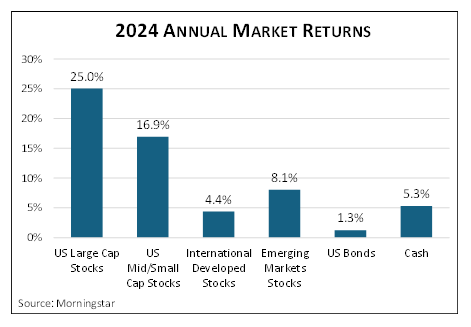
2024 was a good year for most investors despite very mixed performance across asset classes, thanks to another unusually strong year for US large cap stocks. The bellwether S&P 500 returned a whopping 25% last year, leading all major stock categories, so even a moderate allocation there lifted overall portfolio returns. US mid/small cap stocks also did very well, returning nearly 17%, while international developed and emerging markets stocks lagged substantially, gaining only about 4% and 8%, respectively.
Meanwhile, bonds eked out a small gain for the year. Though the Fed cut short-term interest rates, a variety of factors pushed long-term interest rates upward, causing the price of existing bonds to drop. The leading US bond index returned 1.3% , as bond interest income was enough to more than offset price declines.
Lessons for Exuberant Times
The S&P 500’s 25.0% return last year followed a similarly heady 26.3% return in 2023, giving the index its best two-year run since 1997-98 during the nascent internet’s “dot-com” boom. In case you’re wondering, the S&P 500 jumped another 21% in 1999 before peaking in March 2000, from which it shed about half its value in the ensuing 2-1/2 years.
Therein lie lessons. First, we can see that periods of (probably) unsustainably high returns (for example, 20%+/year) tell us very little about what the market will do in the coming year. The 2023-24 party could continue as in 1999, or it could abruptly end as in 2000. The same is true for 2025. Don’t try to time markets.
Second, all booms eventually run out of steam. While the internet was indeed a transformational development, it did not mean infinitely growing profits for businesses benefiting from the new technology. Similarly, AI today offers the possibility of radical change (for better and/or worse), but the combination of competition and finite consumer demand means AI stocks will not become the first proverbial trees to grow to the sky. Don’t get carried away.
We commonly see “recency” bias in how investors evaluate risk. This habit starts early. Company president Don Gould recounts a story from his childhood.
“When I was six years old, the neighbor boy across the street, Walter, invited me over to play with Christmas presents he had just received. Walter’s family had recently moved from Texas to suburban LA, his father a transplanted oil company executive. We were both big fans of the rugged steel Tonka toy trucks, and Walter had struck gold, Santa having delivered the coveted new safari Jeep with its signature candy-striped plastic canopy.
“Walter’s backyard sloped steeply downhill, with a switchback concrete path wending its way through landscaping down to the Rubio Wash, one of LA County’s many flood control channels, at the bottom. Standing at the very top on the back patio, Walter grabbed an older beat-up Tonka jeep of his and gave it a mighty heave down the slope, throwing it like a discus. Miraculously, the jeep landed on the concrete path, squarely on all four tires, unmarred, not unlike an Olympic gymnast “sticking” the landing. Whereupon Walter handed me his new safari jeep and insisted I do the same. Already attuned to concepts of risk and return at that early age, I protested. “You were just lucky with that throw. I’m not gonna throw your new jeep.” Walter would have none of it. The more I resisted, the angrier he got. “It’s MY JEEP and I WANT YOU TO THROW IT DOWN THE HILL!” I suspect my last thought as I let it fly was, yes, it’s your jeep. I’m not sure how or where the safari jeep landed. All I clearly remember is the candy-striped plastic canopy disintegrating upon impact.
“There followed much recrimination, Walter crying over his shattered jeep, me crying over my reluctant role in the disaster, and Walter’s mother Sophie coming out of the house to sort out all the commotion. I pleaded my case, and she wisely sent me home until cooler heads could prevail.”
Walter had understandably concluded from his recent experience that throwing Tonka jeeps was both fun and without much downside risk. Investors often do a similar thing after an extended period of rising stock prices, either underestimating market risk or overestimating their tolerance for the risk.
Investment discipline is the only protection from both our inability to predict the outcome of the market’s next toss and the natural emotions of greed and fear. That discipline includes diversification—today’s winners and losers could quickly swap places—and rebalancing, which helps see that neither bull nor bear markets cause your portfolio to drift away from one that meets your long-term objectives.
What’s Next for Markets
We cannot remember a year-end during which so many have asked our stock market forecast for the coming year. Perhaps it is uncertainty surrounding the change in administration in Washington, but whatever the cause, people seem more curious than usual. We don’t subscribe to the common Wall Street practice of making market forecasts, a futile exercise usually cloaked in a phony aura of expertise and jargon. We have various quips in response to the question of where the market is next headed, such as, “if we knew that, we wouldn’t have to work for a living,” or the more straightforward, “I don’t know."
That said, we can still highlight factors that could help or hurt the stock market in the year ahead. Two stand out. Lower tax rates and lighter regulation—expected outcomes of November’s election results—tend to help corporate profits, a primary driver of stock prices. Many credit this with the stock market’s rise in the first month after the election.
On the converse side, long-term interest rates have moved significantly higher since the election, perhaps indicating concern that we are entering a period of less fiscal restraint, leading to higher deficits, a more rapidly growing national debt, and higher inflation. Higher bond yields are usually (but not always) a drag on stock market performance, and this has been the case for most of December and the first half of January.
The net effect of the two countervailing forces in the ten weeks since the election has been an essentially flat US stock market.
Note: This post is an excerpt from Gould Asset Management’s Economic and Market Review for the Fourth Quarter of 2024. The excerpt is posted here for the benefit of our blog subscribers.
US Stocks Outperform International by Wide Margin in Q4 and 2024
Global stock market performance was mixed in the fourth quarter of 2024, capping off a strong year for many markets. US equities advanced, albeit at a much slower pace than in the first three quarters. Eurozone and Asia markets declined amid concerns over potential new US trade tariffs and political instability in countries like France and Germany.
US large-cap stocks, represented by the S&P 500 index, rose 2.4% in Q4 2024, capping a robust 25.0% gain for the year. After the election, stocks first climbed on expectations of lower taxes and easier regulations, but then gave back gains as those same policy expectations contributed to a jump in long-term interest rates
Consumer Discretionary (up 12.1%) led all US sectors in Q4, finishing the year with a sparkling 26.6% gain on the back of solid consumer spending. Communication Services (up 8.9%) and Technology (up 3.1%) also performed well, and were among the best performing sectors on the year, rising 40.2% and 21.7% respectively. AI was a consistent theme in 2024, driving investor interest and market returns.
US mid and small cap stocks modestly outperformed large caps in Q4, with the Wilshire 4500 stock index rising 4.0% on the period. For the year, US mid and small cap stocks posted strong gains (up 16.9%), but couldn’t keep pace with large caps and the “Magnificent 7” stocks that accounted for more than half of the gains on the S&P 500.
The MSCI EAFE Index fell in Q4 (down 8.1%), finishing 2024 with a modest gain (up 4.4%), impacted by slowdowns in Germany and China, a strong US dollar, and geopolitical uncertainties like potential US trade tariffs. Similarly, the MSCI Emerging Markets Index declined for the quarter (down 7.8%) but rose for the year (up 8.1%), hindered by currency weakness.
Market volatility increased in Q4, due to election uncertainties and policy concerns. The VIX index, a key barometer of market volatility, rose from 16.7 at the start of the quarter to 23.0 around the election, before dropping to 12.7 during a market rally. It later spiked above 28 due to rising bond yields and settled at 17.3 to close 2024.