We hope this note finds you well. 2025’s home stretch is already upon us.
A Dash of AI Makes for a Strange Economic Brew
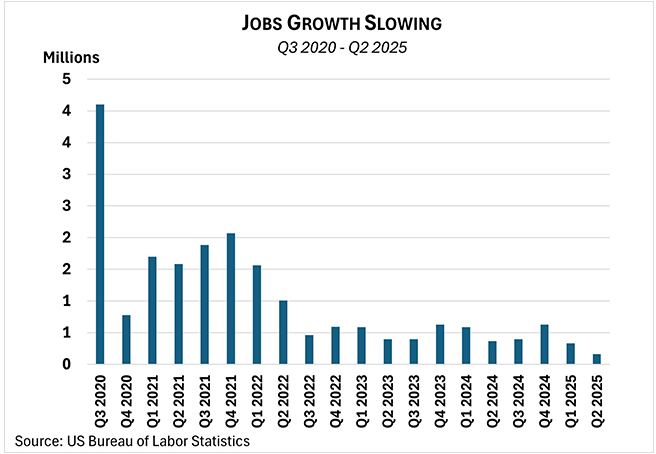
The US economy finds itself in a most unusual place. The normal correlation between economic growth and a vibrant jobs market seemingly has disappeared. By most measures, the US economy is expanding at a healthy clip, even faster than its average 2% real (inflation-adjusted) growth rate of the past quarter century. At the same time, jobs growth has slowed to a trickle, with only 22,000 jobs added in August.
AI (artificial intelligence) might explain some of the disparity, in multiple ways. First, massive spending in AI infrastructure (chips, data centers, power facilities) boosts the economy, even while the long-term return on that investment remains uncertain. Second, AI may be fueling productivity gains (higher output per hour worked), meaning some combination of increased growth and reduced employment. Walmart recently forecasted a flat employee count over the next three years, saying it expects AI to affect “literally every job” at the company.
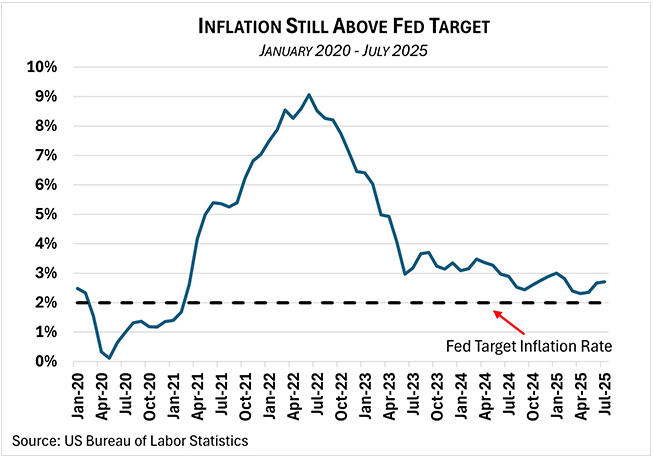
The Federal Reserve last month made its first interest rate cut since the end of 2024, seeing the jobs market challenge as more urgent than subduing inflation, which stubbornly remains above the Fed’s historical 2% target. While lower interest rates tend to stimulate asset prices, it is less clear they will spark jobs growth, especially if AI is the main obstacle to more jobs. We should know the answer soon enough.
Perhaps the current disconnect between economic expansion and employment growth is transitory. Alternatively, it might be the first tangible sign of something AI futurists have long foretold—a world of both rapid economic growth and burgeoning unemployment. Such a world would present significant political and societal challenges.
Notable Market Signposts
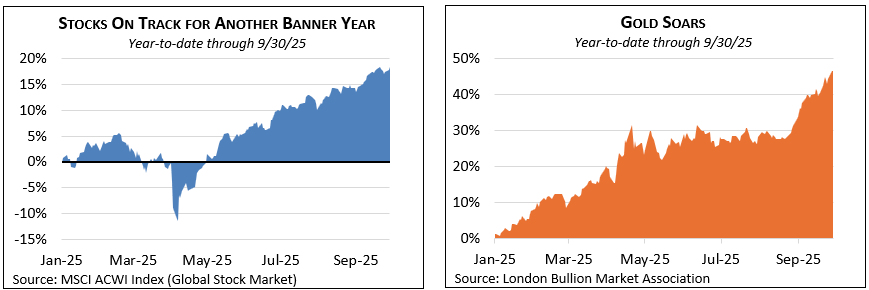
S and international stocks jumped again in the third quarter, with the global equity benchmark rising about 8%, putting markets on course for a third consecutive calendar year of returns substantially above long-term historical averages. For the year to date through quarter’s end, the benchmark S&P 500 was up nearly 15%, while foreign markets returned more than 25%.
And then there’s gold. Alternately labeled a store of value and a barbarous relic, the precious metal is up nearly 50% this year. Remember that gold is an investment that pays no interest or dividends, has no earnings per share, and has real but limited industrial applications. Hence, holding gold entails a significant cost of foregone opportunities. But gold also has managed to maintain its value as a safe-haven “currency” through the centuries, while empires come and go.
We do not see any way to couch gold’s recent ascent as positive news, other than that most of our clients hold some gold in the portfolios we manage. Rather, it is an indication that at some level, even amid a continued bull market, investors are worried. Most likely, they are worried that unsustainable growth in government debt worldwide will threaten the purchasing power of conventional currencies. The tenuous state of today’s politics no doubt intensifies these concerns.
Stock markets are telling a story of optimism, while gold’s message is one of caution. Both can be valid. For a more detailed discussion, be sure to see our quarterly Economic and Market Review that accompanies your quarterly report.
Gould Reaches $1 Billion in Assets Under Management
Last year marked Gould Asset Management’s 25th anniversary, and this year saw us reach another milestone: $1 billion in assets under management! We surpassed that very round number in early September, thanks to continued strong investment returns and new client assets. This accomplishment is only possible because of you, our clients. You have our most heartfelt thanks.
Note: This post is an excerpt from Gould Asset Management’s Economic and Market Review for the Third Quarter of 2025. The excerpt is posted here for the benefit of our blog subscribers.
US Economy Growing Despite Job Market Slowdown
The US economy expanded at a 3.8% annualized rate in the second quarter, rebounding from its 0.5% contraction in the first quarter. The economy maintained some of its momentum in the third quarter, with consumer spending increasing 0.5% in July and 0.6% in August.
The labor market, however, showed signs of stalling. The unemployment rate ticked up to 4.3%, and job growth slowed throughout the summer. Employers added only 22,000 jobs in August after averaging over 160,000 per month in 2024.
The manufacturing sector contracted for a seventh consecutive month in September. New orders and factory employment remained subdued as the industry continues to deal with the effects of tariffs.
Federal Reserve: One Cut, Continued Caution
The Federal Reserve lowered the federal funds rate by 0.25% to 4.00%-4.25% in September, its first cut in almost a year. Policymakers cited a softer labor market as justification for the move, despite ongoing concerns of stubborn inflation. The decision to reduce the rate was unanimous, although one member favored a larger reduction (by 0.50%).
Fed Chair Jay Powell offered no preset course to future interest rate decisions, saying that the committee was now in a “meeting-by-meeting situation.” Still, the latest Fed projections show a narrow majority of members expect two additional rate cuts by the end of the year, consistent with market forecasts.
Persistent inflation was the one notable change in the Fed’s latest round of economic forecasts. Officials penciled in higher inflation in 2026 (2.6%, up from 2.4%).
Many thanks to those who joined us on Tuesday, September 16, 2025, for the live webinar with Don Gould and Scott Smith, which offered timely insights into today’s market environment and addressed a wide range of investor questions.
Don and Scott touched upon quite a few topics which included:
Thanks again to all those who attended. If you have suggestions for future topics or ideas on how we can continue to improve the experience for upcoming broadcasts, please feel free to contact us at contact@gouldasset.com. And as always, feel free to share the replay with friends or family who might find our commentary helpful.
Almost from his first days in office, President Trump has been lobbying for lower interest rates. This has taken the form of the president’s consistent criticism of Federal Reserve chairman Jerome Powell for not lowering rates further, even musing about firing Powell before his term expires next year.
Presidents of both parties — from Lyndon Johnson and Richard Nixon to more recent administrations — have expressed frustration when Fed decisions did not align with their economic or political priorities. What makes today’s situation stand out is the unusually public and persistent nature of the criticism, along with open discussion about terminating the Fed chair.
Lower interest rates usually stimulate economic activity by reducing interest expense for all variety of borrowers, from homeowners with mortgages to businesses taking out loans for expansion or acquisitions. Rate cuts can also boost the stock market simply by making cash and bonds less attractive in comparison. And higher stock prices tend to increase spending by households that own stocks, further juicing the economy.
Political strategist James Carville, summing up a key to modern elections, famously said, “it’s the economy, stupid.” With midterm elections only a little more than a year away, President Trump is likely aware of how the economy’s vigor in 2026 might affect the balance of power in Congress.
The Fed, however, has a broader set of priorities. Its dual mandate, established by Congress in 1977, is to promote both maximum employment and stable prices. These two goals often are at odds with one another, and that teeter-totter relationship puts the Fed in a bind right now.
Inflation, though down sharply from its short-lived post-pandemic peak of 9%, is holding stubbornly above the Fed’s 2% target — currently closer to 3%. Arguably, current policies on trade and immigration are also inflationary. Meanwhile, recent jobs reports show significant slowing in new job creation. Despite the inflation risks, it appears likely the Fed will cut rates in its September 17 announcement, giving greater priority to its employment mandate for the moment.
The Fed was established as an independent agency so that political considerations would not drive monetary policy. A Fed heavily influenced by an administration’s short-term political priorities could, in theory, lose sight of its mandate to control inflation. Market watchers both here and abroad have expressed concern that President Trump’s criticism and threatened firing of Fed chair Powell, as well as his recent actual firings of Fed governor Lisa Cook (currently put on hold by a federal judge) and the head of the Bureau of Labor Statistics, threaten the Fed’s actual or perceived independence.
If bond traders — the so-called bond market “vigilantes” — lose faith in the Fed’s independence, interest rates on longer-term bonds could rise despite the Fed cutting short-term rates, as investors demand higher bond yields to compensate for the increased risk of elevated inflation. While the Fed sets short-term rates, which in turn influence long-term rates, ultimately the bond market determines interest rates on longer-term obligations.
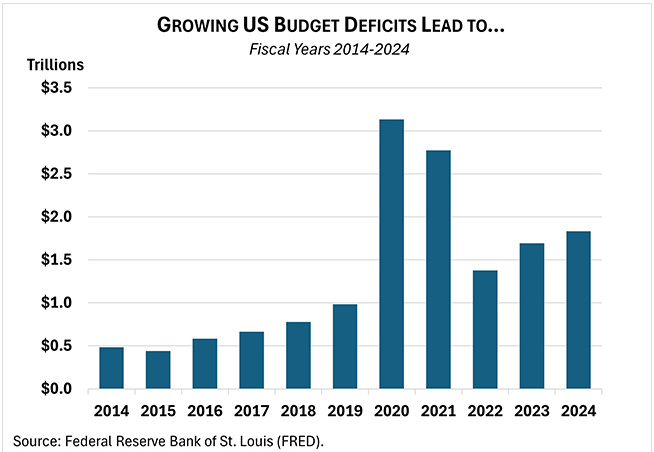
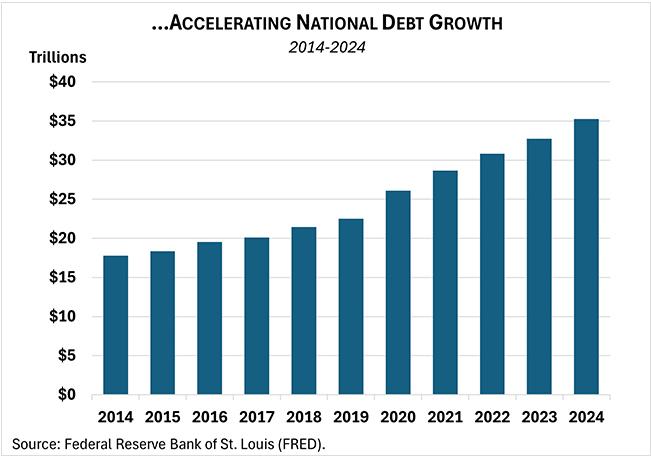
The other big worry surrounding long-term interest rates is America’s burgeoning national debt. The U.S. runs a large annual budget deficit, currently projected at nearly $2 trillion for fiscal year 2025. The U.S. Treasury must borrow that amount to pay the government’s bills, adding to an existing debt pile of about $37 trillion. The problem is that the debt plus the annual interest payments are growing faster than the economy. In a sort of vicious cycle, interest paid on U.S. Treasury debt is now the largest component of the federal budget — larger even than the defense budget — and rapidly rising.
Unless there are major budget cuts and/or tax increases, or the economy grows much faster than it has historically, the Treasury will need to issue ever more debt annually. Other things being equal, a growing supply of new government debt will push longer-term interest rates higher.
And yet … bond and stock market investors have so far largely shown little concern. The yield on the benchmark 10-year Treasury has fallen from 4.8% to near 4.0% since January, and the U.S. stock market is near record highs. Are markets whistling past the graveyard? Or is a new and brighter economy around the corner? Stay tuned.
Donald Gould is president and chief investment officer of Gould Asset Management of Claremont.
We hope this note finds you in summer relaxation mode. We could all use that right now.
Living in Interesting Times
The US experienced a consistently eventful second quarter, offering little respite from the tumultuous first quarter. President Trump’s on-again-off-again tariffs dominated the news in April. Financial markets plunged on the April 2nd implementation of new tariffs, but the president reversed course a week later and markets quickly recovered. Immigration was the top story in May as the president ordered stepped up deportations of undocumented residents, which became a focus of nationwide protests in mid-June. Conflict between Israel and Iran then took center stage in late June, culminating with President Trump’s decision to launch strikes on three Iranian nuclear enrichment facilities. Many other news items simmered in the background throughout the quarter.
Exuberant Markets, Especially Abroad
Mostly ignoring the news cycle, the US stock market finished mid-year at record highs, US bond markets stabilized as Treasury yields settled well below their 2024 year-end levels, and a certain exuberance seemed to possess financial markets as we finished the second quarter. Economic news is mostly supportive. Unemployment remains low, inflation is only a bit above central bank targets, consumer sentiment is improving, and the corporate earnings outlook is positive.
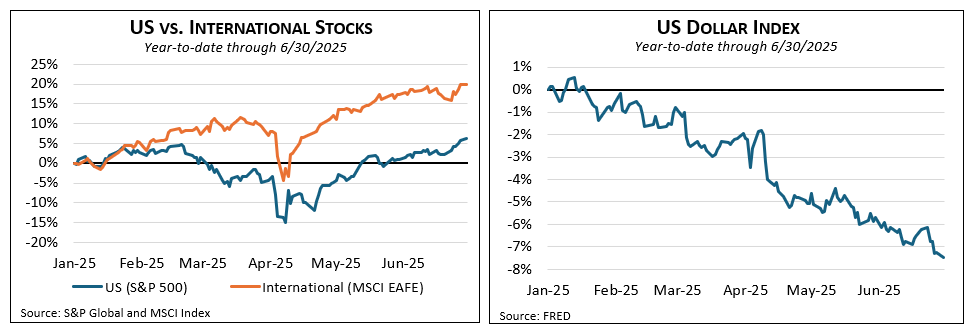
Despite high volatility in April, year-to-date US stock market performance finished slightly above historical averages. However, the US trailed international markets by a wide margin in the first half. The MSCI EAFE index of international developed markets stocks soared 19.9% in the first six months of 2025, outpacing the S&P 500 index’s return of 6.2% for the same period. A good portion of that difference is the result of a 7.5% decline in the US dollar this year, but international stock markets outperformed the US even without adjusting for currency moves.[1]
[1] Dollar weakness—meaning a unit of foreign currency buys more dollars than before—makes foreign investments worth more when their value is translated into US dollar terms. In turn, this increases foreign investments’ return when expressed in US dollars, which is how returns are always reported to US investors.
Policy Impact Questions
Many centerpieces of President Trump’s agenda raise questions about their longer term impact on the US economy. Will higher tariffs reduce trade and raise prices? Will restricting immigration and accelerating deportation constrain the labor supply, raising labor costs and prices in general? Will talk of annexing Canada, acquiring Greenland, or backing away from longstanding commitments to defend Western Europe tend to isolate the US economically and politically? Will the administration’s ideological battle with higher education, including the withholding of federal research funding, cause the world’s top students and researchers to look beyond the US? And if so, how would that affect US leadership in the technology and health care advances that have powered so much of US wealth gains in recent decades? Time will tell the answers to these questions, but perhaps not quickly.
President Trump has displayed a certain pragmatism, regularly backtracking when policy announcements elicit strong negative reactions from the business community or markets. Examples include the quick reversal on tariffs after the stock market plunged; an acknowledgment that the administration’s deportation policy is depriving American businesses of essential workers; less talk about firing Fed chair Jay Powell; the late June US re-embrace of the NATO alliance; even a teased deal with Harvard.
On the one hand, the good absolute performance of US financial markets in 2025 suggests that investors believe these policy questions will be resolved favorably. On the other hand, both foreign stock market outperformance and dollar weakness might reflect lessened confidence in the US as a home for investment capital. The administration’s policies—and the volatility of those policies—may be giving global investors pause.
Meanwhile, though seemingly not yet on the markets’ radar, big questions lurk on topics as diverse as the national debt and the impact of artificial intelligence. Annual interest on the debt is now the single largest US budget item, exceeding even the defense budget. The OBBBA legislation passed in early July is forecast to add another $3.4 trillion to the debt over the next decade. Meanwhile, no one is quite sure whether AI will cause mass unemployment, universal wealth, and/or existential threats to humanity.
Note: This post is an excerpt from Gould Asset Management’s Economic and Market Review for the Second Quarter of 2025. The excerpt is posted here for the benefit of our blog subscribers.
Stocks Rally in Q2, Capping Volatile Quarter
Global stock markets swung sharply in Q2 2025 after new US tariffs in April triggered a swift sell off. Markets rebounded once trade duties were paused, lifted by renewed US tech strength and solid corporate earnings. Despite geopolitical tensions and mixed economic data, sentiment improved over the quarter, even as central banks adopted a more cautious tone on rates.
US large cap stocks, as represented by the S&P 500 Index, rose 10.9% in Q2, as initially elevated trade tensions gradually subsided and investor interest in tech and AI-related stocks rebounded. Optimism about potential Fed rate cuts later this year also provided a tailwind. The strong second-quarter rally puts US large cap stocks up 6.2% year-to-date.
In addition to the Technology sector (up 22.9% in Q2), Communication Services (up 18.5%) also performed well during the quarter, as did Industrials (up 12.9%). The Health Care sector (down 7.2%) was the weakest performer, as the Trump administration’s efforts to lower drug prices in the US put pressure on the share prices of some healthcare companies.
US mid and small cap stocks outpaced large caps in Q2, with the Wilshire 4500 stock index rising 12.3%, though year-to-date gains (up 3.0%) trail large caps. Outperformance stemmed from investors’ renewed risk appetite and a favorable rate environment.
International developed and emerging markets were among the top performers on the quarter, with the MSCI EAFE (developed markets) stock index rising 12.1% (up 19.9% year-to-date), while the MSCI Emerging Markets index climbed 12.2% (up 15.6% year-to-date). International stocks have significantly outpaced US stocks in 2025, bolstered in part by a weaker US dollar (down 7.5%). Additional support has come from the European Central Bank (ECB), which has cut interest rates twice in 2025.
The quarter saw a sharp spike in volatility, reaching levels not seen since the early days of the pandemic. Investor concerns over escalating tariffs pushed the VIX index above 50 in early April. As trade tensions subsided and market sentiment improved, volatility eased, with the index closing the quarter at a pedestrian 17, roughly its historical average