The Trump Account: A Powerful Opportunity Hidden in the Details
For parents and grandparents thinking generationally, the new Trump Accounts contain one of the most compelling wealth building opportunities we have seen in years. This is not so much for what the accounts are on their own, but for what they can become.
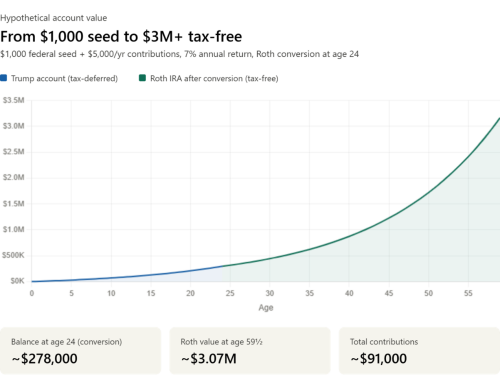
Here is the short version: fund a Trump Account aggressively from birth, wait until your child is in their early 20s and likely still earning a modest income, then convert it to a Roth IRA, paying minimal taxes on the conversion. Done right, roughly $90,000 in contributions could seed a tax-free retirement account worth over $3 million by age 60. We will show the math in a moment.
As a savings vehicle on its own terms, the Trump Account is fine but not exceptional. For most purposes, a 529 or a Roth IRA will serve you better. But if you have already funded those, the Trump Account deserves a close look.
What Is a Trump Account?
Beginning this summer, parents and guardians can open a Trump Account for any child under 18, funded with after-tax dollars up to $5,000 per year, a limit that adjusts for inflation starting in 2028. The accounts must be invested in a US stock index fund until the child turns 18, at which point the rules shift and the account begins following IRA-style tax treatment. Children born between 2025 and 2028 also receive a $1,000 seed contribution from the federal government to get things started. As of mid-March, roughly four million children already have Trump Accounts, with more than 800,000 eligible for the $1,000 government contribution.
Employers and charities can contribute as well, and some high profile donors have stepped in with additional seed money, including Michael and Susan Dell, who have pledged $250 for each child age 10 or under living in a zip code with a median household income below $150,000.
How Do These Compare to 529s?
If your primary goal is saving for college, a 529 plan is clearly the better tool. Contributions to a 529 grow tax-free and come out tax-free when used for qualified education expenses. Many states offer an additional deduction on contributions. Trump Accounts carry none of those education-specific advantages. For families who need to prioritize college savings, the 529 should come first.
Parents and grandparents should maximize their own 401(k)s, IRAs, and 529s before considering a Trump Account. The sequencing matters. Think of the Trump account as the next layer, not the foundation.
The Big Opportunity
If your family can fund one of these accounts aggressively ($5,000 a year, every year, from birth through age 17) and your child has the knowledge and discipline to leave it alone as an adult, there is a potentially extraordinary outcome waiting at the other end.
The math goes like this. Assume the $1,000 in government seed money, $5,000 in annual contributions for 18 years, and a 7% annual return. By the time your child is in their early 20s, the account value will approach $300,000. At that point, if they are in a low tax bracket as many young workers are, they can convert the account to a Roth IRA and pay minimal taxes. Rather than converting all at once, a smart approach is to spread the conversion over a few years, keeping each year's taxable income in a lower bracket and meaningfully reducing the total tax owed.
The conversion tax, paid with outside dollars as a gift from parents or grandparents rather than drawn from the account itself, is quite modest relative to the potential gains. What you've done, in effect, is pre-funded a Roth IRA on your child's behalf at a fraction of the cost of a lump-sum Roth conversion.
From there, the Roth IRA grows completely tax-free for decades. By age 60, that $278,000 conversion, left untouched, would grow to just over $3 million. No required minimum distributions. No ordinary income tax on withdrawals. Just a tax-free nest egg that has been quietly compounding since birth. Put another way, you've used roughly $90,000 in after-tax contributions, plus a modest conversion tax payment, to potentially set your child up with a multimillion dollar tax-free retirement account.
A small note on timing: experts caution against converting immediately at 18. The "Kiddie Tax," which can apply to unearned income for certain individuals under 24, may cause part of the conversion to be taxed at the parents' rate rather than the child's. Patience here pays. Waiting until the child is working, independent, and clearly in a low bracket (typically the early-to-mid 20s) is the smarter move.
Understanding the Risks
This strategy has potential pitfalls that should be understood from the outset.
The first risk is behavioral. The entire thesis depends on your child, in their early 20s, making the disciplined choice not to cash out what may seem like found money. A young adult with more than a quarter million dollars on hand and competing financial priorities is not a guaranteed long-term investor. Helping the child understand the benefits of long-term tax-free compounding will create the best chance of realizing the full potential of these accounts.
The second risk is legislative. Tax laws change. The 529-to-Roth conversion rules, which were themselves a relatively recent and welcome addition to the tax code, already carry a $35,000 lifetime cap. Future Trump Account legislation could impose similar caps, restrict conversions for accounts above a certain balance, or find other ways to tax the transaction more heavily if a low-bracket conversion starts to look too generous. Today's rules might not be permanent. But even if rules change, we see little downside to this strategy.
And, of course, while we have assumed a 7% rate of return, future returns are never guaranteed.
The Bottom Line
The Trump Account is not a replacement for the tools you already have. Fund your own retirement first. Keep the 529 at the top of the priority list for college savings. But if you've done those things and have the capacity to think a generation ahead, this is a genuinely compelling new vehicle because of the Roth conversion opportunity it opens. For those eligible children, the $1,000 seed money is frosting on the cake.
A Trump Account for a child born this year, funded consistently, converted to a Roth IRA in early adulthood, and left to compound for decades, could enable the child to retire with financial security, all because of a decision you made before they ever knew what a tax return was.
As always, the details of your specific situation matter. Tax brackets, other savings priorities, the age of your children, and your estate planning goals all factor in. If you'd like to explore whether this strategy makes sense for your family, we are here to help. Call or email us anytime
As always, we thank you for your business and for the trust you place in us daily. Please call or email whenever we can be of assistance.
Note: This post is an excerpt from Gould Asset Management’s Economic and Market Review for the First Quarter of 2026. The excerpt is posted here for the benefit of our blog subscribers.
US Enters 2026 on Uncertain Footing
The US economy expanded at an annualized rate of just 0.5% in the fourth quarter of 2025, down sharply from 4.4% in the third quarter. A 43-day partial government shutdown that began in October subtracted roughly one percentage point from growth, while exports and business investment also weakened.
Consumer spending stalled in the early months of 2026. Inflation-adjusted spending was flat in January and rose just 0.1% in February, with motor vehicle purchases providing much of the lift. Rising energy costs tied to the Iran conflict pose additional headwinds ahead.
The job market was uneven through the quarter, but the broader trajectory points to gradual cooling. Nonfarm payrolls rebounded from a 133,000 decline in February to a 178,000 gain in March, though net job creation for the quarter was minimal. The unemployment rate edged down to 4.3%, but the improvement reflected a shrinking labor force rather than stronger hiring.
Manufacturing activity turned positive in January for the first time in nearly a year and expanded for a third consecutive month in March. The ISM Manufacturing PMI rose to 52.7 in March, its highest reading since August 2022. However, cost pressures intensified, with the ISM prices index jumping to 78.3, its highest level since June 2022, reflecting the impact of tariffs and elevated energy costs on input prices.
The Fed’s Holding Pattern
The Federal Reserve held the federal funds rate steady at 3.50% to 3.75% at both of its meetings during the quarter, citing elevated economic uncertainty and inflation that continues to run above its 2% target. The March decision was nearly unanimous, with only one dissenting vote in favor of a cut.
Fed Chair Jerome Powell acknowledged the economy is performing reasonably well,while noting that theongoing conflict in the Middle East has meaningfully clouded the outlook. Powell described the current rate range as broadly neutral, neither stimulating nor restraining growth, and emphasized a data-dependent approach, offering no preset path for future adjustments.
The Fed’s latest projections reflect a modest upgrade to the growth outlook alongside higher inflation expectations. Officials now project GDP growth of 2.4% in 2026, up from 2.3% in December, and see core inflation ending the year at 2.7%, up from the prior 2.5% forecast. The median projection still calls for one rate cut in 2026, though seven of nineteen voting and non-voting participants now pencil in no cuts at all this year.
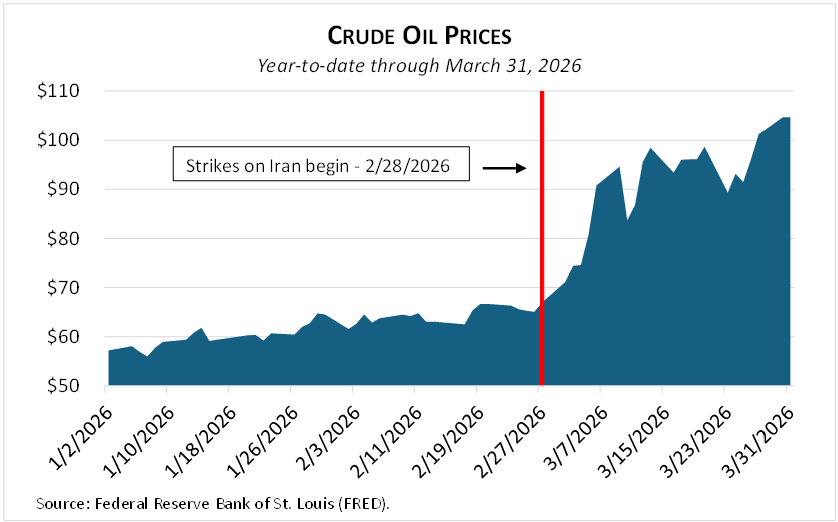
After a modestly positive first two months of the year, markets were jolted by the joint US/Israel surprise airstrikes on Iran at the end of February, triggering a worldwide slide in stock prices that continued through most of March.
Iran’s effective closure of the Strait of Hormuz immediately reduced world oil and gas supplies by roughly 10% and 20%, respectively, causing prices to soar. The net importers of Asia and western Europe saw energy costs spike 50%-150%. Even in the energy-rich US, gasoline prices are up over 30% in just a month. Rising energy costs inevitably mean higher prices for almost all goods.
As we saw during the Covid pandemic, the modern economy depends on highly interdependent global supply chains. When chain links break, unintended consequences follow. Case in point—the Middle East is a major source of fertilizer and helium exports, both curtailed by the war. A lasting fertilizer shortage would mean higher food prices everywhere and potential crop failures, especially in developing countries. Helium is needed for a variety of industrial processes, from making the chips that power AI to the cooling of MRI machines.
As we write this, a tenuous two-week cease-fire is in effect, a first round of negotiations did not result in agreement, and the US has imposed a limited blockade on the Strait of Hormuz. Rumors of further talks are circulating, but the fog of war is dense. The situation is fluid and unpredictable.
Investment Implications
In this conflict, markets must contend with an unusually long list of unknowns. Will the cease-fire hold? Will it lead to a lasting peace or will hostilities soon resume? Will the Strait of Hormuz reopen, how fully, and when? When will this war be over for good? (Prediction market odds on an end by June 30 jumped from 50% to 85% since the cease-fire announcement.) How quickly can energy supplies rebound to pre-war levels, especially considering war damage to oil and gas infrastructure? How might the post-war geopolitical landscape look different? Answers to these questions could determine whether the global economy continues its expansion or falls into recession, so it’s no surprise that markets gyrate with each hint of either resolution or escalation.
Markets and central banks find themselves in the uncomfortable spot of worrying at once about both inflation and recession. Energy supply shocks push up prices—one stark example is a doubling of transcontinental airfares in March alone. But more money spent on airfare leaves less money for everything else. Absent a jump in household income, a sudden rise in the price of something as essential as energy will tend to depress economic activity.
Higher inflation expectations push up bond yields and generally lead to tighter monetary policy (higher short-term interest rates), while recession fears do the opposite. Market yields have reflected this tug-of-war in recent weeks, rising through most of March but easing towards month-end as recession concerns grew. The Fed faces a conundrum.
The war has also pressured the US bond market in other ways. A recent Bloomberg article notes that reduced oil revenue is lessening Middle East oil producing nations’ demand for US Treasurys, while higher oil prices are forcing emerging markets governments to sell Treasurys to cover their higher energy bills. Both actions tend to push yields up and bond prices down.
Yet with all that as a backdrop, in the first half of April, US stocks recovered all their March losses, demonstrating again the market’s ability to confound.
Patience and Perspective are Your Friends
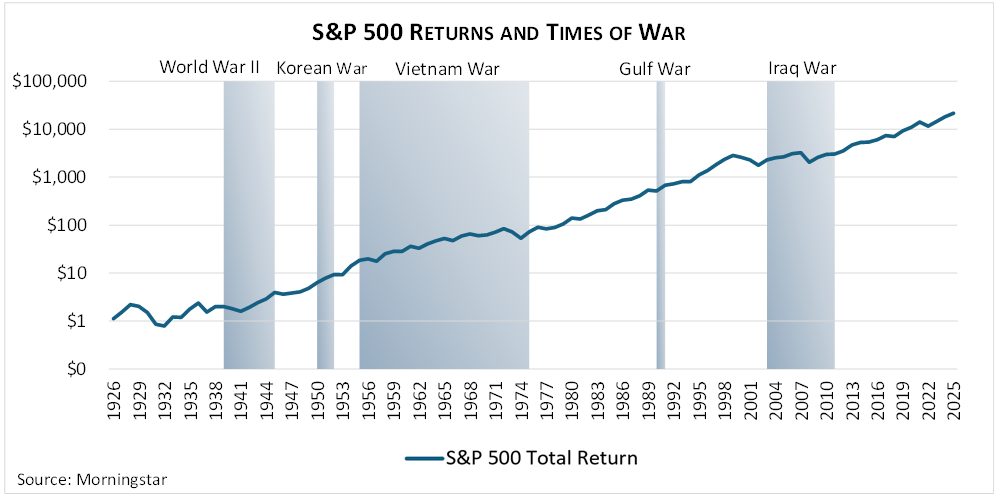
When it feels like the world is spinning so fast that it might come off its axis, we counsel patience and perspective. All wars eventually end, some quickly and some not, some in a lasting resolution and others in stalemate. This conflict is no exception. Short attention spans, as well as political and economic pressures, favor a quicker end, but the jury is still out. The end, when it comes, might be messy and inconclusive. Even a quick resolution will leave world commerce bruised for some period, but history suggests that economies have a natural tendency towards repair, recovery, and resumed growth.
Your advantage amid the discord is that your investment portfolio has a very long attention span. While its market value unavoidably bounces around in response to the nonstop din emanating from the world’s capitals, your portfolio is neither distracted nor diverted from its long-term mission. We aim to keep it that way.
AI Omnipresence
Like you, we watch in amazement as AI finds its way into the nooks and crannies of our work and home lives. We marvel at the capabilities of chatbots like OpenAI ChatGPT, Google Gemini, and Anthropic Claude. Challenged with complex questions, in seconds they spin out well written, thoughtfully organized, apparently deeply researched, highly polished, authoritative sounding answers.
Since the industrial revolution, technology has lessened the need for physical human labor, sending many of us to gyms just to keep our bodies from falling into disrepair. AI is the next step in this evolution, evidently reducing our need to think, as well. Will we all need to rely on Sudoku and Wordle to keep our brains from atrophying?
A cautionary note: remember that the “A” stands for artificial. The intelligence is magnificent, but it is not human. We need to beware the wax museum aspect of all this. That figure of Ronald Reagan at Madame Tussaud’s in Las Vegas looks so lifelike that we feel the Gipper might speak at any moment. And yet, even if skillfully animated to walk and talk, it’s still not Reagan. Likewise, we need to stay alert to the important difference between human and artificial intelligence.
Our business—helping clients achieve lifetime financial security—is fundamentally a human-to-human interaction between advisor and client. What we do requires intelligence, but also critical thinking, empathy, and always a commitment to putting our clients’ interests first. We keep these in mind as we think about the rapid emergence of artificial intelligence in our professional and personal lives.
PS – The cartoon above, which pokes fun at AI’s limitations, was generated in less than one minute from a prompt we gave to Google Gemini AI.
For a detailed discussion of the economy, financial markets, and investment performance, be sure to see the Q1 Economic and Market Review.
As always, we thank you for your business and for the trust you place in us daily. Please call or email whenever we can be of assistance.
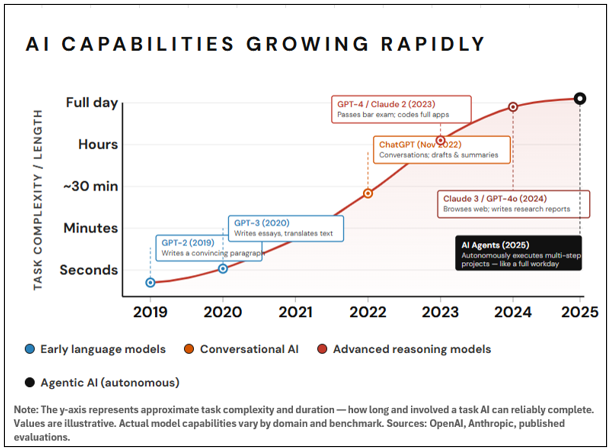
If you love trains, you understand the big difference between knowing a train is due soon and actually seeing the massive engine rounding the bend. For months or even years, artificial intelligence experts have told us to prepare for the arrival of an AI that builds ever more powerful versions of itself. Well, now it’s in sight, horn blaring and ground shaking.
Over the past few weeks, leading AI developers Anthropic and OpenAI have each released new versions with computer programming capabilities that veteran software engineers describe as both astonishing and terrifying. The AI can now do software coding at a level comparable to experts with decades of experience. Soon, its capabilities will zoom past that.
Concurrently, we are told that much of the latest AI was built by the AI itself. This so-called “self-recursive” activity implies ever more powerful AI models, released with increasing frequency.
Productivity Up. Unemployment to Follow?
The most immediate impact of these developments is felt by software coders themselves. Suddenly, they are vastly more productive, as AI can now employ an army of virtual agents to quickly do most of the previously laborious coding work. But this same advance might also make many coders redundant. We read stories of Stanford grads with computer science degrees—once a golden ticket to lucrative employment—facing a more difficult entry level job market.
Of course, AI’s impact doesn’t stop with coders. In a world where almost every business is to varying degrees a technology enterprise, the implications are enormous. Over time, as with technological advances dating back at least to the start of the Industrial Revolution, we can expect AI to take over a wide range of tasks currently performed by humans.
The optimistic take on this envisions a future of greater output and wealth, with employees quickly elevating their work to more valuable activities. The more worrisome outlook is that AI advances quicker than the average worker can adapt, leading to high levels of unemployment. Such impact would be most immediately felt in white collar jobs that are mostly performed on a computer. However, in time, AI-enhanced robotics could replace blue collar workers, too.
AI and Your Investments
The stock market is doing its best to digest all the AI news. We see its verdict rendered in the daily movement of stock prices, much of it very volatile of late. Right now, there are many more questions than answers. Here are a few that are top of mind.
The tech giants (Google, Meta, etc.) are pouring hundreds of billions of dollars annually into building datacenters in a sort of AI arms race that many view as winner-take-all. How will they earn a fair return on these massive investments? And what becomes of the losers in this race?
AI can help companies in many ways, including enabling the creation of new products and services, increasing worker productivity, and reducing labor costs. Will these benefits more than offset the potential reduction in consumer demand resulting from an AI that puts people out of work?
It appears that AI can quickly replicate complex software that may have taken thousands of engineers decades to build and refine. Does this mean AI will ultimately bankrupt countless companies whose primary value resides in their proprietary software?
Economist Joseph Schumpeter coined the phrase “creative destruction” to describe the process by which technological advances lay the groundwork for both the introduction of the better mousetrap and the obsolescence of what came before. With AI, it is very possible we will witness creative destruction of a scale and speed well beyond anything ever experienced.
What is an investor to do in the face of all this? It is impossible to know in advance who the winners and losers will be in the brave new world of AI. The possibility that there will be a very small number of big winners and a much larger number of losers makes the task more challenging still.
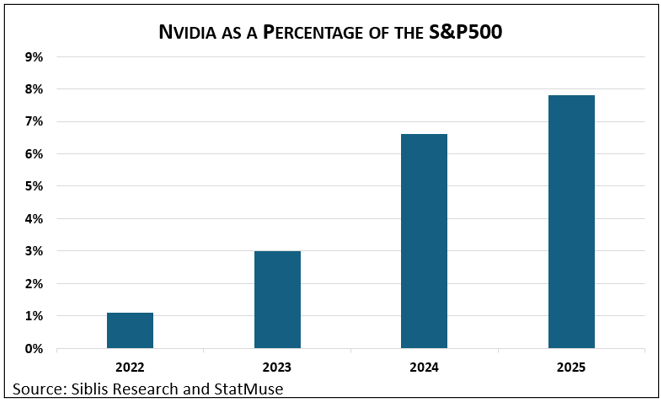
It is wisely said that if you must own the needle in the haystack, you should buy the haystack. Put another way, stay diversified. Index funds—which own the entire market—ensure that you will participate in the growth of the market’s top performers. A prime example is Nvidia, maker of the graphics processors so critical to AI. Its share of the S&P 500 ‘s total value grew from about 1% to well over 7% in just the past three calendar years, which is even more remarkable considering that the index nearly doubled in that timeframe.
It also makes sense to diversify across asset categories, for example, stocks, bonds, real estate, and even perhaps precious metals such as gold. Diversification cannot ensure success. But in the face of AI-fueled rapid change with unpredictable consequences, it might just make failure less likely.
Donald Gould is president and chief investment officer of Gould Asset Management of Claremont.Don is a recurring guest columnist for the Courier, providing his unique insights and observations on matters of money, investing, and personal finance.
Note: This post is an excerpt from Gould Asset Management’s Economic and Market Review for the Fourth Quarter of 2025. The excerpt is posted here for the benefit of our blog subscribers.
Stocks Advance in Q4, Capping a Strong 2025
Global equity markets posted steady gains in Q4, with several major indexes finishing the year near record highs. International stocks outperformed US equities for the first time in several years, aided by a weaker US dollar, more attractive valuations overseas, and rotation away from US tech stocks. Solid earnings growth and expectations central banks would continue lowering interest rates in 2026 supported markets.
US large-cap stocks, represented by the S&P 500 Index, rose 2.7% in Q4 and finished 2025 up a strong 17.9%. Much of the year’s advance was driven by the technology and communication sectors tied to artificial intelligence. Within that group, Alphabet (up 65%) and Nvidia (up 39%) accounted for a disproportionate share of market gains, underscoring the continued influence of a relatively narrow set of leaders.
Sector performance in Q4 highlighted continued shifts in market leadership. Health Care was the strongest performing sector for the quarter, rising 11.7% and finishing the year up 14.6%, while Communication Services gained 7.3% in Q4 and 33.6% year-to-date. Technology posted more modest gains in the Q4 (up 2.3%) but delivered a strong 24.7% return for the year.
US mid and small cap stocks, measured by the Wilshire 4500 Index, were mostly flat in Q4, slipping 0.3%, but ended the year up a 11.9%. After keeping pace with large caps for much of 2025, smaller companies lagged late in the year as investors gravitated toward larger, more established firms amid economic uncertainty.
International stocks were among the strongest performers of 2025, extending gains in the fourth quarter. Developed-market equities rose 4.9% in Q4 and finished the year up 31.2%, while emerging-market stocks gained 4.7% for the quarter and 33.6% for the year. Returns were broad based, with strong performance across Europe, parts of Asia, and emerging markets, supported by improving economic momentum and attractive valuations. A weaker US dollar—down 7.2% in 2025—provided a tailwind for international investors.
Market volatility increased briefly during Q4 but remained contained overall. The VIX Index began the quarter around 16 and spiked above 26 in November amid a brief market sell-off and concerns around interest rate policy. Volatility eased to 15 by yearend, suggesting investors closed 2025 with a steadier outlook.
Fed Rate Cuts Support Solid Q4 for Bonds
US fixed income markets posted modest gains in the fourth quarter, capping the strongest year for bonds since 2000. Short-term Treasury yields continued to decline in Q4 as the Federal Reserve cut its benchmark rate twice by a total of 0.50%. Meanwhile, yields on longer-term Treasurys rose slightly as concerns about significant US fiscal deficits persist. As measured by the Bloomberg US Aggregate Bond Index, US bonds gained 1.1% in the final quarter of 2025, bringing the full-year return to 7.3%.
A sharp steepening of the US Treasury yield curve was a defining feature of both Q4 and 2025 overall. After beginning 2025 at 4.25%, the 2-year Treasury yield, which is highly sensitive to expectations for Federal Reserve policy, declined from 3.60% to 3.47% in Q4. In contrast, the 30-year Treasury yield rose from 4.73% to 4.84% during the quarter, leaving it little changed for the year.
Mortgage backed securities outperformed other fixed income sectors in Q4, returning 1.7% for the quarter and 8.6% for the year. High yield bonds also delivered strong results, gaining 1.6% in Q4 and 8.6% for the year. Long term Treasurys underperformed, returning -1.0% for the quarter and 4.2% for the year.
Happy New Year! We hope this note finds you easing into 2026. For those of us who remember the turn of the millennium, it is hard to believe we have now entered the second quarter of the century.
US Stocks Do It Again
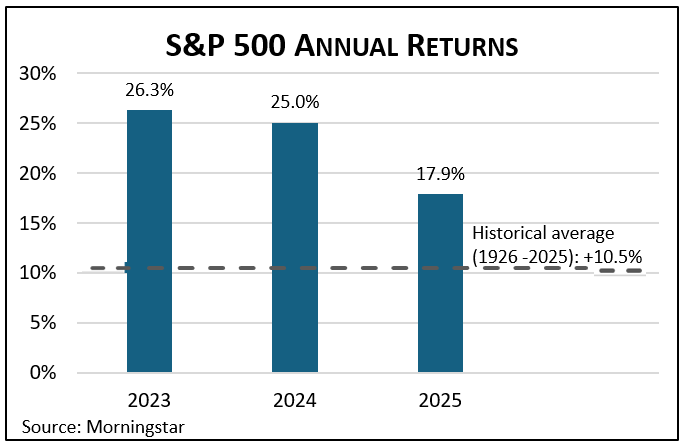
2025 was another banner year for US stocks, with the benchmark S&P 500 up 17.9%—this on the heels of returns of 26.3% and 25.0% in 2023 and 2024. The compound average return for this 3-year stretch is 23.0%, a rate at which money doubles about every 40 months! Over the past century, US large cap stocks have averaged a compound annual return of 10.5%, still terrific, but well below recent experience.
A year ago, we cautioned against expecting these eye-popping returns to continue, though we also noted there was precedent (1997-1999) for the party to continue another year. We will say it again as we enter 2026. Either we are in an unprecedented “new era” of much higher returns (as some AI futurists would suggest) or recent returns are not sustainable. Prior market booms triggered by technological advances—think railroads, electrification, autos, radio, personal computers, biotech, internet—all eventually came back to earth.
We cannot know if this is a new era or just the latest mania, but even as we suspect it’s the latter, we also don’t know when it will end. Faced with this uncertainty, we generally favor regular portfolio rebalancing, selling some of the assets that have risen the most and buying those that have gained the least. And, of course, diversification. These disciplines help keep the market boom from inadvertently pushing clients into portfolios having more risk than intended. But even here, the risk-reduction benefits of rebalancing must be weighed against the often significant tax costs of selling highly appreciated assets.
Foreign Stocks Shine, Gold Glitters
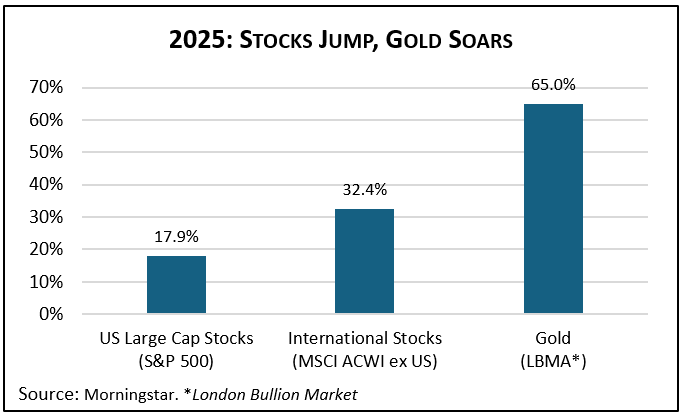
After generally lagging US stocks for many years, foreign stock markets substantially outpaced the US last year, returning about 32% overall and finally rewarding investors for international diversification. More than half the foreign markets’ return edge is explained by a roughly 10% decline in the US dollar, including a 13.3% jump in the euro. To understand this tailwind, consider a laggard German stock that went nowhere in 2025 and started the year worth $1,000. It ended the year worth $1,133, just from the currency effect.
Meanwhile, gold climbed an astounding 65% in 2025, finally surpassing its 1980 all-time high in inflation-adjusted terms. That one ounce coin in your safe deposit box is now worth about $4,500. We think of gold as a hedge against various macro trends, including inflation and geopolitical instability, things we don’t usually associate with outsized stock returns. Yet last year, gold zoomed while stocks flourished. How are we to reconcile this? Any answer is necessarily speculative, but we’ll try a hypothesis.
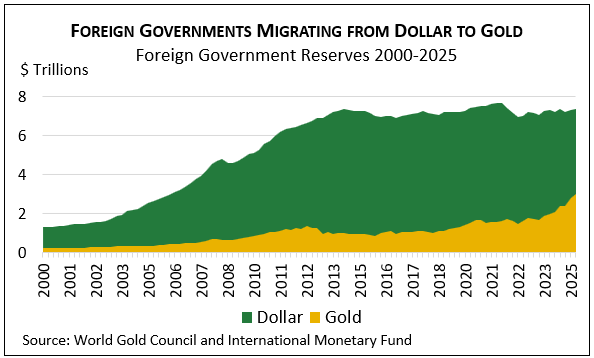
It starts with the historical dominance of the US dollar in the global financial system. For the better part of a century, the dollar has served as the world’s primary reserve currency. Combine this with the substantial policy shifts emanating from Washington since President Trump’s inauguration a year ago and you get big asset price moves. As examples, consider the US decision to impose sweeping worldwide tariffs. Or the conscious weakening of transatlantic alliances, coupled with assertions of US dominance in the Americas. Both policy changes have motivated many foreign governments to diversify their reserves away from the dollar in favor of gold, contributing to a weaker dollar, higher gold prices, and strong foreign stock markets.
Our hypothesis continues with the widely held view that the US is less focused than before on preserving the dollar’s purchasing power. This perception is fed in many ways. Examples include the worsening US fiscal picture, a vicious cycle of persistently large annual budget deficits feeding an ever-growing national debt and interest payments on that debt, in turn further ballooning the deficits. While no one knows what that magic level of US government debt is that causes markets to revolt, debt crises elsewhere have often led to high inflation. Another point of market worry is President Trump’s overt pressure on the Federal Reserve to lower interest rates—this despite inflation currently running nearly a full percentage point above the Fed’s historical 2% target.
Any loss of confidence in the US as a prudent steward of its currency’s value can be expected to drive up the price of assets with a history of preserving purchasing power. These include gold and stocks, especially stocks of companies that can raise their prices to offset inflation. All that said, and perhaps contradicting our own hypothesis, US bonds turned in a strong year amid generally declining interest rates. The leading US bond index gained 7.3%. We will watch this tug-of-war closely.
For a detailed discussion of the economy, financial markets, and investment performance, be sure to see the Q4 Economic and Market Review.
Thank You
As we enter 2026, our 27th year, we manage more than $1 billion for more than 350 clients. We thank you for the trust you place in us daily!
We wish you and yours a healthy, happy, and safe 2026.