Stock Market Decline Accelerates in Q2, Reaching Bear Market Status
The second quarter of 2022 proved highly challenging for US and global markets, as high inflation, rising interest rates, and the war in Ukraine fanned recession concerns and spooked investors, sending stocks tumbling globally.
US large cap stocks, as measured by the S&P 500 stock index, declined 16.1% in the second quarter and are down 20.0% for the year-to-date through June, the market’s worst first half in more than 50 years.
Some of the highest flying sectors over the last couple years were the hardest hit on the quarter, with Consumer Discretionary (down 25.5%) and Technology (down 19.7%) among the worst performers. Every S&P sector declined in Q2 (even Energy), with the recession-resistant Consumer Staples (down 4.0%) and Utilities (down 5.1%) sectors performing best.
Mid and small cap US stocks fared even worse than large cap stocks, with the Wilshire 4500 stock index declining 19.9% on the quarter. Year-to-date, extended markets have shed 25.9%, or more than a quarter of their value. Smaller companies tend to be more sensitive to changes in the economy, suggesting recession concerns are weighing on mid and small cap stocks.
International developed and emerging markets stocks also declined amid the global pullback, but outperformed US stocks, with the MSCI EAFE index falling 14.3% (down 19.3% year-to-date) and the MSCI Emerging Markets index dropping 11.3% (down 17.5% year-to-date). The outperformance is noteworthy considering that the US dollar remained strong in Q2 (up 5.0%), which creates headwinds for international stocks.
Market volatility climbed over the quarter as markets tumbled, with the VIX volatility index rising from about 20 to 28 at quarter-end and reaching 34 on two occasions. Volatility was relatively subdued given the carnage in the market, consistent with an orderly decline.
Many thanks to those who joined us Tuesday, May 3rd, 2022 for Don Gould's live webinar which provided an in-depth update on the current market environment and some of the ongoing challenges facing investors .
Don touched upon quite a few topics which included:
Thanks again to all those who attended. If you have ideas for future topics we should cover or ways we can continue to improve the experience for upcoming broadcasts, please feel free to contact us at contact@gouldasset.com.
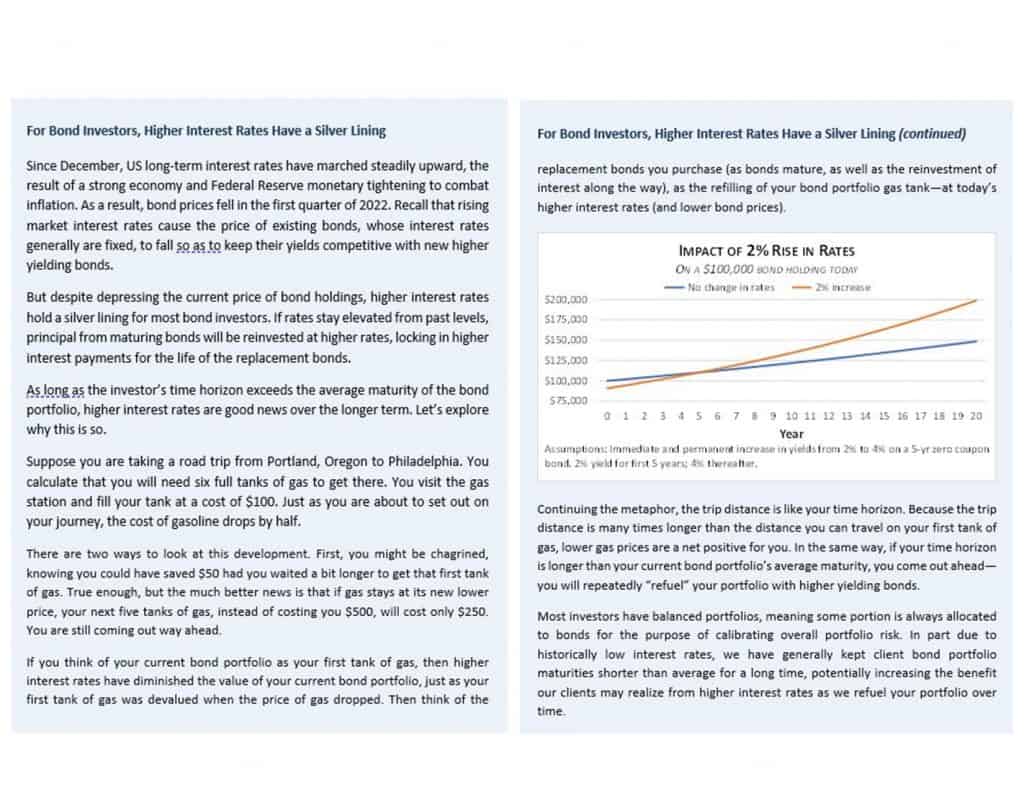
Since December, US long-term interest rates have marched steadily upward, the result of a strong economy and Federal Reserve monetary tightening to combat inflation. As a result, bond prices fell in the first quarter of 2022. Rising market interest rates cause bond prices to fall, to keep their yields competitive with new bonds with higher yields.
Lower bond prices aside, higher interest rates hold a silver lining for most bond investors. If rates stay elevated from past levels, principal from maturing bonds will be reinvested at higher rates, locking in higher interest payments for the life of the replacement bonds. If your investment time horizon exceeds the average maturity of your bond portfolio, higher interest rates are good news over the longer term.
Here’s an analogy. Suppose you are taking a road trip from Claremont, California to Claremont, New Hampshire. You calculate that you will need six full tanks of gas to get there. You visit the gas station and fill your tank at a cost of $100. Just as you are about to set out on your journey, the cost of gasoline drops by half. There are two ways to look at this development. First, you might be chagrined, knowing you could have saved $50 had you waited a bit longer to get that first tank of gas. True enough, but the much better news is that if gas stays at its new lower price, your next five tanks of gas will cost $250, not $500. You are still coming out way ahead.
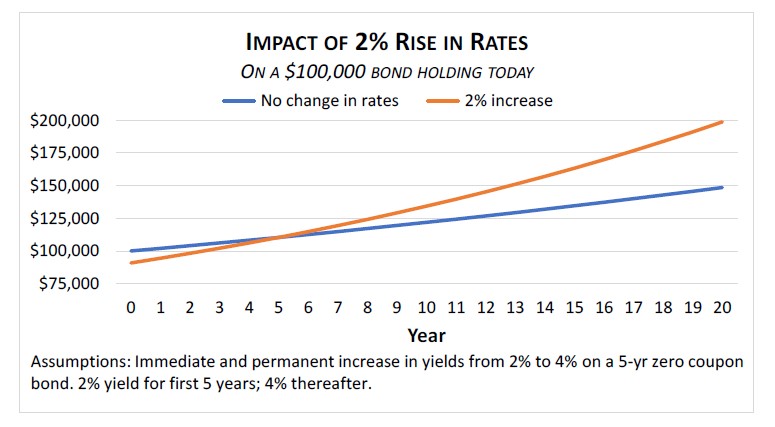
Think of your current bond portfolio as your first tank of gas. Yes, higher interest rates have diminished the value of what you hold today, just as your first tank of gas was devalued when the price of gas dropped. But the replacement bonds you purchase (as existing bonds mature and as interest is reinvested) will pay a higher interest rate. The accompanying chart shows how a 2% rise in market interest rates reduces the bond portfolio’s immediate value, but leads to a substantially higher value over time.
Don Gould is president and chief investment officer of Gould Asset Management.
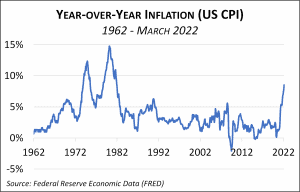
Inflation is now at levels not seen in 40 years, thanks to a
perfect storm of events. First, governments countered the Covid pandemic with
massive fiscal and monetary stimulus, pumping up consumer demand and tightening
labor markets, both inflationary. The pandemic also caused long-lasting
disruptions in supply chains. Now, in the wake of war in Ukraine, energy and
food prices have spiked further.
The Federal Reserve has responded to inflation with a U-turn
on monetary policy, raising short-term interest rates and likely soon reducing
its bond holdings, which puts upward pressure on longer-term interest rates, as
well. The Fed will try to engineer the proverbial “soft landing,” applying the
brakes enough to tamp down inflation, but not so hard as to throw the economy
into recession.
It will be a challenge for the Fed. Higher interest
rates—intended to restrain demand—will be countered by flush consumers and
pent-up demand. And Fed policies can’t help at all on the supply side. Most of
all, the Fed needs to combat inflation expectations that can ingrain a
self-reinforcing cycle of wage and price increases.
Recession Ahead?
Talk of economic recession is suddenly everywhere. Possible
triggers include the Fed’s tightening, rising prices that sap consumer sentiment
and buying power, and global uncertainty surrounding the war in Ukraine.
Countering this view is today’s reality—consumers spending freely, a robust
jobs market, and rising wages.
Ordinarily, we would put low odds on
imminent recession. However, some of us remember when Fed Chair Paul Volcker
jacked up short-term interest rates to near 20% to break the inflationary
psychology of the late 1970s. Recession then was unavoidable. We don’t yet know
what level of interest rates will be required to change today’s mindset.
The Treasury yield curve has flattened and even inverted in
some places, meaning shorter-term interest rates exceed longer-term rates,
historically a harbinger of recession, though not always so. Some help on the
supply side—more people entering the workforce, easing of supply
bottlenecks—could dampen inflationary pressures. Fingers crossed on that score.
Stocks and Bonds Decline in Concert
After nearly 13 years of mostly rising stock and bond prices,
it’s easy to forget that financial markets can go down, as well as up. In most
environments, stocks and bonds tend either to move inversely to one another or
not correlate much at all, steadying overall portfolio returns. However, with
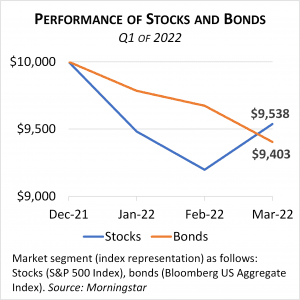
both stock and bond prices falling in the first quarter, investors had few
places to hide. Both aggressive and conservative portfolios declined similarly.
It’s never pleasant to see lower
numbers on our quarterly statements, but as always it helps to put the numbers
in perspective. The S&P 500 benchmark stock index ended the quarter at a
level that represented an all-time high as recently as November of last year.
Likewise, the recent spike in the 10-year US Treasury yield takes it back only
to levels seen repeatedly over the past decade.
However, inflation, both current and projected, is running at a rate not seen in a very long time. Left unchecked, inflation is a serious problem for financial markets. Fortunately, the Fed appears seriously committed to fighting inflation, even at the cost of near-term economic and market pain. Meanwhile, we remind clients that growth-oriented assets such as stocks and real estate eventually adjust to inflation. And as discussed in a separate note in this quarterly report, higher interest rates are mostly good news for bond investors, even though they depress the price of current holdings. Even cash holdings will soon be paying a positive interest rate again.
What we are experiencing today in financial markets is not unprecedented. With calm, discipline, and some adaptation, investors should expect to meet their long-term goals. It's our privilege to be your guide and companion on this journey.
US Growth Strong Despite Emergence of New Headwinds
The US economy expanded at a 6.9% annualized rate in the fourth quarter and grew 5.7% for the whole of 2021, the strongest pace since 1984. Momentum slowed to start the new year amid a surge in Covid cases in January and sustained high inflation.
Employers added over 400,000 jobs for the 11th straight month in March, and the headline unemployment rate fell to 3.6%. Job openings remain near record highs, drawing in more workers to the labor pool. Wage growth is strong, rising 5.6% year over year, but still lags the current pace of inflation.
Manufacturing activity slowed in March as supply chain issues continued to drive up input prices. Hiring in the sector picked up though, allowing factories to clear some of the backlog of unfinished work.
With a marked decline in Covid cases by the end of the quarter, consumers shifted their spending in March from motor vehicles and other goods to services like hotels, restaurants, air travel, and healthcare. Household balance sheets are generally healthy due to accumulated savings through the pandemic and rising wages for workers.
Liftoff at the Federal Reserve
The Fed raised its key interest rate by 0.25% its first increase since 2018, and penciled in six more quarter percentage point hikes by the end of the year as it aims to cool high levels of inflation.
Fed chair Jerome Powell indicated he is willing to do whatever it takes to tame inflation and signaled the committee’s willingness to implement multiple 0.50% rate hikes, if necessary. A plan to reduce the Fed’s balance sheet could also be finalized in May, with officials signaling a quicker unwind than the one carried out in 2017.
Market participants are expecting even tighter monetary conditions than the Fed is projecting. Markets are forecasting the federal funds rate (currently 0.25% 0.50%) to be 2.50% 2.75% by year end, suggesting the Fed will implement several 0.50% rate increases.
Recession talk has increased as a result of monetary tightening, but Mr. Powell deflected these concerns, pointing to strong household balance sheets and consumer demand.
The US stock market rocketed upward
by more than 10% in the fourth quarter, finishing another remarkable year at
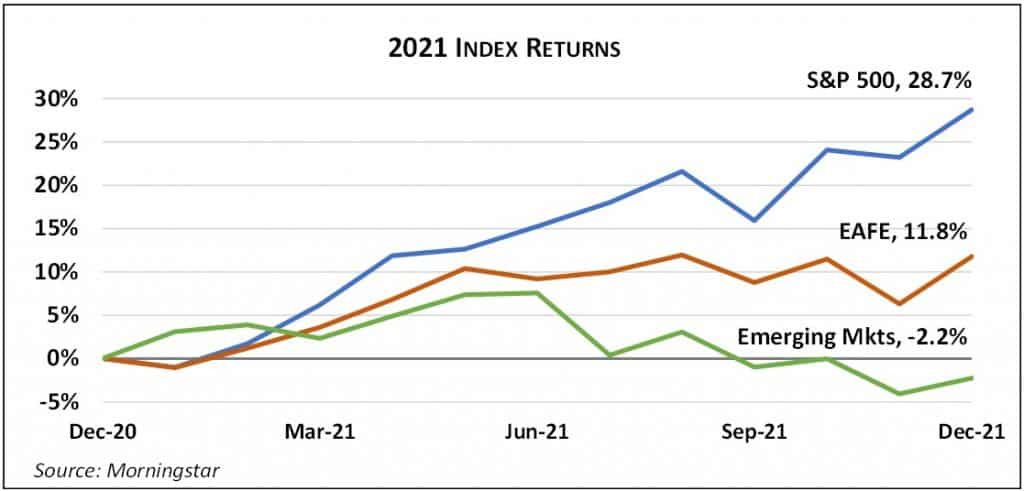
all-time highs. The large cap S&P 500 index returned a whopping 28.7% in 2021.
Strong corporate earnings combined with historically low interest rates
continued to support stock prices.
2021 marked the third straight year of outsized returns for US large cap stocks, a period in which the index achieved a compound annual return of 26.1%. To put that astounding number in perspective, in the 20 years ended 12/31/21 (a period obviously including the most recent three strong years), the S&P 500 had a compound average annual return of about 9.5%, a reminder that the recent streak is far from the norm.
The booming US indexes mask some cautionary
signs. A shrinking number of large growth stocks accounted for most of the
market’s gains late in the year, indicating less “breadth” to the rally. The
accompanying chart illustrates how a concentrated group of stocks (which
included Microsoft, Nvidia, Apple, Alphabet (Google), and Tesla) powered the
S&P 500 higher in recent months.
Foreign stock markets also substantially trailed the US last year, meaning breadth was also lacking globally.
A Less Accommodating Fed
We also note last year’s rebound in
interest rates off the early pandemic lows and the concomitant decline in bond
prices. Steadily declining interest rates have long supported equities by
making stocks more attractive in comparison to bonds. With the Fed now
curtailing bond purchases and likely soon raising short-term interest rates to
try to tamp down resurgent inflation, stock markets face a headwind this year.
2022 has already seen meaningfully higher rates across the yield curve,
accompanied by heightened stock market volatility, so we’ll see if stocks are up
to the challenge.
We continue to closely watch the
course of interest rates because of both their potential impact on stock prices
and the effect they may have on economic growth.
Controlling Risk
A rising market tide tends to lift
all boats and the converse also applies. Tempting as it may be to try to time
the market, no one does it well. Taxes and opportunity cost—being out of the
market when it turns north again—make timing a losing proposition.
We manage the risk of downturns
through prudent diversification, holding both stocks and bonds, as well as
other asset types, in proportions consistent with each client’s tolerance for
risk. Diversification within asset classes is important, too; that is, owning
both growth and value stocks, domestic and international stocks, and so on.
Regular portfolio rebalancing—paring back the biggest winners and reallocating
to the lagging sectors—protects against both excessive optimism and undue
pessimism while keeping overall portfolio risk steadier through time.
Whither Withering Inflation?
Possibly the biggest question
entering 2022 is what course inflation takes this year. Fueled by record
amounts of government stimulus, consumer demand snapped back from its pandemic
lows much more quickly than businesses could crank up supply. When demand grows
faster than supply, prices rise, aka inflation. US inflation surged last year
to over 7%, a level not seen in 40 years.
Sustained higher inflation is
particularly damaging to long-term fixed-rate bonds, as it reduces the purchasing
power of future interest and principal payments. The relatively modest decline
in bond prices last year reflects a market consensus that the pandemic will
recede, supply will adjust upward, and inflation will fade to something closer
to the 2% level that has prevailed since the mid-1990s. The Fed seems
determined not to let expectations of higher inflation become ingrained, even
at the cost of higher interest rates that could slow the economy and drive
market turbulence in the coming months.
Stocks Surge Despite Inflation
and Omicron Concerns, Capping Another Strong Year
US stocks finished the year on a
strong note despite rising Omicron cases and the highest US inflation rate
since 1982. The
market was not to be deterred, with US large cap stocks, as measured by the
S&P 500 stock index, rising 11.0% in the fourth quarter, finishing 2021
with a remarkable 28.7% gain. This is the third straight year of strong US
stock performance.
A market-cap-weighted indexed
approach proved best in 2021, with
a small number of large cap stocks accounting for a significant portion of US
stock gains. This was evidenced by five stocks—Meta (Facebook), Apple, Amazon,
Microsoft, and Google—accounting for nearly a third of the S&P 500’s 28.7%
gain.
Mid and small cap US stocks, as
measured by the Wilshire 4500 index, were unable to keep pace with
large caps, rising
a modest 1.7% in Q4 and 16.0% on the year. The significant underperformance on
the quarter was attributed to fears that slowing economic growth and rising
Omicron concerns would disproportionately impact smaller firms.
Technology stocks, led by strong gains from chipmakers, were the best performing sector in the fourth quarter, rising 16.6% in Q4 and 34.7% on the year. Financials took the top spot on the year—rising 35.0% in 2021—as higher interest rates increase lending profits. Utilities and Consumer Staples trailed the pack, but even they rose 17.7% and 17.3%, respectively, in 2021.
International stocks were unable to keep pace with US equities, lagging for both the quarter and the year, as international economic growth remains slow and the US dollar strong (up 3.3% in 2021). The MSCI EAFE index rose 2.7% in the fourth quarter, finishing the year up 11.8%, or less than half the return of US stocks.
Emerging markets stocks were weaker still, declining 1.2% in Q4 and 2.2% for the year. The causes are myriad, ranging from political instability (Chile), to geopolitical tensions (Russia), to inflation concerns (Brazil), and currency volatility (Turkey), not to mention the impact of Covid. Valuations look attractive, but that’s been the case for many years. Patience is counseled
Last week in Part One of this two-part series, I focused on how to increase the tax benefit of your charitable donations, enabling you to give more to charity at the same net cost. In this Part Two, I will review three other strategies for tax-smart charitable giving.
1 - Donating Appreciated Assets Instead of Cash
Reportedly, 88% of all donations are made in cash, including checks and credit cards. For many donors there’s a better way—giving highly appreciated assets such as stocks and mutual funds. You benefit whether you make donations directly to a charity or via a donor-advised fund (DAF).
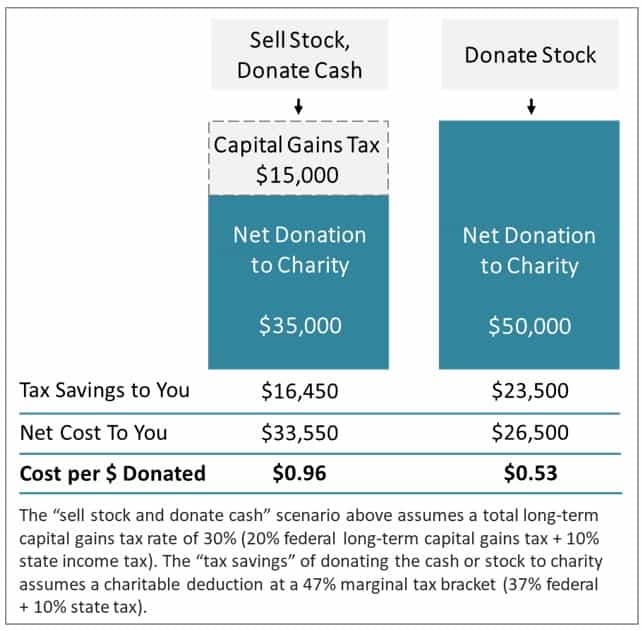
Suppose you were smart (or lucky) enough to buy stock in Amazon 20 years ago that you still own today. Almost 100% of the value of that stock is the increase since you purchased it. If you sold the stock today, say $50,000 worth, depending on your tax bracket you could easily pay 30% ($15,000) in capital gains tax to the IRS and the State of California, leaving you with $35,000 after tax.
The $35,000 cash donation gets you a tax deduction of $35,000, while the charity receives $35,000. If, instead of selling, you donate the stock, you get a tax deduction of $50,000 and the charity receives $50,000. (As a tax-exempt entity, the charity can sell the stock and owe no tax.) Donating the stock directly earns you a larger tax deduction and sends more to the charity, all by avoiding the capital gains taxes you would have paid had you sold the stock yourself. The accompanying chart Illustrates this.
If you think the stock you’ll donate remains a good investment, simply repurchase the same stock right after your donation. If you eventually sell the repurchased stock, your capital gains tax will be much lower because it will be based on the price you paid for the stock today, not 20 years ago.
2 - Qualified Charitable Distributions – A Gift to IRA Owners
Since 2006, people at least 70-1/2 years old have been able to make Qualified Charitable Distributions (QCDs) directly from their IRAs to charities. If you qualify, you can distribute up to $100,000 per year to your favorite charities. The distributions also count towards your required minimum distribution (RMD). (Note: QCDs must come from pre-tax IRA assets only, not from after-tax IRA or Roth IRA assets. Also, QCDs must go directly from your IRA to charities and cannot be made to a DAF.)
The QCD gives people who don’t itemize the same or even better tax benefits than taxpayers who itemize. That’s because QCDs are donations made with pre-tax dollars. For QCD-eligible taxpayers who do not itemize deductions, using the QCD for your charitable donations is a no-brainer.
Even if you itemize you could come out a bit ahead using the QCD instead of the traditional tax-deductible donation route. The QCD reduces your tax return’s top-line income, resulting in tax savings that are at least equal to and sometimes greater than the savings from a charitable deduction lower down on the tax return.
3 - Death and Taxes? Maybe Not So Certain
Every owner of a retirement plan—IRA, 401(k), 403(b), etc.—must name beneficiaries. Most people leave their retirement assets to their spouse and/or other immediate family members.
But if your estate plan includes bequests to charity, consider naming charities as beneficiaries of your retirement plans. When you leave your pre-tax IRA assets to charity, you are transferring funds that never have and never will be taxed. This may well be the lone exception to the adage that the only certain things in life are death and taxes.
Here’s why: With some exceptions such as Roth IRAs, most retirement plans are funded with pre-tax reductions in gross income, usually through a company retirement plan or direct contributions to an IRA. When tax-exempt charities receive your retirement plan assets, they do not pay tax. In other words, you have dollars of income that go untaxed from the day they are earned through the day they are used by your favorite charities. And they said it couldn’t be done.
In contrast, if you leave after-tax assets to charity and your retirement plan assets to family, your heirs will have to pay income tax on the distributions they must take from the retirement assets, and possibly also estate tax on their pre-tax value. While each situation is different and requires careful analysis, if you are planning to leave money to charity, naming charities as beneficiaries of your retirement plans deserves your consideration.
[This article provides general guidance. As with all tax matters, you should consult with your tax advisor before making tax-related decisions.]
Don Gould is president and chief investment officer of Gould Asset Management.
“Give us your clunker and save on taxes!” “Call your PBS station right now and make a tax-deductible donation to support public television!” By now, it has been well pounded into our brains that donations to qualified charities are tax-deductible in the year the gift is made.
The implication is that the donation will lessen your tax bill, reducing the donation’s net cost to you. But that’s not always the case. With year-end approaching, it’s a good time for a refresher on the most tax-smart ways to make your gifts to charity.
In part one of this two-part series, I’ll focus on how to increase the tax savings from your charitable donations. Keep in mind that the real prize to tax-smart giving is that you can potentially give much more to your favorite charities at the same net cost.
To Itemize or Not
Understand that the charitable deduction only benefits taxpayers who itemize their deductions on Schedule A of the Form 1040 tax return. And it only makes sense to itemize your deductions if they total more than the “standard deduction” the IRS affords to all taxpayers.
The tax bill passed in late 2017 boosted the standard deduction for single filers from $6,500 to $12,550 and for married couples from $13,000 to $25,100. If you’re married and your itemized deductions total less than $25,100, you are better off taking the standard deduction and not itemizing.
At the same time, the 2017 tax bill severely limited the so-called SALT (state and local tax) deduction. Taxpayers in states with high income tax rates, including California, were hurt most by this change. Previously, the SALT deduction had been the single largest category of itemized deduction, followed by mortgage interest and charitable contributions.
Together, these two changes have cut the number of taxpayers who itemize by more than two-thirds. And if you don’t itemize, then your next donation to charity will not reduce your tax bill. But fear not—there are still ways to make your gifts more tax-efficient.
(Note: there is one exception to this rule. In 2021, even people who do not itemize can take a deduction for cash donations to charity—$300 for a single person, or $600 for a married couple.)
Bunching Your Donations
Suppose you are a married couple that gives $8,000 annually to charity. And let’s further assume that this plus your other potential deductions totals less than the $25,100 standard deduction. In that case, you will use the standard deduction. The $8,000 you give to charity each year will not reduce your tax bill.
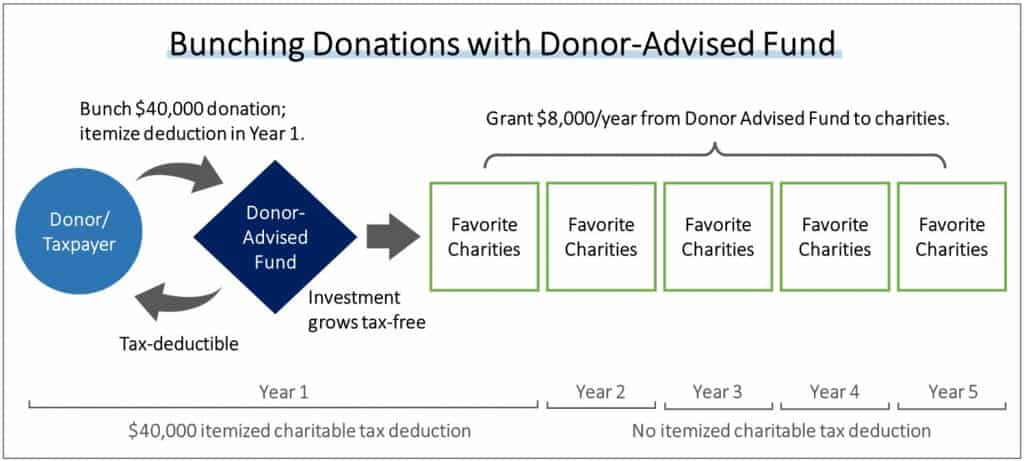
But if instead you make five years’ worth of gifts in a single year ($40,000 total), you would be able to itemize in the year of that gift and significantly reduce your taxable income. This is sometimes called “bunching” your donations.
The Donor-Advised Fund to the Rescue
I hear you thinking, “But my favorite charities need money every year, so I would like to give every year.” Fair enough, and happily there is a clever workaround. It’s called the “donor-advised fund,” or DAF.
A DAF is itself a qualified charity. Fidelity Charitable is the largest, but there are many other DAF sponsors, including Schwab and Vanguard. With a DAF, instead of making donations directly to charities, you can make a lump sum tax-deductible gift to an account you create with the DAF. You then instruct the DAF to make “grants” to your selected charities, whenever you like.
In our example above, you could bunch your donations by making a $40,000 donation to the DAF in 2021, enabling you to itemize deductions and save on this year’s tax bill. Then you can grant $8,000 per year from the DAF over a 5-year period, accomplishing both your tax and charitable objectives. See the accompanying chart for an illustration.
Note: Only your gift to the DAF is tax-deductible. The subsequent grants from the DAF are not. Even if the charity receiving the DAF grant sends you a nice receipt, do not try to take the same tax deduction twice!
Coming in Part Two
In part two next week, I will discuss why donating appreciated securities is better than donating cash. That holds true whether you make donations directly to a charity or via a DAF. I will also talk about the remarkable opportunities that IRAs and other retirement plans offer for making tax-efficient donations to charity.
[This article provides general guidance. As with all tax matters, you should consult with your tax advisor before making tax-related decisions.]
Don Gould is president and chief investment officer of Gould Asset Management.
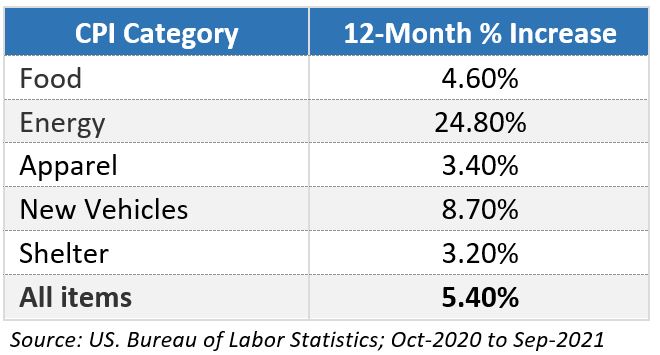
Inflation is back. You can see it at the grocery store, in restaurants, wages, housing costs, gasoline, and many other places. Inflation also manifests in a more subtle way—getting less for what you pay. Have you noticed that the same postage stamp buys slower delivery of your birthday card? Or that you must wait longer to get served in almost any retail setting?
Of the many rules of economics we
were once taught, the role of supply and demand in determining prices is one
that has survived intact. A drop in supply, rise in demand, or a combination of
the two will push prices higher, restoring the balance between the quantity of
goods and services supplied and consumed.
Let’s start with a look at the demand
side, using the US as an example. Understandably, at the pandemic’s outset both
Congress and the Federal Reserve were willing to use every tool at their
disposal to avoid a pandemic-induced economic depression. Trillions of dollars
of fiscal and monetary stimulus largely achieved that aim. Demand levels today
are well above their 2020 lows and probably not too different from their
heights of two years ago.
The Broken Supply Chain
The problem is, the pandemic has
taken a sledgehammer to global supply chains, that network of raw materials,
labor, manufacturing, and transportation that puts a product on the store
shelf. You may recall, not so long ago, businesses boasted of meeting consumer
demand “just-in-time.” While efficient at minimizing product inventory, factory
capacity, etc., thereby improving corporate profits, just-in-time processes
also left no margin for error when supply chains are disrupted.
Likewise, globalization—sourcing the
cheapest labor and materials worldwide—has been lauded for cutting prices and
boosting profits. The flip side of globalization is that the US, for example,
no longer produces many essential items domestically. To take one case, about
80% of key pharmaceutical components are made exclusively abroad. The upshot is
that when activity halts in one part of the world, its effects ripple globally.
Suddenly it seems everything is in
short supply. Take cars as one case study. Today’s vehicles are computers on
wheels, heavily dependent on a variety of chips to operate. Covid outbreaks
have repeatedly shuttered chip factories in Asia, leaving auto manufacturers
unable to push enough cars to the showroom to meet buyer demand. The result:
new cars routinely selling well over sticker price and empty dealer lots.
Perhaps most worrisome is a
persistent labor shortage, a surprise to many who thought that idled workers
would return to the workforce at their earliest opportunity. Instead, the
pandemic has been a wake-up call to many—perhaps a reminder that life is finite
and one should be as selective as circumstances permit in deciding if and where
to work.
Some call this the “Great
Reassessment.” Many baby boomers have retired ahead of schedule. Former
restaurant workers now perceive that work as both stressful and unstable.
Higher wages don’t seem to be enough to fix this—$40,000 per year dishwasher
jobs are going unfilled. Smaller businesses, lacking scale, seem hardest hit.
Help wanted signs are everywhere, often next to a hand-lettered sign advising
of reduced store hours.
Other factors are at work, too. For
example, women are returning to work at a significantly slower rate than men.
This might reflect the disproportionate share of childcare duties taken on by
women, the uneven process of kids returning to school, and the high cost and
limited availability of childcare for pre-kindergarten children.
When a business can’t get all the
workers it needs and must pay more for those it can get, the result is higher
prices for the end-product, and less of it.
And as if on cue, energy prices have
spiked, reminding us of the oil crises that exacerbated inflation in the 1970s.
Energy supplies have not kept up with rebounding consumer demand. A big reason:
climate change and the transition to renewable energy have made fossil fuels
both less desirable and available. Factories in China have curtailed operating
hours due to electricity rationing, further straining supply chains.
Why
Inflation Matters to Investors
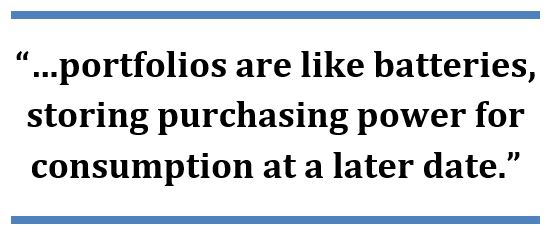
We often look at our portfolios as an end in themselves, but
in fact portfolios are like batteries, storing purchasing power for consumption
at a later date. Like a battery losing some of its charge, inflation erodes the
purchasing power of assets, making our portfolios less valuable in real terms.
Long-term fixed rate bonds are especially vulnerable to unanticipated inflation
because the interest and principal they pay is a fixed dollar amount, even as
the dollar buys less each year.
In a normally functioning market,
investors facing higher expected inflation demand a higher interest rate on new
bonds to compensate for the more rapid loss of purchasing power over the bond’s
life. In turn, this pushes down the price of existing bonds, elevating their
yields to keep them competitive with new bonds.
Meaningfully higher bond yields could
also adversely affect the price of riskier assets such as stocks and real
estate, whose required returns (and therefore prices) are calibrated to the
available yield on less risky assets such as bonds.
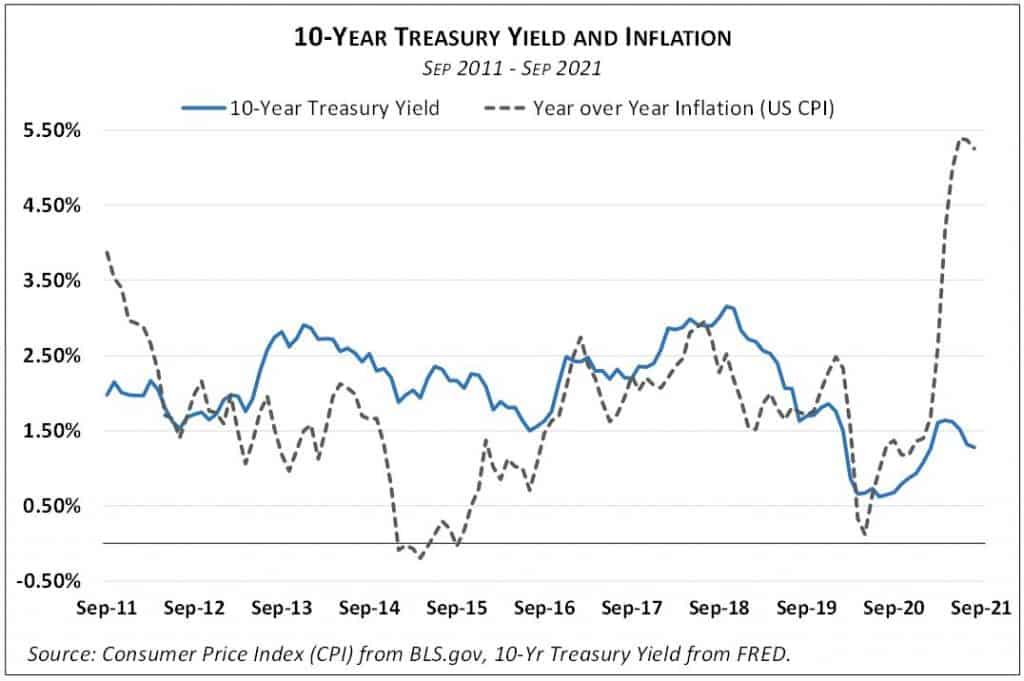
The accompanying chart shows that
despite a bounce from last year’s pandemic lows, bond yields have not nearly
kept up with inflation. Instead, long-term Treasury yields remain near historic
lows. We can think of two possible explanations. One is that the market accepts
the Fed’s assertion that the inflation jump is transitory, and inflation will drop
to pre-pandemic levels relatively soon. The other is that the market expects
inflation to really be higher than recent norms, but expansive monetary policy
(including central bank open-market bond purchases; so-called Quantitative
Easing or QE) is artificially depressing bond yields worldwide.
Whether this jump in inflation is
long-lasting or just a blip may depend in part on psychology. If people believe
inflation is back to stay, contracts will start to build in that assumption,
creating a feedback loop that makes higher inflation a self-fulfilling
prophecy.
No matter how this plays out, we must
acknowledge that inflation meaningfully chipped away at portfolios’ purchasing
power in the last year. We are watching this development closely.