The following is a recap of Don Gould’s remarks to clients at our 25th anniversary client appreciation event at The Huntington on September 30, 2024.
Dear Clients,
It seems that a 25th company anniversary calls for some reflections, so here goes.
First, my thanks to the whole Gould team, from Portfolio Management to Service to Administration. As you know from your interactions with us, it’s an amazing team that always puts service to our clients first. I am so proud of the workplace we have built. It’s a place where we can know each of our clients in a close and personal way, and where our clients—you—can look for trusted advice and excellence in the management of your financial assets. It’s a place where we can see our work meaningfully improving your lives. It’s also a workplace where everyone likes one another, likes their work, and works together as a team, all while promoting a healthy work-life balance.
For most of the 1990s, I was a “big shot” at one of the world’s largest asset managers. I jetted around the world, had a prestigious business card, and regularly rubbed elbows with the famous, powerful, and very wealthy. It was heady stuff. One day I gave it all up to start Gould Asset Management in a one-room office above Goldstein Optometry on Indian Hill Boulevard in bucolic little Claremont. What motivated me to make such a move?
We live in a culture that tends to worship growth and bigness. Bigger is different, but not necessarily better. When I was in a big company, I found that the higher up you are on the ladder, the more removed you are from the people your business is supposed to be serving. You spend most of your time negotiating deals with other businesspeople, and you tend to focus on keeping the people above you happy rather than the company’s clients.
I once read a book titled “Small Is Beautiful: Economics as if People Mattered” by E. F. Schumacher. I took the title to heart and believe it contains an essential truth about business and human relations. Starting Gould Asset Management was about getting back to smallness. We are, at heart, a small and personal company. Not by accident, we are based in Claremont, a small town where people know each other, are involved in the community, and work together toward the collective good. We are proud that Gould is a strong and consistent contributor to that effort.
Now, obviously, this small company has grown. From one person to fourteen, serving well over 300 households and nonprofit organizations, with about $950 million in assets under management. So, you may be thinking, how does this growing company stay small? I think that is both our great accomplishment and our ongoing commitment to you, our clients. We have retained the culture and essence of a small and personal business, and we will strive to maintain that no matter how much we may grow by the numbers.
How will we do that? First, by always making service to our existing clients our top priority; we will never sacrifice quality of service for the sake of growth. Second, by keeping our independence. That starts with running our own show—our company is majority-owned and 100% controlled by the people who work here. That means we are not beholden to some large, remote organization telling us how to manage our clients’ portfolios. Independence means we can think independently on your behalf, and we believe this leads to better outcomes. At Gould, there’s only one client and it’s you.
Finally, none of this happens without you, our clients. On behalf of the whole Gould team, thank you from the bottom of our hearts for allowing us to serve you for the last 25 years. To the next 25!
Twenty-five years ago, I started Gould Asset Management in a small office above what was then Goldstein Optometry, on the east side of Indian Hill Boulevard between First and Second streets. The occasion of our silver anniversary prompted me to reflect on the major changes I’ve witnessed in the investment world since 1999. This is the first in a series looking back at major developments over the last quarter century, and lessons learned.
The Vanguard effect: driving down fund costs
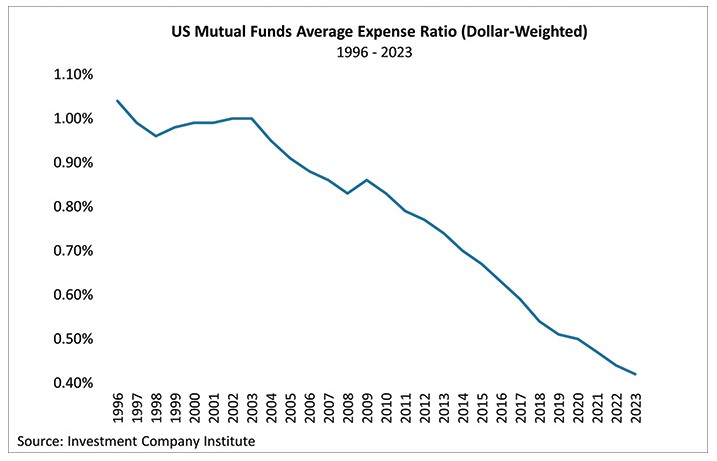
Among the most important financial services industry trends of the last quarter century is the steady decline in the cost of core investment products such as mutual funds. It all began with Vanguard, the mutual fund behemoth launched in the 1970s. Unlike for-profit fund companies, Vanguard’s management company is indirectly owned by its customers, the investors in its funds. Consequently, Vanguard charges only enough management fees to cover its costs, with no profit margin added on, leading to lower fund expenses than most competitors.
This cost edge has given Vanguard funds a lasting performance advantage, enabling Vanguard to grow faster than its competitors. As a fund grows, its fixed costs are spread over a larger base, leading to still lower fund expenses per dollar invested, a larger performance advantage, and yet bigger funds — a virtuous circle.
Thanks to Vanguard, price competition has spread across the entire fund industry, bringing down costs for all investors and effectively shifting hundreds of billions of dollars annually from fund managers to investors. Vanguard’s founder, the late Jack Bogle, arguably has done more for investors than anyone else, ever.
Enter the index fund:investments get commoditized
But the story would not be complete without another Vanguard innovation, the index fund. An index fund simply seeks to replicate the performance of a selected index (such as the S&P 500) by owning all the component stocks of the index in the same proportions as the index.
Index funds have become a commodity — Vanguard’s and Fidelity’s S&P 500 funds are virtually indistinguishable, holding the same stocks in the same proportions. Like soybeans or copper, there is essentially no difference between two index funds following the same index. So, like dueling gas stations on opposite corners, index fund providers must compete on their management fees, which have become vanishingly small. Many index funds charge less than two basis points annually, which equates to under $20 per year on a $100,000 investment.
Historically, mutual funds were promoted with the idea that if you just picked the right fund (which employed the right manager, who picked the right stocks), you would beat the pack. But because the average performance of all investors is, by definition, average, for every stock picker who beats the average, there must be one who trails it. Unlike in mythical Lake Wobegon, all money managers cannot be above average. Compounding the challenge, markets seem to be mostly efficient. That means that a manager who beats the market in one year has only a coin’s toss chance of doing it again the next year.
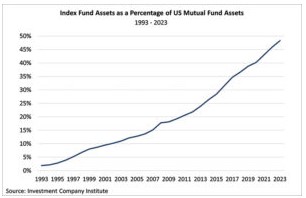
Collectively, non-index funds, aka active funds, perform in line with an index fund (before expenses and taxes), though individual fund performance varies widely. This is true, even if you could find that elusive manager who consistently beats the market.* When we consider the higher expenses of active funds, their collective performance consistently trails the performance of index funds. So, it’s no surprise that index funds have steadily gained market share in recent decades.
A third innovation is the exchange-traded fund, or ETF. The ETF is a special form of a mutual fund that trades continuously throughout the day, like individual stocks. Traditional mutual funds trade only once a day. First launched by State Street Bank in 1993, the ETF is in many ways a better mousetrap than the traditional mutual fund, offering greater liquidity and ease of trading, better tax efficiency, and lower costs. ETFs, which are mostly index funds, have boomed in recent decades and represent the latest chapter in the commoditization of investment products.
In a commoditized world, the biggest players tend to have the lowest prices. Think Amazon and Walmart in retailing. Their counterparts in the ETF world are BlackRock and Vanguard, which together control about two-thirds of the market. Each firm oversees roughly $9 trillion in assets.
The tax savings have a present value of roughly $30 million, recouping part of the contract money he left on the table—and at the expense of California’s tax collector, not the Dodgers.
Next up is, Part II — The empire strikes back: investments get complexified.
Don Gould is president and chief investment officer of Gould Asset Management of Claremont.
Socially responsible investing is on the rise, and Gould Asset Management has a process to support clients who want to incorporate social considerations into their investment portfolios.
According to Sustainable Signals, a report from the Morgan Stanley Institute for Sustainable Investing, roughly 54% of individual investors say they plan to increase sustainable investments over the next year. And 77% of global investors are interested in investing in companies or funds that give them both a competitive market return and a positive impact on society or the environment.
If you want to invest and try to move the needle on a specific issue or cause, Gould Asset Management has considerable experience in socially responsible investing. Here’s a look at the process a registered investment advisor (RIA) can use to help you make a difference.
What Is Socially Responsible Investing?
Socially responsible investing, also known as ethical investing, green investing, sustainable investing, or values-based investing, focuses on selecting investments that aim to generate competitive long-term financial returns while positively impacting society. Once considered an unusual approach, it has evolved and grown in popularity among investors over the years.
This investment strategy is often implemented with a focus on three key factors: environmental, social, and governance (ESG).
Environmental: Company’s policies and impact with respect to the environment
Social: Company’s practices with employees, customers, and the community
Governance: Company’s management structure, policies, and practices
Socially responsible investing also includes impact investing, where an investment is expected to produce a direct social benefit, and investment screening, which excludes companies and/or industries whose businesses or practices run contrary to a client’s goals.
Our Role in Assisting Your Socially Responsible Investing Goals
Many Gould Asset Management clients consider socially responsible investing for their portfolios, and our process supports them. Understanding clients' objectives and values is essential in all types of investing, but it is especially important here.
The advisors at Gould Asset Management work closely with clients to learn about their social goals, values, and motivations. A crucial point to understand from the start is how clients think about defining and implementing a socially responsible investment plan. It’s different for every client.
While each client might have a different way of looking at socially responsible investing, there are three elements we focus on to align with our clients’ investment goals:
Determining the social goals with the highest priority
Identifying the investments that match those priorities
Understanding the tradeoffs
To identify investments for clients, our firm monitors an ever-growing pool of socially responsible investment vehicles, including index and actively managed funds, exchange-traded funds, managed mutual funds, and individual equities managed according to client-specified criteria.
Gould Asset Management overlays its approach to socially responsible investing on top of diversified, risk-managed strategies, which can be customized for different risk tolerances and return objectives.
A Financial Advisor Can Guide Your Socially Responsible Investment Journey
Do you have causes or issues you want to support financially while generating a competitive market return? Gould Asset Management works with a diverse range of investors, applying our substantial experience in socially responsible investing.
Please contact us to see how we might help you invest in a way that supports the issues and causes you believe in. To schedule a meeting, call (909) 445-1291, email contact@gouldasset.com, or request a meeting on our website.
About Scott
Scott Smith is Partner and Senior Portfolio Manager at Gould Asset Management (founded in 1999), an independent registered investment adviser based in Claremont, California. The firm manages customized portfolios on behalf of individuals, families, and nonprofits, and offers a range of services, including retirement planning, charitable giving strategies, and values-based investment options. As fiduciaries, they always put their clients’ interests first while providing a culture of superior personal service.
Scott Smith joined Gould Asset Management in 2004 and is a partner at the firm. In his role as a senior portfolio manager, he provides ongoing expert management of client investment portfolios, with an emphasis on Gould’s asset allocation and covered-call writing strategies. Among his investment interests, Scott has developed expertise in helping clients implement their “responsible investing” goals, which can include environmental, social and corporate governance aims. He also oversees the firm’s investment technology initiatives.
Prior to 2004, Scott worked as a business and litigation consultant for Tucker Alan Inc (now Navigant Consulting), where he performed financial and economic analyses, developed financial models, and conducted market and company-specific research.
Scott received a Bachelor of Arts in Economics, with honors, from Claremont McKenna College and an MBA from the Peter F. Drucker and Masatoshi Ito Graduate School of Management at the Claremont Graduate University (CGU). It was at CGU that Scott met Don Gould, who was teaching an investment management practicum course as an adjunct faculty member. Upon completion of the course (and Scott’s MBA), Don offered Scott a position at Gould and the rest, as they say, is history.
Scott holds the Chartered Financial Analyst® (CFA®) designation, and is a member of the CFA Institute and the CFA Society of Los Angeles. Scott resides in Claremont, California with his wife, Claire, and their two children, Addie and Asher. He enjoys traveling, skiing, and golfing in his free time and is actively involved in his local church. To learn more about Scott, connect with him on LinkedIn.
How is it already July? Some posit that time seems to accelerate because each successive year represents a smaller fraction of our lifetime. In briefer contexts, the perception of time seems to depend on where you sit. For example, during the recent deciding Game 7 of the National Hockey League’s Stanley Cup Finals, the Florida Panthers led the Edmonton Oilers 2-1 early in the final 20-minute period. The announcer insightfully observed that Edmonton players and coaches likely saw the clock flying by (their time running out), while to the Florida side it seemed to crawl. (Florida outlasted the clock, hanging on to win 2-1 and taking its first-ever championship.)
Another Banner Quarter for Stocks
Time moves briskly for investors when stock indexes are surging upward as they have in 2024, and while the pace of the rise moderated in the second quarter, equity markets still did well. The leading global benchmark added about 3%, taking its year-to-date gain to nearly 12%. Meanwhile, the S&P 500 US large cap index did better still as the usual tech giants fueled a 4.3% second quarter rise, bringing the year-to-date return to a heady 15.3%. Since the 2022 financial markets debacle, the S&P 500 is up a remarkable 45.6%
Bond returns remained lackluster in the second quarter, as interest income mostly offset modest bond price declines. But stellar stock market returns were enough for balanced portfolios to deliver solid returns in the second quarter and for 2024 year-to-date.
Both stocks and bonds may benefit from newfound, if cautious, optimism that the economy will achieve a soft landing, bringing inflation back toward central bank targets without a near-term recession. For a more detailed discussion on the economy and financial markets, be sure to see our accompanying quarterly Economic and Market Review.
Curbing Our Enthusiasm
To put recent equity market returns in perspective, US stocks have compounded at an average rate of about 10% per year over the past century, so we’ve seen about four years’ worth of normal returns in just the past 18 months. As usual, we have no crystal ball—returns over the next 3, 6, or 12 months could fall anywhere on the map. But common sense tells us that in an economy growing at its long-term trend rate of about 2% per year (net of inflation), recent equity market returns are not sustainable.
Further tempering our view is that by historical measures, stocks are expensive. What do we mean by “expensive?” We maintain an internal measure that compares how much investors are paying for a dollar of corporate earnings (from stocks) to what they must pay for a dollar of bond interest. As compensation for accepting the much greater volatility of stock markets, we would expect a dollar to buy more earnings than interest. When the spread is narrow, the expected reward for owning stocks is less, and in that situation, we might say stocks are expensive.
By our measure, the S&P 500 is, by a small amount, at its most expensive since at least 1941. Sadly, knowing when stocks are expensive has not been a reliable guide for market timing (and nor has anything else). Stock markets can remain expensive for a long time and continue climbing throughout. And there’s never any guarantee that historical relationships will be the norm in the future. Nonetheless, we believe the risk-reward tradeoff for stocks is less attractive than usual. Accordingly, in the second quarter we modestly trimmed our equity allocations in balanced portfolios. Should the situation persist, we are likely to continue to trim.
We note that valuation is only one of many factors we consider in determining target asset allocations. Even with our recent reduction in equity allocation, we remain slightly above a neutral target stock allocation. And, of course, regular portfolio rebalancing helps ensure that buoyant stock markets don’t leave risk exposures at undesirably high levels.
The Big Get Bigger
The ten largest US stocks now account for 37% of the S&P 500’s total value, their highest level since the 1960s. Just three stocks—Microsoft, Nvidia, and Apple—make up 21% of the index value. As investors, should we be concerned about the rising concentration? The answer is a definite maybe.
Those who worry about growing concentration cite similar periods in market history that ended badly. Some recall the so-called “Nifty 50” from the late 1960s. Xerox , GE, IBM, and Coca-Cola headlined the list of companies to buy and hold forever. The problem with this almost religious devotion to any set of stocks is that investors begin to ignore price. Almost any stock price can be justified—for a time. Eventually, usually after a negative turn in investor sentiment, people begin to scrutinize how much they are paying for an uncertain stream of future earnings. Before long, this buy-and-hold-no-matter-what wisdom is widely (and smugly) regarded as just another chapter in the long history of foolish speculative manias. Such was the fate of the Nifty 50.
Arguing the other side are those who say that this time is different. Today’s market leaders are viewed as quasi-monopolies that have already won a winner-take-all game. The omnipresence of Microsoft software, Apple iPhones, and Nvidia chips (reportedly an 80+% share of the AI chip market) makes this a compelling argument.
Absent the crystal ball, it’s impossible to know which side will prevail. Fortunately, you don’t need to pick sides. Diversification through index funds assures exposure to the market’s leaders. Index funds are often called “passive” because they simply replicate the weightings of a selected benchmark index such as the S&P 500. In fact, indexes (and the funds that follow them) are quite dynamic. Their company weightings change minute to minute based on the relative performance of the component stocks. Additionally, stocks are regularly added to (and removed from) the index based on such factors as a company’s growth (or shrinkage) and company mergers.
Most importantly, the stocks that perform the best make up a growing share of the index over time. If today’s big keep getting bigger, their weight in the index fund will continue to grow. And just as important, when today’s leaders are ultimately supplanted by companies we’ve not yet heard of, the index fund will own those, too.
[1] “Nifty” now seems like such a quaint word.
[2] The younger generations might be shocked to know that baby boomers viewed the first photocopiers with the same kind of wonder now reserved for virtual reality and artificial intelligence.
[3] In case you missed it, our recent webinar on AI touches on the potential rewards and risks of owning Nvidia. You can watch a replay here.
Note: This post is an excerpt from Gould Asset Management’s Economic and Market Review for the Second Quarter of 2024. The excerpt is posted here for the benefit of our blog subscribers.
Large-Caps Lead the Way in Q2 as Markets Continue Upward
US mega-cap tech stocks and emerging markets led the charge in the second quarter despite moderating economic growth, interest rate uncertainty, and geopolitical tensions. Investor optimism for artificial intelligence (AI) remains high, with strength in the large-cap technology sector pulling broad-based indexes higher. Meanwhile, international developed markets and mid and small cap stocks lagged.
US large cap stocks, as represented by the S&P 500 index, advanced 4.3% in Q2, with tech and especially AI-related stocks leading the charge. Investors also grew more optimistic about Fed rate cuts later this year, providing some added tailwind amid easing inflation. Year-to-date, US large cap stocks have risen 15.3% and are up nearly 25% over the past 12 months.
In addition to the Technology sector (up 8.8% in Q2), Communication Services (up 5.4%) also performed well on the quarter, as did Utilities (up 4.6%). Year-to-date, Tech has been the clear leader (up 18.0% in 2024), followed by Financials (up 10.2%), though the latter pared gains in Q2.
US mid and small cap stocks lagged large caps by a wide margin in Q2, with the Wilshire 4500 stock index falling 3.4%, putting year-to-date gains at a modest 3.9%. Investors are concerned that any potential economic slowdown might weigh heaviest on smaller companies, and AI-related gains have mostly bypassed smaller capitalization stocks.
International developed and emerging markets returns diverged in Q2, with the MSCI EAFE (developed markets) stock index falling 0.2% (up 5.8% year-to-date), while the MSCI Emerging Markets index rose 5.1% (up 7.7% year-to-date). A rebound in Chinese stock prices fueled emerging markets, while signs of economic slowing weighed on international developed stocks.
Market volatility rose briefly in April, with the VIX volatility index reaching a high of 19, but quickly subsided in May and June, finishing the quarter near 12.
If you think most financial advisors are more or less the same, think again. Beyond the numbers, a relationship built on trust, understanding, and shared goals can go a long way in helping you develop an investment strategy that works for you.
According to recent research, clients most value the following attributes in their financial advisors:
Frequent, proactive communication
Personalized investing guidance
Matching client needs with services provided
It seems that a strong personal connection plays as big a role as financial performance in the best client-advisor relationships. The research also suggests that solid relationships between clients and advisors are key to positive, long-term collaborations.
At Gould Asset Management, relationships are core to our business, and trust is at the heart of our relationship with each client. Here’s why your relationship with your financial advisor matters.
Your Relationship Is About Managing Money…and Much More
A strong relationship between you and your financial advisor is built on trust and understanding. That trust can lead to a more comprehensive plan and more personalized advice. Thorough and customized financial planning can result in a portfolio that meets your investment needs.
Initially, you might wonder why you and your financial advisor spend time discussing more than just money management. For example, your advisor might ask about your health, housing, or retirement plans. You might even chat about your upbringing, family, hobbies, and personal values.
But think about it this way: The more a financial advisor knows about you, the better you can work together to tailor strategies to your goals.
A thoughtful financial advisor does more listening than talking. This personal attention to the details of your life is a good sign the financial advisor cares about you and is looking out for your interests.
Why Your Personal Relationship with a Financial Advisor Matters
Trust between you and your financial advisor offers benefits in both directions. The more you lean on your financial advisor for financial guidance, the more your advisor can use their skills and experience to find strategies that deliver on your goals.
Here’s what to look for in a personal relationship with your advisor:
Trust and Comfort
A financial advisor who provides open, honest, and clear communication can build trust and comfort with a client. You should feel understood and supported by your financial advisor. This level of comfort can provide you confidence when making decisions.
Quality Advice
A financial advisor who understands more about your values, goals, and personal life can provide customized guidance. While there are no guarantees with investing, a tight alignment between the investor’s objectives and the advisor’s guidance could offer advantages.
Behavioral Coaching
Financial decisions can be emotional, especially in volatile markets or during a life change.
When you trust your advisor, you can rely on them to steer you clear of making calls based on emotions and encourage you to stay the course of your financial plan. You’ve learned you can depend on and trust your financial advisor, and your advisor can offer reassurance about your decisions.
Focused Planning
When you and your financial advisor are well attuned to one another, a financial plan focused on your goals can naturally follow. Whether your goal is building wealth, retiring in comfort, providing for the next generation, or supporting a charity, a financial advisor who understands what you believe in and want to do can build a better financial plan.
A financial advisor who gives quality advice, understands and caters to your needs, and provides emotional support adds significant value to your relationship.
Find a Financial Advisor
If you need help meeting your financial goals, let’s talk. We’ll introduce you to our financial advisor and client service teams, which work together to deliver personal client service tailored to your unique circumstances and desires.
Tom Carr joined Gould Asset Management in 2002. He is a partner and chief compliance officer for the firm. His primary responsibilities include compliance oversight, portfolio management, investor reporting, and relationship management with clients and financial advisors. As a portfolio manager, Tom plays a lead role in the fixed income area and has been instrumental in establishing and maintaining Gould’s high level of client service. Prior to joining Gould Asset Management, he was a senior investment specialist with Charles Schwab & Co., where he provided financial planning and investment advice for nine years.
Tom has a BA in Management Science from the University of California at San Diego and holds both the CERTIFIED FINANCIAL PLANNER™ (CFP®) and Accredited Estate Planner® (AEP®) certifications. He has served as treasurer for the House of Ruth, a non-profit organization that assists women and children affected by domestic violence. He also is a member of the board of directors of the Estate Planning Council of Pomona Valley, the board of the Inland Empire Estate Planning Seminar, and the consultative board of Pomona Catholic High School. Tom is an avid sports fan and enjoys cycling, running, and golf. To learn more about Tom, connect with him on LinkedIn.
Many thanks to those who joined us Tuesday, May 21st, 2024 for our live webinar with Professor David Bachman of Pitzer College and company president Don Gould.
Professor Bachman and Don had an engaging discussion on artificial intelligence (AI), the latest developments in AI technology and its impact on the economy, markets, and the world.
Thanks again to all those who attended. If you have ideas for future topics we should cover or ways we can continue to improve the experience for upcoming broadcasts, please feel free to contact us at contact@gouldasset.com.
Following a strong 2023, stock market gains accelerated in the first quarter, with the leading global benchmark up 8.3% and the US large cap S&P 500 surging 10.6%, or roughly what the market averages in a full year.
Investor psychology can be a major driver of short-term market performance. One clue is to watch how the media rationalizes each market move. When psychology is bullish, any piece of news has a silver lining. Conversely, when investors are in a dour mood, both sides of the coin are “tails.”
The first quarter was a case in point for the bull camp. Much of 2023’s gains were predicated on the expectation that the Federal Reserve would cut short-term interest rates as economic growth moderated. (Lower rates make stocks more attractive in relation to bonds.) Instead, the economy defied almost universal predictions of recession, and in 2024 it is powering ahead on the back of jobs gains that continually surprise on the upside. Of course, this postpones any Fed rate cuts, which by 2023’s standards should be bad news for markets.
Yet stock markets continued their climb in the first quarter, necessitating a change in the pundits’ explanations. Conventional wisdom now is that higher employment and the artificial intelligence (AI) boom should push stocks higher. This is a reasonable hypothesis, though it conveniently ignores 2023’s focus on interest rate cuts as the key driver of equity market performance.
For an investing public that understandably wants to know the “whys” of market moves, the influence of mass psychology can be a bit discomfiting. While rationality eventually prevails in markets, one investment industry veteran has likened the process to the effect of gravity on a feather in a windstorm. A loose feather will eventually reach the ground, but the path will be circuitous and cannot be predicted or explained.
AI – The Latest Mania
Every so often there comes along a scientific or technological breakthrough that bowls us over with its world-changing potential. The birth of the internet in the 1990s was one such instance. Arguably, the advent of widely available artificial intelligence (AI) engines over the past 1-2 years is another. With each big new thing there is usually a publicly traded company that, through luck or foresight, finds itself positioned to reap extraordinary profits from the sudden burst of demand for its product, and finds itself the darling of investors.
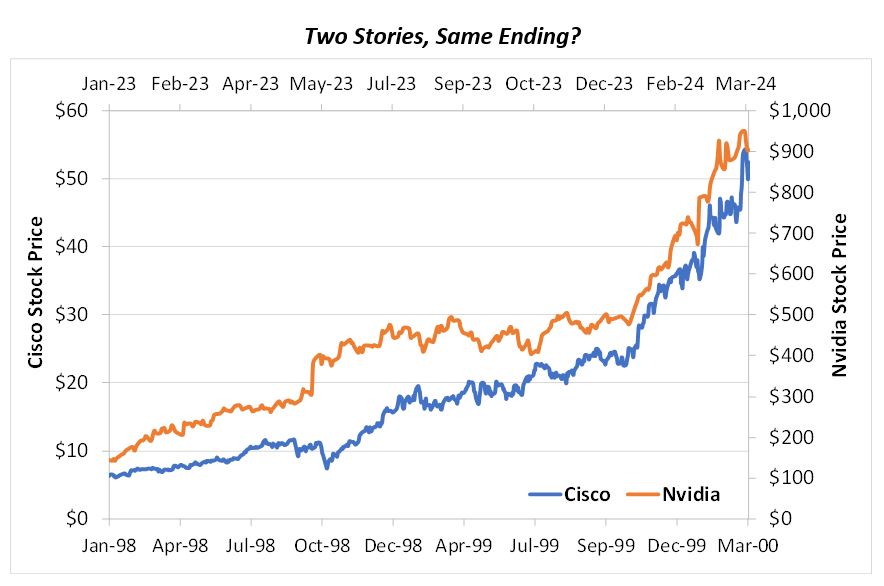
In the internet boom, that company was Cisco Systems. Cisco was the leading manufacturer of routers, an essential hardware component for virtually every internet-ready business and household. With AI, that company is Nvidia, a chipmaker whose product is particularly well suited for the massive processing demands of AI.
From the beginning of 1998 to about the end of the first quarter of 2000, Cisco stock rose 761%. Over a shorter period, from the beginning of 2023 to late March this year, Nvidia climbed 550%. Nvidia now sports a market capitalization of over $2 trillion, trailing only Microsoft and Apple.
Cisco stock peaked in March 2000 at about $80/share, bottomed out a year later at under $14/share, and then languished for a decade. 24 years later, the stock still rests 10% below its 2000 peak.
Investors correctly marked the internet as an epochal change. Where they erred with Cisco was projecting that trend onto the fortunes of a single company. Giant profits always attract competition, driving down prices and profits. As we watch the understandable hype surrounding AI, it’s important not to get carried away with projections of perpetually growing AI riches for a select few companies.[1] We are not forecasting Nvidia’s future—remember that feather in the windstorm. But diversification remains the sensible course here, enabling investors to participate in the big winners of both today and tomorrow.
[1] Bloomberg columnist John Authers has highlighted the parallels between Cisco and Nvidia.
Note: This post is an excerpt from Gould Asset Management’s Economic and Market Review for the First Quarter of 2024. The excerpt is posted here for the benefit of our blog subscribers.
US Targets Soft Landing in 2024
The US economy grew at a 3.4% annualized rate in the fourth quarter of 2023, underpinned by robust consumer spending and business investment.
The labor market remains healthy, with employers adding 303,000 jobs in March and more workers entering the job market. The headline unemployment rate decreased to 3.8%, marking a streak of 26 months below 4%, the longest such stretch since the late 1960s.
Consumer spending, which accounts for more than two-thirds of US GDP, increased by 0.8% in February, the largest increase since January 2023. Consumer confidence held steady in March as waning fears of a recession were replaced with anxiety about the state of politics heading into this year’s presidential election.
US manufacturing activity rebounded in March, with the ISM Manufacturing index jumping 2.5% and finally crossing the expansion threshold of 50% after 16 months in contraction territory. Factory production and new orders increased, but employment in the sector remained subdued.
The Fed Holds Steady Again
The Federal Reserve maintained its federal funds target range between 5.25% and 5.50%, marking the fifth consecutive meeting without a change. Despite the slight uptick in inflation, Fed officials still expect to make three 0.25% rate cuts this year, but reduced the number of forecasted cuts in 2025 from four to three.
The past two months of inflation data haven’t significantly altered the Fed’s view that inflation is coming down to its target of 2%, but the figures also haven’t given Fed officials enough confidence to begin cutting rates now. As a result, Fed Chair Jerome Powell did not provide any insight into the timing of the first rate cut other than that it is on track for some time this year.
Updated Fed projections show a slight increase in inflation from 2.4% to 2.6% and a considerable upward revision to economic growth from 1.4% to 2.1% this year. Fed policymakers are basically split on the number of rate cuts this year, with 10 seeing three or more cuts and 9 expecting two or fewer cuts.